

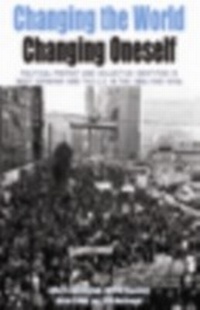
Changing the World, Changing Oneself
Political Protest and Collective Identities in West Germany and the U.S. in the 1960s and 1970s
1st Edition
Published on 1. March 2010
356 pages
978-1-84545-808-9 (ISBN)
Description

A captivating time, the 60s and 70s now draw more attention than ever. The first substantial work by historians has appeared only in the last few years, and this volume offers an important contribution. These meticulously researched essays offer new perspectives on the Cold War and global relations in the 1960s and 70s through the perspective of the youth movements that shook the U.S., Western Europe, and beyond. These movements led to the transformation of diplomatic relations and domestic political cultures, as well as ideas about democracy and who best understood and promoted it. Bringing together scholars of several countries and many disciplines, this volume also uniquely features the reflections of former activists.
Reviews / Votes
"That these essays range widely while remaining firmly grounded in their particular contexts is a testament to the cohort of scholars from around the globe that assembled the volume as well as to the diligence of the contributors themselves mostly younger scholars from institutes in the U.S., Europe and Japan. The result greatly expands our knowledge of the insurgency on both sides of the Atlantic that erupted in the 1960s and continued into the 1970s and beyond. It inspires scholars of the U.S. and Europe to rethink the meaning and limitations of the nation, to challenge narrow disciplinary constraints, and to see 1968 as part of a longer history of protest and rebellion across the continent and the world." ? Comparativ. Leipziger Beitraege zur Universalgeschichte"Until recently, the connection between the West German and US student movements of the 1960s was more often assumed than proven. This has changed in the last decade as historians have explored the details of the transatlantic relationship, producing an impressive analysis of the diversity of exchange and mutual influence. This book gathers much of this innovative work in one volume, providing an entry point to the scholarly discussion and a welcome assignable text for courses in the emerging subfield of the 'global 1960s'." ? Political Studies Review
"The volume is a trailblazing contribution to research on the role of selfhood and activism within the transnational societal transformations that enveloped the western world, beginning in the late 1960s, and it deserves a wide readership. It conceptualizes in unique ways the relationship between communalist politics and individualism during a key historical conjuncture in German/ American history." ? Social History
"The anthology is very well-edited. The essays are coherent and build upon each other... The book clearly contributes to a better understanding of transatlantic relations in the age of global protest. Particularly on the micro-level it presents a critical approach of the protagonists on both sides of the Atlantic that makes the reader aware of an interconnection or transculturality of each other's past and present." ? H-Soz-u-Kult
"The collection addresses several issues that are currently very important growth areas in scholarship: protest movements, their transnational connections, the question of Americanization/Westernization in Europe, and the 1960s/1970s in general as an important watershed in postwar history...There have been other recent works that have focused on these issues, but this collection has the advantage of being truly transatlantic in its approach and in the inclusion of some of the most interesting younger scholars working in the field." ? Ronald Granieri, University of Pennsylvania
"This tantalizing volume explores the neglected impact of intercultural exchanges during the 1968 generational rebellion by focusing on German-American transfers of critical ideas, protest practices and feelings of solidarity. It especially emphasizes the close connection between freeing personal life-styles and liberating politics at home and abroad." ? Konrad Jarausch, University of North Carolina at Chapel Hill and the Zentrum fuer Zeithistorische Forschung in Potsdam
"This wonderfully innovative compilation of scholarly articles and participant recollections tackles the multifaceted transfer of ideas and people between West Germany and the United States to shed new light on 1960s protests and their long afterlife." ? Uta G. Poiger, Northeastern Unviersity
More details
Series
Language
English
Place of publication
Oxford
United Kingdom
Target group
College/higher education
Professional and scholarly
Illustrations
Bibliography; Index
ISBN-13
978-1-84545-808-9 (9781845458089)
DOI
10.3167/9781845456511
Copyright in bibliographic data and cover images is held by Nielsen Book Services Limited or by the publishers or by their respective licensors: all rights reserved.
Schweitzer Classification
Other editions
Additional editions
Belinda Davis | Wilfried Mausbach | Martin Klimke
Changing the World, Changing Oneself
Political Protest and Collective Identities in West Germany and the U.S. in the 1960s and 1970s
Book
08/2012
1st Edition
Berghahn Books
€42.30
Shipment within 15-20 days
Belinda Davis | Wilfried Mausbach | Martin Klimke
Changing the World, Changing Oneself
Political Protest and Collective Identities in West Germany and the U.S. in the 1960s and 1970s
Book
03/2010
1st Edition
Berghahn Books
€136.50
Shipment within 3-4 weeks
Persons
Belinda Davis is Professor and Director of Graduate Studies, Department of History at Rutgers University.
Content
Introduction
Belinda Davis, Wilfried Mausbach, Martin Klimke and Carla MacDougall
PART I: ATLANTIC CROSSINGS: FROM GERMANY TO AMERICA AND BACK
Chapter 1. Intellectual Transfer: Theodor W. Adorno's American Experience
Detlev Claussen
Chapter 2. The Limits of Praxis: The Social-Psychological Foundations of Theodor Adorno's and Herbert Marcuse's Interpretations of the 1960s Protest Movements
John Abromeit
PART II: SPACES AND IDENTITIES
Chapter 3. America's Vietnam in Germany - Germany in America's Vietnam: On the Relocation of Spaces and the Appropriation of History
Wilfried Mausbach
Chapter 4. Topographies of Memory: The Sixties Student Movement in Germany and the USA: Representations in Contemporary German Literature
Susanne Rinner
Chapter 5. "We too are Berliners": Protest, Symbolism and the City in Cold War Germany
Carla MacDougall
PART III: PROTEST AND POWER
Chapter 6. A Growing Problem for Foreign Policy: The West German Student Movement and the Western Alliance
Martin Klimke
Chapter 7. Ostpolitik as Domestic Containment: The Cultural Contradictions of the Cold War and the West German State Response
Jeremi Suri
PART IV: POWER AND RESISTANCE
Chapter 8. Transformation by Subversion? The New Left and the Question of Violence
Ingrid Gilcher-Holtey
Chapter 9. "From Protest to Resistance": Ulrike Meinhof and the Transatlantic Movement of Ideas
Karin Bauer
PART V: (EN)COUNTER-CULTURE
Chapter 10. White Negroes: The Fascination of the Authentic in the West German Counterculture of the 1960s
Detlef Siegfried
Chapter 11. The Black Panther Solidarity Committee and the Trial of the Ramstein
Maria Hoehn
Chapter 12. Between Ballots and Bullets
Georgy Katsiaficas
Chapter 13. A Whole World Opening Up: Transcultural Contact, Difference, and the Politicization of New Left Activists
Belinda Davis
PART VI: A RETROSPECTIVE
Chapter 14. "We didn't know how it was going to turn out": Contemporary Activists Discuss Their Experiences of the 1960s and 1970s
Notes on Contributors
Bibliography
Index
Belinda Davis, Wilfried Mausbach, Martin Klimke and Carla MacDougall
PART I: ATLANTIC CROSSINGS: FROM GERMANY TO AMERICA AND BACK
Chapter 1. Intellectual Transfer: Theodor W. Adorno's American Experience
Detlev Claussen
Chapter 2. The Limits of Praxis: The Social-Psychological Foundations of Theodor Adorno's and Herbert Marcuse's Interpretations of the 1960s Protest Movements
John Abromeit
PART II: SPACES AND IDENTITIES
Chapter 3. America's Vietnam in Germany - Germany in America's Vietnam: On the Relocation of Spaces and the Appropriation of History
Wilfried Mausbach
Chapter 4. Topographies of Memory: The Sixties Student Movement in Germany and the USA: Representations in Contemporary German Literature
Susanne Rinner
Chapter 5. "We too are Berliners": Protest, Symbolism and the City in Cold War Germany
Carla MacDougall
PART III: PROTEST AND POWER
Chapter 6. A Growing Problem for Foreign Policy: The West German Student Movement and the Western Alliance
Martin Klimke
Chapter 7. Ostpolitik as Domestic Containment: The Cultural Contradictions of the Cold War and the West German State Response
Jeremi Suri
PART IV: POWER AND RESISTANCE
Chapter 8. Transformation by Subversion? The New Left and the Question of Violence
Ingrid Gilcher-Holtey
Chapter 9. "From Protest to Resistance": Ulrike Meinhof and the Transatlantic Movement of Ideas
Karin Bauer
PART V: (EN)COUNTER-CULTURE
Chapter 10. White Negroes: The Fascination of the Authentic in the West German Counterculture of the 1960s
Detlef Siegfried
Chapter 11. The Black Panther Solidarity Committee and the Trial of the Ramstein
Maria Hoehn
Chapter 12. Between Ballots and Bullets
Georgy Katsiaficas
Chapter 13. A Whole World Opening Up: Transcultural Contact, Difference, and the Politicization of New Left Activists
Belinda Davis
PART VI: A RETROSPECTIVE
Chapter 14. "We didn't know how it was going to turn out": Contemporary Activists Discuss Their Experiences of the 1960s and 1970s
Notes on Contributors
Bibliography
Index
