

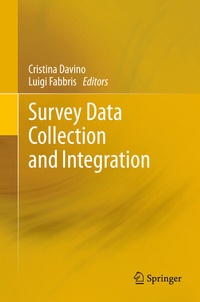
Survey Data Collection and Integration
Description

Reviews / Votes
From the book reviews:
"The book under review deals with problems that require practical solutions that either deviate from the traditional methodology or do not have a specific solution at all. The methodology described in this volume is very valuable as it provides additional statistical tools for generating data and extracting the necessary information. . The book Survey Data Collection and Integration is a valuable addition to the expanding repertoire of statistical methodology." (C. R. Rao, Technometrics, Vol. 56 (1), January, 2014)
More details
Other editions
Additional editions
Persons
Cristina Davino is an associate professor of Statistics at the University of Macerata, Italy, and a member of the Doctoral Committee for the Ph.D. in Statistics at the University of Naples Federico II. Her research fields include: multidimensional data analysis, data mining (neural networks, association rules), quantile regression, statistical surveys, sensitivity analysis of composite indicators, evaluation of quality of life, and evaluation of educational planning.
Luigi Fabbris is a full professor in Social Statistics at the Statistics Department, the University of Padua, Italy, where he lectures in Survey Methodology and Social Statistics. His research fields are multivariate analysis, survey sampling and questionnaire design; he was also active in social indicators, nexuses between education and work, social conditions of women, immigrants, the elderly and the homeless.
Content
Part 1: Introduction to Statistical Surveys: Critical Points, Challenges and Need for Development (Luigi Biggeri).- Part 2: Questionnaire Design: Measurement Scales for Scoring or Ranking Sets of Interrelated Items (Luigi Fabbris).- Assessing Multi-Item Scales for Subjective Measurement (Cristina Davino and Rosaria Romano).- Statistical Tools in the Joint Analysis of Closed and Open-Ended Questions (Simona Balbi and Nicole Triunfo).- The Use of Self-Anchoring Scales in Social Research: The Cantril Scale for the Evaluation of Community Action Orientation (Immacolata Di Napoli and Caterina Arcidiacono).- Part 3: Sampling Design and Error Estimation: Small Area Estimation of Poverty Indicators ( Monica Pratesi, Caterina Giusti and Stefano Marchetti).- Non-Sampling Errors in Household Surveys: The Bank of Italy's Experience (Giovanni D'Alessio and Giuseppe Ilardi).- Part 4: Data Integration: Enriching a Large Scale Survey from a Representative Sample by Data Fusion: Models and Validation (Tomàs Aluja-Banet, Josep Daunis-i-Estadella and Yan Hong Chen).- A Business Survey on Job Vacancies: Integration with Other Sources and Calibration (Diego Bellisai, Stefania Fivizzani and Marina Sorrentino).
