

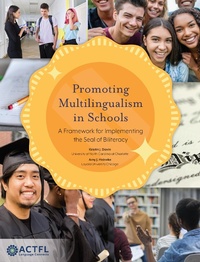
Promoting Multilingualism in Schools
A Framework for Implementing the Seal of Biliteracy
Published on 1. March 2022
227 pages
979-8-9857108-1-6 (ISBN)
Description

Promoting Multilingualism in Schools: A Framework for Implementing the Seal of BiliteracyThis new title examines a comprehensive framework for implementing the Seal of Biliteracy in the classroom. Covering all aspects of the Seal of Biliteracy' s movement, this book will help you frame the work in your school and community, ensure access for all students, and evaluate your efforts, among other critical aspects of using the framework in learning.
More details
Other editions
Additional editions

Kristin J. Davin | Amy J. Heineke
Promoting Multilingualism in Schools
A Framework for Implementing the Seal of Biliteracy
Book
03/2022
ACTFL
€38.90
Shipment within 10-20 days
Content
- Intro
- Title Page
- Copyright
- Contents
- Acknowledgments
- Preface
- Chapter 1. The Seal of Biliteracy
- Understanding the Seal of Biliteracy
- Exploring the Movement and State-Level Policy Variations
- Introducing the 5Ps Framework for Implementation
- Using This Book to Promote Change in Your Unique Context
- Tool 1.1. Determine State SoBL Requirements
- Tool 1.2. Connect with an Exemplar School in Your State
- Chapter 2. Purpose: Framing the Work in Your School and Community
- Considering Current Goals and Priorities
- Probing the School and Community Context
- Drafting Goals for Implementation
- Situating Goals Within State and Local Policies
- Seeking Buy-in from Local Stakeholders
- Tool 2.1. Define the Purpose for the Seal of Biliteracy
- Tool 2.2. Map the Linguistic Landscape
- Tool 2.3. Seek Support for the Seal of Biliteracy
- Chapter 3. Proficiency Assessment: Ensuring Access for All Students
- Considering Your Current Language Assessments
- Procuring the Tools: What Tests and Resources Are Needed
- Ensuring Access for Users of Less Commonly Tested Languages
- Improving Logistics of Language Assessment Processes
- Attaching Assessments to Instruction and Program Efficacy
- Tool 3.1. Identify SoBL Assessment Requirements in Your State
- Tool 3.2. Create Assessment Prompts
- Tool 3.3. Develop an Assessment Plan
- Tool 3.4. Evaluate Assessment Procedures
- Chapter 4. Program: Enhancing Pathways to Developing Biliteracy
- Considering Your Current Language Programs
- Providing High-Leverage Language Instruction
- Designing Longitudinal Curricular Trajectories
- Developing Programs That Foster Biliteracy
- Tool 4.1. Self-Assess on High-Leverage Practices
- Tool 4.2. Evaluate Language Programming
- Tool 4.3. Consider Macro-level Programs
- Tool 4.4 Probing Program Access
- Chapter 5. Partners: Involving Multiple Stakeholders in Implementation
- Considering Current Partners
- Building Capacity to Support Students' Language Development
- Fostering Partnerships with Community Organizations
- Connecting with Professional Organizations
- Aligning with Institutions of Higher Education
- Connecting with Businesses and Future Employers
- Tool 5.1. Audit Teachers' Related Expertise
- Tool 5.2. Research Potential Partners
- Tool 5.3. Explore Organizations and Resources
- Chapter 6. Promotion: Increasing Awareness and Access to Expand Reach
- Considering Your Current Promotion
- Developing Awareness Among School Colleagues
- Conveying Information to Students and Their Families
- Enhancing Communication with Communities
- Recognizing and Celebrating Students' Accomplishments
- Tool 6.1. Reflect on Relevant Stakeholders
- Tool 6.2. Develop a Promotion Plan
- Chapter 7. Moving Forward: Implementing and Evaluating Efforts
- Framing This Work in Schools
- Enacting the Framework: Action Plans for Implementation
- Reflecting on Biliteracy Efforts: Exploring Avenues for Advocacy and Change
- Tool 7.1. Action Plan Template for SoBL Goals, Evaluation, and Implementation
- Tool 7.2. Advocacy Considerations to Enhance Access and Equity
- References
- Appendices
- Appendix 1. External Proficiency Assessments
- Appendix 2. Self-Assessment to Determine Test Readiness based on NCSSFL-ACTFL Intermediate Mid Can-Do Statements
- Appendix 3. Sample Interpersonal Speaking/Listening Prompts for Intermediate Mid
- Appendix 4. Sample Interpersonal Speaking/Listening Prompts for Intermediate High
- Appendix 5. Sample Presentational Writing Prompts for Intermediate Mid
- Appendix 6. Sample Presentational Writing Prompts for Intermediate High
- Appendix 7. Scoring Speaking Samples at the Intermediate Level
- Appendix 8. Scoring Writing Samples at the Intermediate Level
- Appendix 9. Action Plan Example for Initiating SoBL Implementation
- Appendix 10. Action Plan Example for Refining SoBL Implementation
