

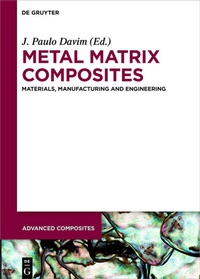
Metal Matrix Composites
Materials, Manufacturing and Engineering
1st Edition
Published on 24. October 2014
XII, 204 pages
978-3-11-031544-8 (ISBN)
Available for download
Description

Metal Matrix Composites (MMC's) have found an increased use in various industries due to their special mechanical and physical properties. They are a composite material with at least two constituent parts, one being a metal and are made by dispersing a reinforcing material into a metal matrix. The markets are: telecommunications, automotive, power semiconductor, opto-electronics, military and aerospace, heavy transportation, space systems and satellites, medical, and industrial lighting. Applications within these markets include microwave, micro-electronic packaging, laser diode, HB-LED's, and advanced radar.
More details
Other editions
Additional editions
Book
10/2014
1st Edition
De Gruyter
€229.00
Article exhausted; check different version
E-Book
10/2014
1st Edition
De Gruyter
€230.00
Available for download
Book
10/2014
1st Edition
De Gruyter
€230.00
Shipment within 7-9 days
Persons
Content
- Intro
- Preface
- Contents
- List of contributing authors
- 1 Metal matrix composites for thermal management
- 1.1 Introduction
- 1.2 Composite materials for thermal management
- 1.2.1 Liquid infiltration
- 1.2.2 Powder metallurgy
- 1.3 Design and modeling of metal matrix composites for electronics
- 1.3.1 Volume fraction of ceramic phase
- 1.3.2 Thermal conductivity
- 1.3.3 Coefficient of thermal expansion
- 1.4 Families of advanced metal matrix composite materials for electronics
- 1.4.1 SiC-based composites
- 1.4.2 Carbon-based composites
- 1.4.3 Diamond-based composites
- 1.5 The future of metal matrix composites in electronics
- References
- 2 Recent research and developments on the mechanical behavior of CNT-reinforced metal matrix composites
- 2.1 Introduction
- 2.2 CNT-Al composites
- 2.3 CNT-Co composites
- 2.4 CNT-Cu composites
- 2.5 CNT-Fe composites
- 2.6 CNT-Mg composites
- 2.7 CNT-Ni composites
- 2.8 CNT-Ti composites
- 2.9 Concluding remarks
- References
- 3 Novel preparation and mechanical properties of in situ synthesized (TiB+La2O3)/TiNbTaZr composites
- 3.1 Introduction
- 3.1.1 The application of rare earth elements in β titanium alloys
- 3.1.2 The influence of rare earth elements in titanium alloys
- 3.1.3 Biosafety of rare earth elements
- 3.2 Materials preparation and experimental procedures
- 3.2.1 Materials preparation
- 3.2.2 Experimental procedures
- 3.3 Results and discussions
- 3.3.1 Phase analysis
- 3.3.2 Thermodynamic analysis
- 3.3.3 Microstructure analysis
- 3.3.4 Microstructure of reinforcements
- 3.3.5 Analysis of the solidification mechanism
- 3.3.6 Superelasticity
- 3.3.7 In situ characterization of microstructure
- 3.3.8 Mechanical properties
- 3.4 Conclusions
- References
- 4 Microstructure formation of particle-reinforced metal matrix composite coatings produced by thermal spraying
- 4.1 Particle-reinforced MMC coatings formed ex situ by thermal spraying of powder mixtures and composite particles
- 4.2 MMC coatings with reinforcing particles formed in situ during thermal spraying
- 4.3 Design of particle-reinforced MMC coatings using flexible variation of spraying parameters in computer-controlled detonation spraying
- 4.4 Post-spray treatment of MMC coatings
- References
- 5 Fabrication of Al-metal matrix composites by liquid stirring technique
- 5.1 Introduction
- 5.2 Fabrication of Aluminium metal matrix composites
- 5.2.1 Fabrication of the stirring arrangement
- 5.2.2 Mold-making and preparation of the mold cavity
- 5.2.3 Estimation of raw materials for Al/5, 10, 15 wt.% reinforced MMC casting
- 5.2.4 Experimental procedure
- 5.3 Physical, chemical and mechanical properties of stir cast samples
- 5.3.1 Physical property of stir cast samples
- 5.3.2 Mechanical properties of stir cast samples
- 5.3.3 Analysis of the reinforced weight fraction
- 5.3.4 Microstructural characterization
- 5.4 Optimization of stir casting parameters for Al/15 wt.% SiC-MMC
- 5.4.1 S/N Ratio for micro-hardness of prepared Al/15 wt.% SiC-MMC
- 5.4.2 ANOVA for micro hardness of prepared Al/15 wt.% SiC-MMC
- 5.4.3 Mathematical model for micro hardness of prepared Al/15 wt.% SiC-MMC
- 5.4.4 S/N Ratio for tensile strength of prepared Al/15 wt.% SiC-MMC
- 5.4.5 ANOVA for tensile strength of prepared Al/15 wt.% SiC-MMC
- 5.4.6 Mathematical model for tensile strength of prepared Al/15 wt.% SiC-MMC
- 5.5 Conclusion
- References
- 6 Material removal processes for metal matrix composites
- 6.1 Introduction
- 6.2 Conventional machining processes
- 6.2.1 Turning of PMMCs
- 6.2.2 Milling of PMMCs
- 6.2.3 Drilling of PMMCs
- 6.3 Unconventional machining of MMCs
- 6.3.1 Electrochemical machining of PMMCs
- 6.3.2 Electric discharge machining of PMMCs
- 6.3.3 Ultrasonic machining of PMMCs
- 6.4 Conclusion
- References
- 7 An investigation into machining Al/SiC metal matrix composites
- 7.1 Milling of metal matrix composites
- 7.1.1 Introduction
- 7.1.2 Experimental procedure
- 7.1.3 Results and discussion
- 7.2 Summary
- 7.3 Drilling of metal matrix composites
- 7.3.1 Introduction
- 7.3.2 Experimental setup and procedure
- 7.3.3 Results and discussion
- 7.3.4 Summary
- References
- 8 Application of response surface method and desirability function for the optimization of machining parameters of hybrid metal matrix (Al/SiC/Al2O3) composites
- 8.1 Introduction
- 8.2 Materials and methods
- 8.2.1 Fabrication of hybrid metal matrix composites
- 8.2.2 Machining experiment
- 8.3 Modeling and optimization
- 8.3.1 Modeling of machining parameters using the response surface method
- 8.3.2 Optimization of machining parameters using the desirability function approach (DFA)
- 8.4 Results and discussion
- 8.5 Conclusions
- References
- Index

