

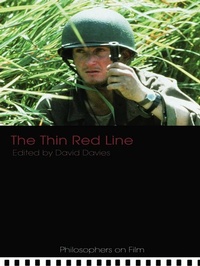
The Thin Red Line
Published on 27. October 2008
128 pages
978-1-135-97757-3 (ISBN)
Description

The Thin Red Line is the third feature-length film from acclaimed director Terrence Malick, set during the struggle between American and Japanese forces for Guadalcanal in the South Pacific during World War Two. It is a powerful, enigmatic and complex film that raises important philosophical questions, ranging from the existential and phenomenological to the artistic and technical.
This is the first collection dedicated to exploring the philosophical aspects of Malick's film. Opening with a helpful introduction that places the film in context, five essays, four of which were specially commissioned for this collection, go on to examine the following:
the exploration of Heideggerian themes - such as being-towards-death and the vulnerability of Dasein's world - in The Thin Red Line
how Malick's film explores and cinematically expresses the embodied nature of our experience of, and agency in, the world
Malick's use of cinematic techniques, and how the style of his images shapes our affective, emotional, and cognitive responses to the film
the role that images of nature play in Malick's cinema, and his 'Nietzschean' conception of human nature.
The Thin Red Line is essential reading for students interested in philosophy and film or phenomenology and existentialism. It also provides an accessible and informative insight into philosophy for those in related disciplines such as film studies, literature and religion.
Contributors: Simon Critchley, Hubert Dreyfus and Camilo Prince, David Davies, Amy Coplan, Iain Macdonald.
This is the first collection dedicated to exploring the philosophical aspects of Malick's film. Opening with a helpful introduction that places the film in context, five essays, four of which were specially commissioned for this collection, go on to examine the following:
the exploration of Heideggerian themes - such as being-towards-death and the vulnerability of Dasein's world - in The Thin Red Line
how Malick's film explores and cinematically expresses the embodied nature of our experience of, and agency in, the world
Malick's use of cinematic techniques, and how the style of his images shapes our affective, emotional, and cognitive responses to the film
the role that images of nature play in Malick's cinema, and his 'Nietzschean' conception of human nature.
The Thin Red Line is essential reading for students interested in philosophy and film or phenomenology and existentialism. It also provides an accessible and informative insight into philosophy for those in related disciplines such as film studies, literature and religion.
Contributors: Simon Critchley, Hubert Dreyfus and Camilo Prince, David Davies, Amy Coplan, Iain Macdonald.
Reviews / Votes
'The Thin Red Line is an intense and illuminating collection of essays, covering a breadth of approaches to this film, ranging from philosophical film analysis motivated by a Heideggerian approach to an in-depth discussion of filmic techniques. As such, it is a valuable contribution to the growing field of film and philosophy... Its emphasis on the philosophical significance of human limitations and finitude brings out what is unique and important about The Thin Red Line in clear and intelligent prose, shedding much-needed light on this extraordinary film.' - Havi Carel, UWE Bristol, UK'This is an exciting new anthology on one of the most philosophical of filmmakers. The essays are original, provocative, and ruminative - just like Malick's work - and explore how film itself may serve as a spur to our philosophical reflections regarding death, calm, humanity, sense, and nature.' - Daniel Flory, Montana State University, USA 'The Thin Red Line is an intense and illuminating collection of essays, covering a breadth of approaches to this film, ranging from philosophical film analysis motivated by a Heideggerian approach to an in-depth discussion of filmic techniques. As such, it is a valuable contribution to the growing field of film and philosophy... Its emphasis on the philosophical significance of human limitations and finitude brings out what is unique and important about The Thin Red Line in clear and intelligent prose, shedding much-needed light on this extraordinary film.' - Havi Carel, UWE Bristol, UK
'This is an exciting new anthology on one of the most philosophical of filmmakers. The essays are original, provocative, and ruminative - just like Malick's work - and explore how film itself may serve as a spur to our philosophical reflections regarding death, calm, humanity, sense, and nature.' - Daniel Flory, Montana State University, USA
More details
Series
Language
English
Place of publication
London
United Kingdom
Publishing group
Taylor & Francis Ltd
Target group
College/higher education
File size
1,19 MB
ISBN-13
978-1-135-97757-3 (9781135977573)
Copyright in bibliographic data and cover images is held by Nielsen Book Services Limited or by the publishers or by their respective licensors: all rights reserved.
Schweitzer Classification
Other editions
Additional editions
Person
David Davies is a Professor in the Department of Philosophy at McGill University, Canada. He is the author of Art as Performance (2004) and Aesthetics and Literature (2007), and in this series, editor (with Amy Coplan) of Blade Runner (Routledge, 2015).
Content
1. Introduction David Davies 2. Calm-On Terrence Malick's The Thin Red Line Simon Critchley 3. The Thin Red Line: Dying without Demise, Demise Without Dying Hubert Dreyfus and Camilo Prince 4. Vision, Touch and Embodiment in The Thin Red Line David Davies 5. Form and Feeling in Terrence Malick's The Thin Red Line Amy Coplan 6. Nature and the Will to Power in Terrence Malick's The New World Iain Macdonald
