

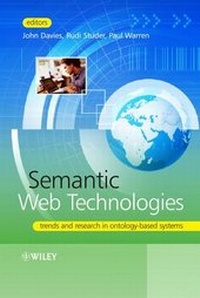
Semantic Web Technologies
Description

Reviews / Votes
"The authors have created an easy-to-read, exampled-based book onthe semantic Web that will be useful to students, practitioners,researchers, and novices alike. I highly recommend it to allprofessionals with an interest in this field." (ComputingReviews, March 13, 2008) "...readers interested in developing ontologies forreasoning will get a strong foundation and direction to begin theirjourneys on the Semantic Web." (CHOICE, March 2007) "...an interesting, well-written computer science textbookthat is well worth reading by anyone interested in the semanticWeb." (Computing Reviews.com, March 2, 2007) "...a good exposition on the state of the art in semanticWeb research." (Computing Reviews.com, January 17, 2007) "...a useful addition to a Semantic Web library."(www.freepint.com, 5th October 2006)More details
Other editions
Additional editions
Persons
Content
1. Introduction.
1.1. Semantic Web Technologies.
1.2. The Goal of the Semantic Web.
1.3. Ontologies and Ontology Languages.
1.4. Creating and Managing Ontologies.
1.5. Using Ontologies.
1.6. Applications.
1.7. Developing the Semantic Web.
References.
2. Knowledge Discovery for Ontology Construction.
2.1. Introduction.
2.2. Knowledge Discovery.
2.3. Ontology Definition.
2.4. Methodology for Semi-automatic Ontology Construction.
2.5. Ontology Learning Scenarios.
2.6. Using Knowledge Discovery for Ontology Learning.
2.7. Related Work on Ontology Construction.
2.8. Discussion and Conclusion.
Acknowledgments.
References.
3. Semantic Annotation and Human Language Technology.
3.1. Introduction.
3.2. Information Extraction: A Brief Introduction.
3.3. Semantic Annotation.
3.4. Applying 'Traditional' IE in Semantic Web Applications.
3.5. Ontology-based IE.
3.6. Deterministic Ontology Authoring using Controlled Language IE.
3.7. Conclusion.
References.
4. Ontology Evolution.
4.1. Introduction.
4.2. Ontology Evolution: State-of-the-art.
4.3. Logical Architecture.
4.4. Data-driven Ontology Changes.
4.5. Usage-driven Ontology Changes.
4.6. Conclusion.
References.
5. Reasoning With Inconsistent Ontologies: Framework, Prototype, and Experiment.
5.1. Introduction.
5.2. Brief Survey of Approaches to Reasoning with Inconsistency.
5.3. Brief Survey of Causes for Inconsistency in the Semantic WEB.
5.4. Reasoning with Inconsistent Ontologies.
5.5. Selection Functions.
5.6. Strategies for Selection Functions.
5.7. Syntactic Relevance-Based Selection Functions.
5.8. Prototype of Pion.
5.9. Discussion and Conclusions.
Acknowledgment.
References.
6. Ontology Mediation, Merging, and Aligning.
6.1. Introduction.
6.2. Approaches in Ontology Mediation.
6.3. Mapping and Querying Disparate Knowledge Bases.
6.4. Summary.
References.
7. Ontologies for Knowledge Management.
7.1. Introduction.
7.2. Ontology usage Scenario.
7.3. Terminology.
7.4. Ontologies as RDBMS Schema.
7.5. Topic-ontologies versus Schema-ontologies.
7.6. Proton Ontology.
7.7. Conclusion.
References.
8. Semantic Information Access.
8.1. Introduction.
8.2. Knowledge Access and the Semantic WEB.
8.3. Natural Language Generation from Ontologies.
8.4. Device Independence: Information Anywhere.
8.5. SEKTAgent.
8.6. Concluding Remarks.
References.
9. Ontology Engineering Methodologies.
9.1. Introduction.
9.2. The Methodology Focus.
9.3. Past and Current Research.
9.4. Diligent Methodology.
9.5. First Lessons Learned.
9.6. Conclusion and Next Steps.
References.
10. Semantic Web Services-Approaches and Perspectives.
10.1. Semantic Web Services-A Short Overview.
10.2. The WSMO Approach.
10.3. The OWL-S Approach.
10.4. The SWSF Approach.
10.5. The IRS-III Approach.
10.6. The WSDL-S Approach.
10.7. Semantic Web Services Grounding: The Link Between The SWS and Existing Web Services Standards.
10.8. Conclusions and Outlook.
References.
11. Applying Semantic Technology to a Digital Library.
11.1. Introduction.
11.2. Digital Libraries: The State-of-the-art.
11.3. A Case Study: the BT Digital Library.
11.4. The Users' View.
11.5. Implementing Semantic Technology in a Digital Library.
11.6. Future Directions.
References.
12. Semantic Web: A Legal Case Study.
12.1. Introduction.
12.2. Profile of The Users.
12.3. Ontologies for Legal Knowledge.
12.4. Architecture.
12.5. Conclusions.
References.
13. A Semantic Service Oriented Architecture for the Telecommunications Industry.
13.1. Introduction.
13.2. Introduction to Service Oriented Architectures.
13.3. A Semantic Service Orientated Architecture.
13.4. Semantic Mediation.
13.5. Standards and Ontologies in Telecommunications.
13.6. Case Study.
13.7. Conclusion.
References.
14. Conclusion and Outlook.
14.1. Management of Networked Ontologies.
14.2. Engineering of Networked Ontologies.
14.3. Contextualizing Ontologies.
14.4. Cross Media Resources.
14.5. Social Semantic Desktop.
14.6. Applications.
Index.
