

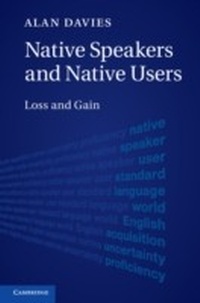
Native Speakers and Native Users
Loss and Gain
1st Edition
Published on 23. July 2013
978-1-107-28746-4 (ISBN)
Description

'Native speakers' and 'native users' are terms traditionally used to differentiate between speakers who have acquired a language from birth and speakers who have learnt a second language. This book highlights the problems associated with making such a clear cut distinction. By analysing a range of literature, language uses and proficiency tests, Davies argues that there is no significant difference between native speakers and native users, and emphasises the importance of the Standard Language. Whilst individual native speakers may vary considerably, the academic construct of the native speaker is isomorphic with the Standard Language which is available to both native speakers and native users through education. In this book, Davies explores the 'native user' as a second language speaker who uses language with 'native speaker' competence. This book will be of significant interest to students and researchers working in the fields of second language acquisition and applied linguistics.
Reviews / Votes
'Davies interrogates the Native Speaker, together with the conspiring partner Native User, with disarming logic and multiple lines of incriminating evidence. The two prove to be implicated inextricably not only in their expected guises of learning, losing, standardizing, and assessing languages but also to be acting in collusion in a broad array of social circumstances around the world ranging from religious rituals to literary personae. This is triumphant, passionate, and elucidating intellectual sleuth work.' Alister Cumming, University of Toronto 'From the macroscopic domains of national identity to the intimacy of a Quaker meeting, Davies tackles the two central concepts that lie at the heart of all linguistics - speech and language use. Few applied linguistics researchers and theoreticians are as versed in the cognitive and experimental research as the ethnographic and qualitative - in this book, theory and empirical data share centre stage. Davies continually challenges himself and in doing so unsettles what we all take for granted. A delightful combination of reflection, erudition and an appreciative joy of all forms of language acquisition.' Miriam Meyerhoff, University of Auckland '... explores a number of issues central to applied linguistics, second language acquisition, sociolinguistics, and the study of language generally ... One major contribution of this new book ... is its unravelling of a cluster of complex issues related to such distinctions as 'native speaker' versus 'native user', and 'Standard English' versus 'world Englishes'. The wide-ranging theoretical discussion of these key notions is illuminated by reference both to empirical research on language testing worldwide, and the detailed analysis of a number of relevant discourses, including those of postcolonial literatures. The scholarly reach of this book is attested to by its discussion of English linguistics, conversation analysis, language loss, language norms, second language acquisition, and world Englishes ... an erudite, intellectually layered, and intelligently witty book [and] an important contribution to the discussion of key ideas and ideologies in the linguistic sciences.' Kingsley Bolton, Nanyang Technological University, Singapore 'The book is carefully structured through solid arguments, which are richly illustrated by literate examples or empirical studies. The reader will find engaging examples and rich references to literature that will revive his/her interest in exploring the nature and scope of native and non-native speakers and in establishing stronger relationships between theoretical and applied linguistics.' Laura Dubcovsky, Linguist ListMore details
Language
English
Place of publication
Cambridge
United Kingdom
Target group
Professional and scholarly
Illustrations
4 Tables, black and white; 1 Line drawings, black and white
File size
2,72 MB
ISBN-13
978-1-107-28746-4 (9781107287464)
Copyright in bibliographic data and cover images is held by Nielsen Book Services Limited or by the publishers or by their respective licensors: all rights reserved.
Schweitzer Classification
Other editions
Additional editions
Book
08/2013
Cambridge University Press
€125.60
Shipment within 15-20 days
Person
Content
1. Introduction; 2. The sense of language loss; 3. Is a New English English?; 4. Second language learning and second language acquisition; 5. Language norms and standard English; 6. Empirical studies; 7. Talking in silence: Ministry in Quaker meetings; 8. Textual hoaxes: questioning the taken-for-granted; 9. Conclusion.
