

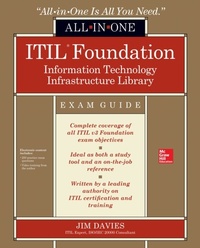
ITIL Foundation All-in-One Exam Guide
1st Edition
Published on 5. August 2016
303 pages
978-0-07-184213-6 (ISBN)
Available for download
Description

Written by an Information Technology Infrastructure Library (ITIL) consulting and training expert, this all-new guide helps you pass the ITIL v3 Foundation certification exam and serves as an on-the-job reference. ITIL Foundation All-in-One Exam Guide takes you through ITIL Foundation v3 (2011), explaining the fundamentals of IT Service Management, the five stages of the service lifecycle, ITIL processes, functions within them, and their crucial interactions, all while clearing up common misapprehensions about ITIL and adding valuable insights and examples. The ITIL is the best practice framework adopted worldwide for managing IT services, and the ITIL Foundation Certification can be considered a pre-requisite for success for all involved in IT services, as well as a stepping stone to IT Service Management certifications in ITIL. Exam Tips, accelerated reviews, and end-of-chapter practice exam questions ensure you re on track to pass the Foundation exam. Filled with practical exercises and examples that reinforce learning, the book and electronic content include more than 300 practice exam questions and exclusive, real-world examples of how an understanding of ITIL can be used to address common service management challenges. ITIL Licensed Product -- an official endorsement of the quality and accuracy of the book's content Electronic content includes practice exams in a customizable test engine, video training from the author on key concepts, worksheets, and a Quick Review Guide In-depth case studies analyze projects end-to-end through ITIL's framework, taken from the author's 40 years of experience as an ITIL consultant Jim Davies, ITSM UK s 2013 Trainer of the Year and ITIL Champion provides his 10 Commandments of IT Service Management
More details
Other editions
Additional editions
Jim Davies
ITIL Foundation All-in-One Exam Guide
Book
08/2016
McGraw-Hill Inc.,US
€37.50
Shipment within 15-20 days
Content
- Cover
- Title Page
- Copyright Page
- Dedication
- Contents
- Preface
- Acknowledgments
- Introduction
- Chapter 1 ITIL Fundamentals
- ITSM or ITIL?
- Heritage of ITIL
- Version 1
- Version 2
- Version 3
- Beyond a Superficial Understanding of ITIL
- Common Misapprehensions and Misconceptions About ITIL
- What ITIL Is
- My Ten Commandments (What Is Compulsory in ITIL)
- The Three Axioms
- Complementary Frameworks
- "Best" Sounds Good, But What Does It Mean?
- Crucial Definitions in ITIL
- Business
- Ownership
- Service
- Exercise 1-1: What Do You Understand by Service?
- Answers to Exercise 1-1
- More Crucial Definitions in ITIL
- Outcome
- Service Management
- IT Service Management (ITSM)
- Service Providers
- Stakeholders
- Process
- Function
- Roles
- Getting Organized the ITIL Way
- Maintaining Control Through Governance
- Risk
- Tools
- Chapter Review
- Quick Review
- Questions
- Answers
- Chapter 2 The Service Lifecycle
- What Is the Service Lifecycle?
- The Five Lifecycle Stages
- Service Strategy
- Service Design
- Service Transition
- Service Operation
- Continual Service Improvement
- Lifecycle Stages in Action
- Processes and Functions
- Exercise 2-1: Processes and Functions in the Service Lifecycle
- Chapter Review
- Questions
- Answers
- Chapter 3 Service Strategy
- The Purpose of Service Strategy
- Service Providers and Service Categories
- Value Creation
- Assets
- Resources
- Capabilities
- Service Strategy Processes
- Strategy Management
- Service Portfolio Management
- Business Relationship Management
- Financial Management for IT Services
- Demand Management
- Roles in Service Strategy
- Tools in Service Strategy
- Chapter Review
- Quick Review
- Further Reading
- Questions
- Answers
- Chapter 4 Service Design
- The Purpose of Service Design
- Holistic Service Design
- Service Solutions
- Management Information Systems and Tools
- Technology Architectures and Management Architectures
- Processes
- Measurement Methods and Metrics
- The Principles of Service Design
- The Service Design Package
- Service Design Processes
- Design Coordination Process
- Service Catalog Management Process
- Service Level Management (SLM) Process
- Exercise 4-1: Service Level Agreement Contents
- Capacity Management
- Availability Management
- IT Service Continuity Management
- Information Security Management Process
- Supplier Management Process
- Roles in Service Design
- Tools in Service Design
- Chapter Review
- Quick Review
- Answer to Exercise 4-1
- Questions
- Answers
- Chapter 5 Service Transition
- The Purpose of Service Transition
- Outsourcing
- Service Transition Processes
- Transition Planning and Support
- Knowledge Management
- Service Asset and Configuration Management
- Change Management
- Exercise 5-1: Why Changes Fail and How Effective Change Management Can Improve Matters
- Release and Deployment Management
- Service Validation and Testing
- Change Evaluation
- Roles in Service Transition
- Tools in Service Transition
- Chapter Review
- Quick Review
- Answer to Exercise 5-1 (Part 2)
- Questions
- Answers
- Chapter 6 Service Operation
- The Purpose of Service Operation
- The Scope of Service Operation
- Principles of Service Operation
- Balance
- Communication
- Service Operation Processes
- Event Management
- Incident Management
- Problem Management
- Request Fulfillment
- Access Management
- Service Operation Functions
- Service Desk
- IT Operations Management
- Technical Management
- Applications Management
- Roles in Service Operation
- Tools in Service Operation
- Chapter Review
- Quick Review
- Questions
- Answers
- Chapter 7 Continual Service Improvement
- The Purpose of Continual Service Improvement
- The Principles of Continual Service Improvement
- The Deming Cycle (Plan-Do-Check-Act)
- Continual Service Improvement Register
- Continual vs. Continuous
- Continual Service Improvement Is Not a Project
- Continual Service Improvement Process
- Seven-Step Service Improvement Process
- The Continual Service Improvement Approach
- Measurement and Metrics
- Baselines
- Metrics, KPIs, and CSFs
- A Cautionary Thought
- Implementing Continual Service Improvement
- Next Actions
- Further Actions
- Kotter's Eight Steps
- Roles in Continual Service Improvement
- CSI Manager
- Other CSI Roles
- Tools in Continual Service Improvement
- Chapter Review
- Quick Review
- Questions
- Answers
- Chapter 8 IT Service Management in the Real World
- Real-World Stories
- Fun with Finance
- Beware Apollo, the Project Manager
- Outsourcing Occasions
- Configuration Conundrums
- It Was a Quiet Day in the Office When . . .
- Have We Got a Problem?
- Common Challenges
- "IT Is Just More Overhead"
- Does the IT Director Have to Make Business Decisions?
- I Need to Get Started Now-Today!
- Is Your Change Manager Considered Omnipotent?
- How Many Hours Is This Going to Take?
- Listen, This Is a Major Disruption-I Want a "Sev 1"
- Service Management Improvement
- Tool Selection
- The Continual Service Improvement Register
- The International Standard: ISO/IEC 20000
- Chapter Review
- Questions
- Answers
- Appendix A Implementation
- Appendix B ITSM Qualifications Structure
- Appendix C Instant ITIL Expertise
- ITIL Buzz-Phrase Generator
- Instructions for Use
- Appendix D About the Download
- System Requirements
- Installing and Running Total Tester
- Video Training from the Author
- PDF Copy of the Book
- Technical Support
- Total Seminars Technical Support
- McGraw-Hill Education Content Support
- Glossary
- Index

