

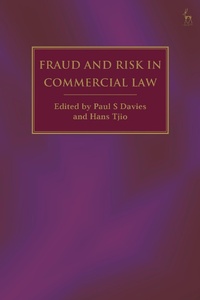
Fraud and Risk in Commercial Law
1st Edition
Published on 8. August 2024
408 pages
978-1-5099-7077-3 (ISBN)
Description

This book focuses on contemporary problems related to fraud and risk in commercial law.
It has been said by some that we are in a 'golden age of fraud'. In part this has been caused by globalisation, technological changes and the financialisation of business. This has resulted in the creation of automated linkages with integrated supply chains and the creation of systemic risks, which have been exacerbated by new forms of intangible assets like tokens and their ease of movement. While regulation has ebbed and flowed given the desire of governments to generate economic growth, as well as the distrust of their coercive powers, the courts have sought to strike a balance between considerations such as commercial certainty and fairness.
The book provides an analysis of key contemporary issues on the theme of fraud and risk in commercial law, including: technology and fraud, secondary liability and 'failure to prevent' economic crime, abuse of business entities, insolvency and creditor protection, injunctions and other orders, cross-border issues, the relationship between regulation and private law, and solutions for policy makers.
It has been said by some that we are in a 'golden age of fraud'. In part this has been caused by globalisation, technological changes and the financialisation of business. This has resulted in the creation of automated linkages with integrated supply chains and the creation of systemic risks, which have been exacerbated by new forms of intangible assets like tokens and their ease of movement. While regulation has ebbed and flowed given the desire of governments to generate economic growth, as well as the distrust of their coercive powers, the courts have sought to strike a balance between considerations such as commercial certainty and fairness.
The book provides an analysis of key contemporary issues on the theme of fraud and risk in commercial law, including: technology and fraud, secondary liability and 'failure to prevent' economic crime, abuse of business entities, insolvency and creditor protection, injunctions and other orders, cross-border issues, the relationship between regulation and private law, and solutions for policy makers.
More details
Edition
1. Auflage
Language
English
Place of publication
London
United Kingdom
Publishing group
Bloomsbury Publishing PLC
Target group
College/higher education
Professional and scholarly
ISBN-13
978-1-5099-7077-3 (9781509970773)
Copyright in bibliographic data and cover images is held by Nielsen Book Services Limited or by the publishers or by their respective licensors: all rights reserved.
Schweitzer Classification
Other editions
Additional editions
Paul S. Davies | Hans Tjio
Fraud and Risk in Commercial Law
Book
approx. 01/2026
Hart Publishing
€79.80
Not yet published
Paul S. Davies | Hans Tjio
Fraud and Risk in Commercial Law
Book
08/2024
Hart Publishing
€163.42
Shipment within 15-20 days
Persons
Paul S Davies is Professor of Commercial Law at UCL Faculty of Laws, UK.
Hans Tjio is the CJ Koh Professor of Law at the NUS Faculty of Law and is Director of its EW Barker Centre for Law and Business, Singapore.
Hans Tjio is the CJ Koh Professor of Law at the NUS Faculty of Law and is Director of its EW Barker Centre for Law and Business, Singapore.
Content
1. Negotiating a Brave New World, Fraud and Risk in Modern Commercial Law, Andrew Phang (Singapore Management University)
2. Force Majeure Clauses: Character, Scope and Protection, Michael Bridge KC (London School of Economics, UK)
3. Managing Fraud Risk in the Age of AI, Christopher M Bruner (University of Georgia, USA)
4. Where's WALL-E? Corporate Fraud in the Digital Age, Elise Bant (The University of Western Australia)
5. From Customer to Creditor: Consumer Risk and Protection During Central Cryptocurrency Exchange Insolvencies, Justin Lim (National University of Singapore)
6. Blockchain Tokenisation: 'NFTy' Trick or Griftonomics? Timothy Chan (National University of Singapore) and Kelvin FK Low (University of Hong Kong)
7. The Mareva Injunction and Crypto Fraud, Man Yip (Singapore Management University)
8. Subordination of the Wrongdoer in Tracing Claims, Magda Raczysnka (University College London, UK)
9. The Proprietary Consequences of Fraud, William Swadling (University of Oxford, UK)
10. Agency Law and the Protection of Third Parties (and Principals) - Whither the Balance? Tan Cheng-Han (National University of Singapore)
11. Compromise Agreements, Paul S Davies (University College London, UK)
12. Insurance of Commodities Fraud, Özlem Gürses (King's College London, UK)
13. Preventing Fraud on Bank Customers and Creditors, Hans Tjio (National University of Singapore)
14. Mind your Own (Micro)Business: Fraud, Risk and Microbusinesses, Devon Airey (3 Verulam Buildings, UK) and Jodi Gardner (University of Auckland, New Zealand)
15. Should the Delaware Caremark Fiduciary Duty be Part of the Corporate Governance Regime in English Law? Weiming Tan (National University of Singapore)
16. China's Corporate Credit System and the Boundaries of Corporate Liability, Virginia Harper Ho (City University of Hong Kong)
2. Force Majeure Clauses: Character, Scope and Protection, Michael Bridge KC (London School of Economics, UK)
3. Managing Fraud Risk in the Age of AI, Christopher M Bruner (University of Georgia, USA)
4. Where's WALL-E? Corporate Fraud in the Digital Age, Elise Bant (The University of Western Australia)
5. From Customer to Creditor: Consumer Risk and Protection During Central Cryptocurrency Exchange Insolvencies, Justin Lim (National University of Singapore)
6. Blockchain Tokenisation: 'NFTy' Trick or Griftonomics? Timothy Chan (National University of Singapore) and Kelvin FK Low (University of Hong Kong)
7. The Mareva Injunction and Crypto Fraud, Man Yip (Singapore Management University)
8. Subordination of the Wrongdoer in Tracing Claims, Magda Raczysnka (University College London, UK)
9. The Proprietary Consequences of Fraud, William Swadling (University of Oxford, UK)
10. Agency Law and the Protection of Third Parties (and Principals) - Whither the Balance? Tan Cheng-Han (National University of Singapore)
11. Compromise Agreements, Paul S Davies (University College London, UK)
12. Insurance of Commodities Fraud, Özlem Gürses (King's College London, UK)
13. Preventing Fraud on Bank Customers and Creditors, Hans Tjio (National University of Singapore)
14. Mind your Own (Micro)Business: Fraud, Risk and Microbusinesses, Devon Airey (3 Verulam Buildings, UK) and Jodi Gardner (University of Auckland, New Zealand)
15. Should the Delaware Caremark Fiduciary Duty be Part of the Corporate Governance Regime in English Law? Weiming Tan (National University of Singapore)
16. China's Corporate Credit System and the Boundaries of Corporate Liability, Virginia Harper Ho (City University of Hong Kong)
