

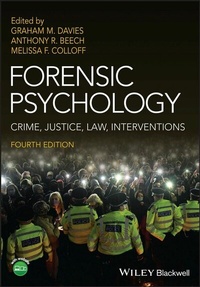
Forensic Psychology
Description

Complete introduction to forensic psychology and understanding psychology's expanding influence on the study of law, crime, and criminality
Highlighting the often-sizable gap between media myths surrounding forensic practice and reality, Forensic Psychology presents a broad range of topics within the field, including detailed treatments of the causes of crime, investigative methods, the trial process, and interventions with different types of offenders and offenses.
To aid in reader comprehension, this Fourth Edition is supplemented with additional online resource materials, including related links, multiple choice questions, and PowerPoint slides.
Authored by a wide range of experienced forensic psychology professionals and drawing on a wealth of experience from leading researchers and practitioners, Forensic Psychology includes information on:
* Psychological approaches to understanding crime and developmental and psychological theories of offending
* Contributions of neuroscience in understanding risk factors for offending and effects of interpersonal crime on victims
* Eyewitness evidence, psychopathy, interviewing witnesses and suspects, detecting deception, and offender profiling and crime linkage
* Interpersonal violence and stalking, judicial processes, safeguarding vulnerable witnesses, criminal responsibilities, and the role of the expert witness
* Rehabilitation of offenders, risk assessment, treating dangerous offenders, and interventions with female offenders and offenders with intellectual disabilities
With comprehensive coverage of the subject and its many important intricacies, the Fourth Edition of Forensic Psychology is essential reading for undergraduates' first encounter with the subject area and is also an excellent introduction for more specialized postgraduate courses.
More details
Other editions
Additional editions
Persons
Professor Graham M. Davies, Department of Neuroscience, Psychology and Behaviour, University of Leicester, United Kingdom.
Professor Anthony R. Beech, School of Psychology, University of Birmingham, United Kingdom.
Dr. Melissa F. Colloff, School of Psychology, University of Birmingham, United Kingdom.
Content
Contributors xix
Preface to the Fourth Edition xxiii
About the Editors xxv
About the Companion Website xxvi
Theory and Practice in Forensic Psychology 1
Graham M. Davies, Anthony R. Beech, and Melissa F. Colloff
Part 1 The Causes of Crime 25
Chapter 1A Psychological Approaches to Understanding Crime 27
Emma J. Palmer
Chapter 1B Developmental and Psychological Theories of Offending 49
David P. Farrington
Chapter 2 Psychopathy 77
Steven M. Gillespie and Carlo Garofalo
Chapter 3 Understanding Risk factors for Offending: The Contributions of Neuroscience 103
Lilia Psalta, Anthony R. Beech, and Adrian Raine
Chapter 4 Effects of Interpersonal Crime on Victims 137
Catherine Hamilton-Giachritsis and Emma Sleath
Part 2 Investigating Crime 173
Chapter 5 Criminal Investigation and Decision Making 175
Neil Shortland and Laurence Alison
Chapter 6 Eyewitness Evidence 199
Melissa F. Colloff, Heather D. Flowe, and Tia C. Bennett
Chapter 7 Interviewing Witnesses 233
Allison P. Mugno, Lindsay C. Malloy, and David J. La Rooy
Chapter 8 Interviewing Suspects 265
Erik Mac Giolla and Pär Anders Granhag
Chapter 9 Detecting Deception 289
Pär Anders Granhag and Maria Hartwig
Chapter 10 Offender Profiling and Crime Linkage 313
Jessica Woodhams, Matthew Tonkin, and Amy Burrell
Chapter 11 Interpersonal Violence and Stalking 337
Louise Dixon and Erica Bowen
Chapter 12 Terrorism 367
Max Taylor
Part 3 The Trial Process 393
Chapter 13 Judicial Processes 395
Jacqueline M. Wheatcroft
Chapter 14 Safeguarding Vulnerable Witnesses 425
Graham M. Davies and Rachel Wilcock
Chapter 15 Criminal Responsibility and Legal Insanity 457
John M. Fabian
Chapter 16 The Role of the Expert Witness 481
Daniel T. Wilcox and Leam A. Craig
Part 4 Dealing with Offenders 507
Chapter 17 The Rehabilitation of Corrections Clients: Good Lives and Risk Reduction 509
Tony Ward, Gwenda M. Willis, and David S. Prescott
Chapter 18 Risk Assessment 539
Anthony R. Beech and Ruth M. Hatcher
Chapter 19 Treating Dangerous Offenders 569
Leigh Harkins, Adam J. Carter, Andrea Jackson, and Jayson Ware
Chapter 20 Interventions with Justice-Involved Girls and Women 603
Franca Cortoni and Nathalie M. G. Fontaine
Chapter 21 Interventions for Offenders with Intellectual Disabilities 627
John L. Taylor and Ian Freckelton
Chapter 22 Working with Mental Health Issues in People Who Have Offended 659
Jason Davies and Claire Nagi
Chapter 23 Modifying Risk Factors, Building Strengths 691
Corine de Ruiter and Vivienne de Vogel
Part 5 Forensic Psychology: Emerging Issues, Future Challenges 713
Chapter 24.1 The Utility of Cyberpsychology and Forensic Cyberpsychology 715
Mary Aiken
Chapter 24.2 Data-Driven Policing 719
Kari Davies
Chapter 24.3 The Cognitive Neuroscience of Eyewitness Identification 723
John T. Wixted
Chapter 24.4 Targets of Explanation in Correctional and Forensic Psychology 727
Tony Ward
Chapter 24.5 Future Directions in Treatment: What Might Work for Whom, Where, and When? 730
Jason Davies
Chapter 24.6 Cultural Responsivity Considerations in the Assessment and Treatment of Justice-Involved Populations 734
Ida Dickie
Chapter 24.7 Future Approaches to Personality Difficulties, Trauma, and Reducing the Risk of Reoffending 737
Jackie Craissati
Index 741
Theory and Practice in Forensic Psychology1
GRAHAM M. DAVIES, ANTHONY R. BEECH, AND MELISSA F. COLLOFF
CHAPTER OUTLINE
Forensic psychology is a broad and growing area of psychological research and practice. It embraces a variety of studies at the interface of psychology and the law, spanning both legal and criminological issues. The legal aspect of forensic psychology concerns the application of psychological knowledge and methods to the processes of law and the criminological aspect deals with the application of psychological theory and method to the understanding (and reduction) of criminal behaviour through interventions. Hence, the legal aspect deals with evidence, witnesses, and the courts, while the criminological aspect focuses on crime and perpetrators. Among the range of tasks undertaken by forensic psychologists can be:
- piloting and implementing treatment programmes for offenders
- generating research evidence to support penal policy and practice
- undertaking assessments of risk for violent and sexual offenders
- domestic violence and family issues
- treating offenders with drug or alcohol problems
- writing reports and giving evidence in court
- advising parole boards and mental health tribunals
- crime analysis and offender profiling
- conducting experimental and field studies on the reliability of witnesses
- advising on interview techniques with suspects and vulnerable witnesses
- counter-terrorism policy and hostage negotiation
The umbrella term forensic psychology is used to embrace both legal and criminological research and application, even though the term forensic strictly means the employment of scientific tests, or techniques, used in connection with the detection of crime. As the issue of crime and offending continues to grow in importance in society, it seems inevitable that policymakers will turn increasingly to forensic psychology to answer questions such as "what makes a person commit a crime?" and "how can crime be reduced?" Therefore, the aim of this book is to give a broad outline of current topics in psychology ranging from the causes of crime (Part 1), investigating crime (Part 2), the trial process (Part 3), and dealing with perpetrators (Part 4). It also looks forward to future developments in the field through the eyes of leading researchers and practitioners in the field (Part 5).
FORENSIC PSYCHOLOGY
To understand how forensic psychology emerged as the high-profile psychological science it is today, it is useful to begin by examining briefly the roots of both legal psychology and criminological psychology before describing the professional pathways into forensic psychology and the principal organisations and journals which support the discipline, followed by an overview of the structure and content of the book.
Legal Psychology
Legal psychology was one of the first areas of applied psychology to be explored by experimental psychologists. It then languished as a discipline until the 1970s when there was a great resurgence of interest in research at the interface of psychology and law, which continues today. Legal psychology began in Europe around the turn of the twentieth century (see Davies & Gudjonsson, 2013). Prominent among these pioneers was the Austrian Hans Gross (1847-1915), who, in his career, claimed to have performed over 45,000 pre-trial examinations of witnesses. As a result of his experiences, he became sceptical about eyewitness testimony and developed tests to try to identify those who might prove reliable. He described his experiences in probably the first textbook of legal psychology, Kriminalpsychologie (Criminal Psychology), published in 1898.
One issue of concern to Gross was the suggestibility of witnesses under questioning. The French Psychologist, Alfred Binet (1857-1911), had conducted some of the earliest studies of suggestibility and conformity effects in children, described in his book La Suggestibilité (1900), and these ideas were taken up by the German Psychologist Louis William Stern (1871-1938). It was Stern who, as part of his programme of research into what he termed the Psychologie der Aussage (the psychology of statements; Sterne, 1902), started the first journal devoted to witness psychology. Stern also introduced new methods such as the "event test": a carefully rehearsed incident staged in front of onlookers who were subsequently asked to report the events in their own words and answer questions concerning details-a technique still in use today. Suggestibility, particularly in relation to vulnerable witnesses and its impact on their testimony, remains a focus of current research (see Ridley et al., 2012, and Chapters 6 and 7 of this book).
The Aussage movement continued to be active in Germany up until the First World War, but the person credited with publicising the new science to the English-speaking world was Stern's friend, Hugo Münsterberg (1863-1916). Münsterberg moved from Germany to Harvard University in 1892 to accept an invitation from William James to set up their first experimental psychology laboratory. Münsterberg's interests in psychological aspects of the law went well beyond issues of testimony. In 1908 he published On the Witness Stand, a book aimed at publicising and promoting the value of psychology to law enforcement in general and the courts in particular. Among the topics discussed by Münsterberg (1908) were:
- The accuracy of witness testimony
- The detection of deception
- False confessions
- Suggestive questioning at court, and
- Effective interviewing procedures
Sadly, the emergence of Münsterberg's book did not usher in a new dawn for legal psychology. Its somewhat bombastic tone, and casual generalisations, alienated lawyers (he dismissed them as "obdurate"), precisely the group to whom the implications of the book might most usefully have been directed. It drew from the distinguished American jurist, John H. Wigmore (1863-1943) a majestic rebuke in the form of a satirical account of an imaginary trial in which Münsterberg's more specious and expansive statements were held up to ridicule (Wigmore, 1909). Wigmore did concede that while psychology had little to offer to the law at present, there might come a time when psychology would have matured sufficiently to make a significant contribution. This rejection of Münsterberg's ideas was followed by his death in 1916, which effectively ended the study of legal psychology in the United States for many years. When interest in legal psychology revived in the 1970s, most of the topics Münsterberg identified remained central to contemporary research, together with new themes arising from the stresses of modern-day living.
One of the principal drivers for the renewed involvement of psychologists in legal matters were concerns about mistaken identification, which had led to miscarriages of justice. In the United Kingdom, Lord Justice Devlin (1976) was asked by the Home Office to conduct an enquiry into a series of cases involving mistaken identity, sometimes by more than one witness. The Devlin Report (1976) into law and practice on identification was the first in the United Kingdom to include evidence taken from psychologists on perception and identification. One of its recommendations was that "research should be directed as to establishing ways in which the insights of psychology can be brought to bear on the conduct of identification parades and the practice of the courts" (p. 149). This led directly to Home Office funding for research into bodily (Shepherd et al., 1982) and voice identification (Bull & Clifford, 1984); and, in turn, to a more positive approach generally toward the value of psychological research as applied to the police and the law (Kebbell & Davies, 2006). Research on identification issues remains a major theme in contemporary forensic research (see Valentine & Davis, 2015, Chapter 6, and Wixted, in Part 5 of this book).
In the United States, the involvement of psychologists in witness testimony took a rather different turn. In the United Kingdom, psychologists with expertise in witness matters are not generally permitted to give evidence in criminal trials, with limited exceptions, such as issues of alleged false confession (Gudjonsson, 2003). In the United States, Elizabeth Loftus and Robert Buckhout (1935-1990)...
