

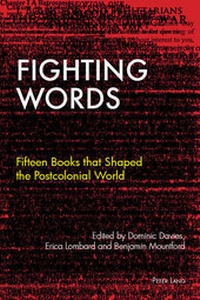
Fighting Words
Description

Can a book change the world? If books were integral to the creation of the imperial global order, what role have they played in resisting that order throughout the twentieth century? To what extent have theories and movements of anti-imperial and anticolonial resistance across the planet been shaped by books as they are read across the world?
Fighting Words responds to these questions by examining how the book as a cultural form has fuelled resistance to empire in the long twentieth century. Through fifteen case studies that bring together literary, historical and book historical perspectives, this collection explores the ways in which books have circulated anti-imperial ideas, as they themselves have circulated as objects and commodities within regional, national and transnational networks. What emerges is a complex portrait of the vital and multifaceted role played by the book in both the formation and the form of anticolonial resistance, and the development of the postcolonial world.
More details
Other editions
Additional editions
Persons
Content
CONTENTS: Tessa Roynon et al.: Introduction to Race and Resistance Across Borders in the Long Twentieth Century - Dominic Davies/Erica Lombard/Benjamin Mountford: Introduction: Fighting Words: Books and the Making of the Postcolonial World - Dominic Davies: From Communism to Postcapitalism: Karl Marx and Friedrich Engels's The Communist Manifesto (1848) - Imaobong Umoren: Anna Julia Cooper's A Voice from the South (1892): Black Feminism and Human Rights - Christina Twomey: Ambivalence, Admiration and Empire: Emily Hobhouse's The Brunt of the War and Where it Fell (1902) - Reiland Rabaka: W. E. B. Du Bois's The Souls of Black Folk (1903): Of the Veil and the Color-Line, of Double-Consciousness and Second-Sight - Priyasha Mukhopadhyay: Wake Up, India: A Plea for Social Reform (1913): Annie Besant's Anticolonial Networks - Janet Remmington: Sol Plaatje's Native Life in South Africa (1916): The Politics of Belonging - Elleke Boehmer: Making Freedom: Jawaharlal Nehru's An Autobiography (1936) and The Discovery of India (1946) - Rouven Kunstmann: Joseph B. Danquah's The Akan Doctrine of God (1944): Anticolonial Fragments? - Johanna Richter: The Resistant Forces of Myth: Miguel Ángel Asturias's Men of Maize (1949) - Ruth Bush: The Hip-Hop Legacies of Cheikh Anta Diop's Nations nègres et culture (1954) - Asha Rogers: Culture in Transition: Rajat Neogy's Transition (1961-1968) and the Decolonization of African Literature - John Narayan: Frantz Fanon's The Wretched of the Earth (1961): The Spectre of the Third World Project - Benjamin Mountford: «The Match is in the Spinifex»: Frank Hardy's The Unlucky Australians (1968) - Michael R. Griffiths: Provenance, Identification and Confession in Sally Morgan's My Place (1987) - Erica Lombard: Freedom Fighter/Postcolonial Saint: The Symbolic Legacy of Nelson Mandela's Long Walk to Freedom (1994) - Antoinette Burton/Isabel Hofmeyr: Afterword: Plotting a Postcolonial Course in Fifteen Chapters.
