

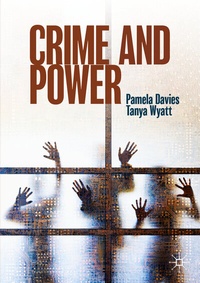
Crime and Power
Description

This textbook makes a concerted effort to expose crimes committed by those wielding unfettered personal power and crimes by corporations, business and states, crimes against human and non-human species and the environment. It examines an increasingly complex interplay of issues which surely should be at the heart of any criminology programme. This text adopts a fresh and innovative approach to exposing the crimes of the powerful, situating and understanding crimes and victimisations as it does within a framework where questions of structural and personal power in society are key.
Fourteen case studies are threaded throughout the book and this methodology is used as a teaching resource for studying and uncovering the crimes of the powerful. The first three chapters comprehensively contextualise the problems of crime and power and establish the importance of power to understanding crime and victimisation in society. The chapters within Part I and Part II of the book then explore individual and group power respectively. Each of these chapters explore a case study or case examples followed by 'Pause for Thought' questions. Bigger 'Go Further' study questions are posed at the close of these chapters challenging students to engage in their own case study research to investigate the dynamics of crime and power.
More details
Other editions
Additional editions
Persons
Pamela Davies is Professor of Criminology at Northumbria University, UK. She is a criminologist whose research focuses on gender, harm, crime and victimization.
Tanya Wyatt is Professor of Criminology, Northumbria University, UK
Content
1. Introduction.- 2. What is power and who are the powerful?.- 3. Invisibility.- Part I: Individual Characteristics and their Power Dynamics.- 4. Class, Status and Elites.- 5. Race and Ethnicity.- 6. Religion and Culture.- 7. Age.- 8. Gender.- Part II: The Power of Groups and the Doing of Crime.- 9. Corporations.- 10. Organised Crime.- 11. States.- 12. Militias and Insurgents.- 13. Crimes of the Powerful Conclusion.
