

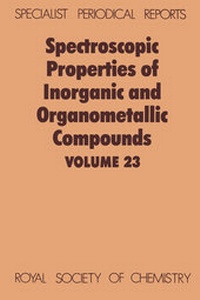
Spectroscopic Properties of Inorganic and Organometallic Compounds
Volume 23
1st Edition
Published on 31. October 2007
496 pages
978-1-84755-507-6 (ISBN)
Description

Spectroscopic Properties of Inorganic and Organometallic Compounds provides a unique source of information on an important area of chemistry. Divided into sections mainly according to the particular spectroscopic technique used, coverage in each volume includes: NMR (with reference to stereochemistry, dynamic systems, paramagnetic complexes, solid state NMR and Groups 13-18); nuclear quadrupole resonance spectroscopy; vibrational spectroscopy of main group and transition element compounds and coordinated ligands; and electron diffraction. Reflecting the growing volume of published work in this field, researchers will find this Specialist Periodical Report an invaluable source of information on current methods and applications. Specialist Periodical Reports provide systematic and detailed review coverage in major areas of chemical research. Compiled by teams of leading experts in their specialist fields, this series is designed to help the chemistry community keep current with the latest developments in their field. Each volume in the series is published either annually or biennially and is a superb reference point for researchers. www.rsc.org/spr
More details
Series
Edition
1. Auflage
Language
English
Place of publication
Cambridge
United Kingdom
Target group
Professional and scholarly
ISBN-13
978-1-84755-507-6 (9781847555076)
DOI
10.1039/9781847555076
Copyright in bibliographic data and cover images is held by Nielsen Book Services Limited or by the publishers or by their respective licensors: all rights reserved.
Schweitzer Classification
Other editions
Additional editions
G. Davidson | E. A. V. Ebsworth
Spectroscopic Properties of Inorganic and Organometallic Compounds
Volume 23
Book
08/1990
Royal Society of Chemistry
€334.50
Shipment within 3-4 weeks
Persons
Content
- Spectroscopic Properties Of Inorganic And Organometallic Compounds
- Contents
- Chapter 1 Nuclear Magnetic Resonance Spectroscopy
- 1 Introduction
- 2 Stereochemistry
- Complexes of Groups IA and IIA
- Complexes of Groups IIIA and IVA, the Lanthanides and Actinides
- Complexes of V, Nb, and Ta
- Complexes of Cr, Mo, and W
- Complexes of Mn, Tc, and Re
- Complexes of Fe, Ru, and Os
- Complexes of Co, Rh, and Ir
- Complexes of Ni, Pd, and Pt
- Complexes of Cu, Ag, and Au
- Complexes of Zn, Cd, and Hg
- 3 Dynamic Systems
- Fluxional Molecules
- Lithium
- Sodium
- Beryllium
- Calcium, Strontium, Barium, and Lanthanum
- Yttrium
- The Lanthanides
- Thorium
- Titanium, Zirconium, and Hafnium
- Vanadium
- Niobium and Tantalum
- Chromium, Molybdenum, and Tungsten
- Manganese
- Rhenium
- Iron and Ruthenium
- Osmium
- Cobalt
- Rhodium and Iridium
- Nickel
- Palladium and Platinum
- Copper
- Cadmium
- Mercury
- Boron
- Aluminium
- Indium
- Thallium
- Silicon, Germanium, Tin, and Lead
- Nitrogen
- Phosphorus
- Selenium
- Tellurium
- Equilibria
- Solvation Studies of Ions
- Group 1A
- Magnesium
- Yttrium
- Lanthanum
- Chromium
- Molybdenum
- Manganese
- Cobalt
- Nickel
- Palladium
- Platinum
- Zinc
- Aluminium
- Gallium
- Silicon, Germanium, and Tin
- Nitrogen
- Ionic Equilibria
- Group 1A
- Group IIA
- Scandium
- The Lanthanides
- Titanium
- Zirconium
- Vanadium
- Niobium and Tantalum
- Chromium
- Molybdenum
- Tungsten
- Manganese
- Iron
- Ruthenium
- Cobalt
- Rhodium
- Nickel, Palladium, and Platinum
- Copper
- Silver
- Gold
- Zinc
- Cadmium
- Mercury
- Boron
- Aluminium and Gallium
- Thallium
- Silicon
- Germanium
- Tin
- Lead
- Nitrogen
- Phosphorus
- Arsenic
- Tellurium
- Chlorine
- Equilibria among Uncharged Species
- Lithium
- Europium
- Uranium
- Titanium
- Zirconium and Hafnium
- Chromium
- Molybdenum
- Tungsten
- Rhenium
- Iron
- Ruthenium
- Cobalt
- Rhodium
- Nickel
- Palladium and Platinum
- Copper
- Gold
- Zinc
- Cadmium and Mercury
- Aluminium and Indium
- Silicon
- Tin
- Selenium
- Course of Reactions
- Scandium
- Titanium and Zirconium
- Vanadium
- Tantalum
- Chromium
- Molybdenum and Tungsten
- Manganese
- Rhenium
- Iron and Ruthenium
- Osmium
- Cobalt
- Rhodium
- Iridium
- Nickel
- Palladium and Platinum
- Gold
- Mercury
- Boron
- Aluminium
- Silicon
- Tin
- Phosphorus
- Arsenic
- Selenium
- Tellurium
- 4 Paramagnetic Complexes
- The Transition Metals
- Chromium
- Molybdenum, and Tungsten
- Manganese
- Rhenium
- Iron
- Ruthenium
- Cobalt and Rhodium
- Nickel
- Copper
- Complexes of the Lanthanides and Actinides
- Lanthanides
- Actinides
- 5 Solid-state N.M.R. Spectroscopy
- Motion in Solids
- Structures of Solids
- Molecules Sorbed onto Solids
- Water Sorbed onto Solids
- Atoms and Other Molecules Sorbed onto Solids
- 6 Group IIIB compounds
- Boron Hydrides and Carboranes
- Other Compounds of Boron
- Complexes of Other Group IIIB Elements
- 7 Group IVB Elements
- 8 Group VB Elements
- 9 Compounds of Groups VI and VII and Krypton and Xenon
- 10 Appendix
- Chapter 2 Nuclear Quadrupole Resonance Spectroscopy
- 1 Introduction
- 2 Main-group Elements
- Group I (Sodium-23 and Potassium-39)
- Group III (Boron-11 and Gallium-69, and -71)
- Group V (Nitrogen-14, Arsenic-75, Antimony-121 and 123, and Bismuth-209)
- Group VI (Oxygen-17)
- Group VII (Chlorine-35 and -37, Bromine-79 and -81, and Iodine-127)
- 3 Transition Metals and Lanthanides
- Manganese-55
- Copper-63 and -65
- Niobium-93
- Lanthanum-139
- Praseodymium-141
- Tantalum-181
- Rhenium-187
- References
- Chapter 3 Rotational Spectroscopy
- 1 Introduction
- 2 Weakly Bond Complexes
- 3 Triatomic Molecules and Ions
- 4 Tetra-atomic Ions and Molecules
- 5 Penta-atomic Ions and Molecules
- 6 Molecules Containing Six or More Atoms
- References
- Chapter 4 Characteristic Vibrations of Compounds of Main Group Elements
- 1 Group I
- 2 Group II
- 3 Group III
- Boron
- Aluminium
- Gallium
- Indium
- Thallium
- 4 Group IV
- Carbon
- Silicon
- Germanium
- Tin and Lead
- 5 Group V
- Nitrogen
- Phosphorus
- Arsenic
- Antimony and Bismuth
- 6 Group VI
- Oxygen
- Sulphur and Selenium Rings and Chains
- Other Sulphur and Selenium Compounds
- Tellurium
- 7 Group VII
- References
- Chapter 5 Vibrational Spectra of Transition-element Compounds
- 1 Scandium, Yttrium, and the Lanthanides
- 2 Titanium, Zirconium, and Hafnium
- 3 Vanadium, Niobium, and Tantalum
- 4 Chromium, Molybdenum, and Tungsten
- 5 Manganese, Technetium, and Rhenium
- 6 Iron, Ruthenium, and Osmium
- 7 Cobalt, Rhodium, and Iridium
- 8 Nickel, Palladium, and Platinum
- 9 Copper, Silver, and Gold
- 10 Zinc, Cadmium, and Mercury
- 11 Actinides
- References
- Chapter 6 Vibrational Spectra of Some Co-ordinated Ligands
- 1 Carbon and Silicon Donors
- 2 Complexes Containing CO, CS, or CSe Ligands
- 3 Boron Donors
- 4 Nitrogen Donors
- Molecular Nitrogen, Azido-, and Related Complexes
- Amines and Related Ligands
- Ligands containing C=N Groups
- Cyanides, Isocyanides, and Related Complexes
- Nitrosyls
- 5 Phosphorus or Antimony Donors
- 6 Oxygen Donors
- Molecular Oxygen, Peroxo-, Aquo, and Related Complexes
- Carboxylato- and Related Complexes
- Keto-, Alkoxy, Ether, and Related Complexes
- Ligands containing O-N or O-P Bonds
- Ligands containing O-S or O-Te Bonds
- Ligands containing O-Cl Bonds
- 7 Sulphur and Selenium Donors
- 8 Potentially Ambident Ligands
- Cyanates, Thio- and Selenocyanates, and their Iso-analogues
- Ligands Containing N and O or P and O Atoms
- Ligands Containing N and S or P and S Atoms
- Ligands Containing S and O Atoms
- References
- Chapter 7 Moessbauer Spectroscopy
- 1 Introduction
- Books and Reviews
- 2 Theoretical
- 3 Instrumentation and Methodology
- 4 Iron-57
- General Topics
- Fundamental Studies and Metallic Iron
- Iron-57 Impurity Studies, Polymers, and Ion-Exchange
- Matrix Isolation, Liquid Crystals, and Emission Studies
- Compounds of Iron
- High-spin Iron (II) Compounds
- High-spin Iron (III) Compounds
- Intercalation Compounds Containing Iron
- Mixed-Valence Compounds and Unusual Electronic States
- Spin-crossover Systems and Unusual Spin States
- Low-spin and Covalent Compounds
- Biological Systems and Related Compounds
- Oxide and Chalcogenide Compounds Containing Iron
- Hydroxides
- Wuestite and Related Oxides
- Haematite and Related Oxides
- Magnetite and Spinel-type Oxides
- Superconducting Ceramics Containing Iron
- Other Oxides
- Inorganic Oxide Glasses Containing Iron
- Chalcogenides
- Applications of Iron-57 Moessbauer Spectroscopy
- Catalysts
- Minerals and Coal
- Corrosion Studies
- Other Applications
- 5 Tin-119
- General Topics
- Inorganic Tin (II) and Tin (IV) Compounds
- Superconducting Ceramics
- Organotin Compounds
- 6 Other Elements
- Main-Group Elements
- Krypton ( Kr-83 )
- Germanium (Ge-73)
- Antimony (Sb-121)
- Tellurium (Te 125)
- Iodine (I-127, and I-129)
- Caesium (Cs-133)
- Transition-metal Elements
- Nickel (Ni-61)
- Zinc (Zn-67)
- Ruthenium (Ru-99)
- Tungsten (W-183)
- Iridium (Ir-193)
- Gold (Au-197)
- Lanthanide and Actinide Elements
- Neodymium (Nd-145)
- Europium (Eu-151)
- Gadolinium (Gd-155)
- Dysprosium (Dy-161
- Erbium (Er-166)
- Thulium (Tm-169 )
- Ytterbium (Yb-170 and 174)
- Neptunium (Np-237)
- 7 Backscatter and Conversion Electron Moessbauer Spectroscopy
- Iron-57
- Implantation Studies and Films
- Corrosion Products and Alloys
- Compounds of Iron
- Other Elements
- References
- Chapter 8 Gas-phase Molecular Structure Determined by Electron Diffraction
- 1 Introduction
- 2 Compounds of Elements in Main Groups I, II, and III
- 3 Compounds of Elements in Main Group IV
- 4 Compounds of Elements in Main Group V
- 5 Compounds of Elements in Main Group VI
- 6 Compounds of Transition Metals
- References
