

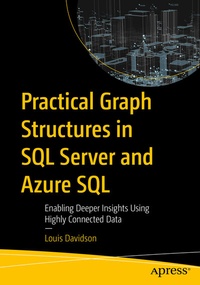
Practical Graph Structures in SQL Server and Azure SQL
Description

The graph examples in the book are useful for analyzing social media relationships, complex product-to-customer relationships, and any other type of data analysis in which indirect connections that otherwise might be missed using conventional techniques can be mined for their insight and business value.
Tree structures are covered, with emphasis on a structure commonly used by organizations to aggregate data at different levels of an organization. The book provides code examples of SQL Graph objects as well as an alternate tree implementation technique. Included is sample data (and data generators) for you to test for performance and choose the implementation approach that best suits your needs and that of your application.
If your job involves analyzing or storage of data elements that are connected in a networked topology, then this is the book that will help you bring the power of SQL Server to bear on that data and take advantage of your existing knowledge.
What You Will Learn
-
Understand the graph model and the associated terms used in graph analysis
- Store highly connected data in SQL Server and Azure SQL alongside existing relational data
- Make full use of the graph table feature that is refined and enhanced in SQL Server 2019
- Implement high performance tree structures that will make storing and querying tree data possible
-
Report on data associated with a tree structure to aggregate results at different levels
Who This Book Is For
More details
Other editions
Additional editions
Person
Louis has been active in speaking about database design and implementation at many conferences over the past 25 years, including SQL PASS, SQL Rally, SQL Saturday events, CA World, Music City Data, and the devLink Technical Conference. He has a bachelor's degree in computer science from the University of Tennessee at Chattanooga. For more information, please visit his website at drsql.org.
