

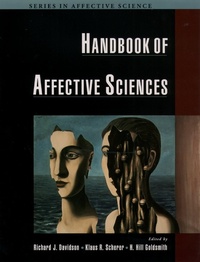
Handbook of Affective Sciences
1st Edition
Published on 19. December 2002
1218 pages
978-0-19-802912-0 (ISBN)
Description

This volume is a comprehensive roadmap to the burgeoning area of affective sciences, which now spans several disciplines. The Handbook brings together, for the first time, the various strands of inquiry and latest research in the scientific study of the relationship between the mechanisms of the brain and the psychology of mind.
In recent years, scientists have made considerable advances in understanding how brain processes shape emotions and are changed by human emotion. Drawing on a wide range of neuroimaging techniques, neuropsychological assessment, and clinical research, scientists are beginning to understand the biological mechanisms for emotions. As a result, researchers are gaining insight into such compelling questions as: How do people experience life emotionally? Why do people respond so differently to the same experiences? What can the face tell us about internal states? How does emotion in significant social relationships influence health? Are there basic emotions common to all humans?
This volume brings together the most eminent scholars in the field to present, in sixty original chapters, the latest research and theories in the field. The book is divided into ten sections: Neuroscience; Autonomic Psychophysiology; Genetics and Development; Expression; Components of Emotion; Personality; Emotion and Social Processes; Adaptation, Culture, and Evolution; Emotion and Psychopathology; and Emotion and Health.
This major new volume will be an invaluable resource for researchers that will define affective sciences for the next decade.
More details
Other editions
Additional editions

Richard J. Davidson | Klaus R. Sherer | H. Hill Goldsmith
Handbook of Affective Sciences
Book
05/2009
Oxford University Press Inc
€151.66
Shipment within 15-20 days
DAVIDSON | SCHERER | Goldsmith
Handbook of Affective Sciences
Book
12/2002
Oxford University Press Inc
€84.18
Withdrawn from sale
Content
- Intro
- Contents
- Contributors
- Introduction
- Part I. Neuroscience
- 1 Introduction: Neuroscience
- 2 Parsing the Subcomponents of Emotion and Disorders of Emotion: Perspectives from Affective Neuroscience
- 3 Comparing the Emotional Brains of Humans and Other Animals
- 4 Emotional Learning Circuits in Animals and Humans
- 5 The Contributions of the Lesion Method to the Functional Neuroanatomy of Emotion
- 6 Emotion and Memory: Central and Peripheral Contributions
- 7 Functional Neuroimaging of Depression: A Role for Medial Prefrontal Cortex
- Part II. Autonomic Psychophysiology
- 8 Introduction: Autonomic Psychophysiology
- 9 The Autonomic Nervous System and Its Coordination by the Brain
- 10 Motivational Organization of Emotions: Autonomic Changes, Cortical Responses, and Reflex Modulation
- 11 Autonomic Specificity and Emotion
- 12 Methodological Considerations in the Psychophysiological Study of Emotion
- 13 On the Automaticity of Autonomic Responses in Emotion: An Evolutionary Perspective
- 14 Emotional Modulation of Selective Attention: Behavioral and Psychophysiological Measures
- Part III. Genetics and Development
- 15 Introduction: Genetics and Development
- 16 Genetics of Emotional Development
- 17 Behavioral Inhibition as a Temperamental Category
- 18 Emotional Development in Early Childhood: A Social Relationship Perspective
- 19 Emotional Development During Infancy
- 20 Dynamic Development of Component Systems of Emotions: Pride, Shame and Guilt in China, and the United States
- Part IV. Expression of Emotion
- 21 Introduction: Expression of Emotion
- 22 Facial Expression of Emotion
- 23 Vocal Expression of Emotion
- 24 Expression of Emotion in Nonhuman Animals
- 25 Creative Expression and Communication of Emotions in the Visual and Narrative Arts
- 26 Emotional Expression in Music
- 27 Language and Emotion
- Part V. Cognitive Components of Emotion
- 28 Introduction: Cognitive Components of Emotion
- 29 Appraisal Processes in Emotion
- 30 Affective Influences on Attitudes and Judgments
- 31 The Role of Affect in Decision Making
- 32 Remembering Emotional Events: A Social Cognitive Neuroscience Approach
- 33 Information Processing Approaches to Emotion
- Part VI. Personality
- 34 Introduction: Personality
- 35 Information Processing Approaches to Individual Differences in Emotional Reactivity
- 36 Individual Differences in Emotional Reactions and Coping
- 37 Emotion and Life-Span Personality Development
- Part VII. Emotion and Social Processes
- 38 Introduction: Emotion and Social Processes
- 39 Emotional Factors in Attitudes and Persuasion
- 40 The Self and Emotion: The Role of Self-Reflection in the Generation and Regulation of Affective Experience
- 41 Affect and Prosocial Responding
- 42 Affect, Aggression, and Antisocial Behavior
- 43 Two Types of Relationship Closeness and Their Influence on People's Emotional Lives
- Part VIII. Evolutionary and Cultural Perspectives on Affect
- 44 Introduction: Evolutionary and Cultural Perspectives on Affect
- 45 The Moral Emotions
- 46 Emotions as Dynamic Cultural Phenomena
- 47 Adaptive Rationality and the Moral Emotions
- Part IX. Emotion and Psychopathology
- 48 Introduction: Emotion and Psychopathology
- 49 Response Modulation and Emotion Processing: Implications for Psychopathy and Other Dysregulatory Psychopathology
- 50 Physiological and Pharmacological Induction of Affect
- 51 Neuroimaging and the Neurobiology of Anxiety Disorders
- 52 Cognitive Biases in Emotional Disorders: Information Processing and Social-Cognitive Perspectives
- 53 The Neurobiology of Affiliation: Implications for Autism
- 54 Neurobiology of Depressive Disorders
- Part X. Emotion and Health
- 55 Introduction: Emotion and Health
- 56 Emotional Expression and Cancer Progression
- 57 The Role of Emotion on Pathways to Positive Health
- 58 Bottom-Up: Implications for Neurobehavioral Models of Anxiety and Autonomic Regulation
- 59 Stress and Affect: Applicability of the Concepts of Allostasis and Allostatic Load
- Index
- A
- B
- C
- D
- E
- F
- G
- H
- I
- J
- K
- L
- M
- N
- O
- P
- Q
- R
- S
- T
- U
- V
- W
- X
- Y
- Z
