

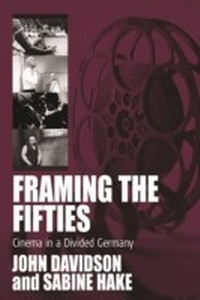
Framing the Fifties
Cinema in a Divided Germany
1st Edition
Published on 1. July 2007
260 pages
978-0-85745-541-3 (ISBN)
Description

The demise of the New German Cinema and the return of popular cinema since the 1990s have led to a renewed interest in the postwar years and the complicated relationship between East and West German cinema in particular. A survey of the 1950s, as offered here for the first time, is therefore long overdue. Moving beyond the contempt for "Papa's Kino" and the nostalgia for the fifties found in much of the existing literature, this anthology explores new uncharted territories, traces hidden connections, discovers unknown treasures, and challenges conventional interpretations. Informed by cultural studies, gender studies, and the study of popular cinema, this anthology offers a more complete account by focusing on popular genres, famous stars, and dominant practices, by taking into account the complicated relationships between East vs. West German, German vs. European, and European vs. American cinemas; and by paying close attention to the economic and political conditions of film production and reception during this little-known period of German film history.
Reviews / Votes
"This collection of essays on the cultural history of post-World War II Berlin is a fine and coherent example of the conference-inspired anthology...The sheer number of subjects...in this slim volume is impressive and enlightening, and each essay has an excellent bibliography to point the reader in the direction of further literature. As an ensemble, the essays in the volume work well together, to the point that many refer to each other." ? German Studies Review"These essays are for the most part interesting and persuasive and are an important step in reclaiming what Hake in her introduction calls the 'last terra incognito of German film studies'." ? German Studies Review
"This very attractive collection invites the reader to study the larger project of German cinematic postwar reconstruction and identity formation with a number of excellent essays. The volume appears remarkably coherent, insofar as all 14 contributions are well-researched and well-written investigations... Undoubtedly, Framing the Fifties will trigger further and much-needed research to reintroduce complexity into a field of study that has long suffered from discursive impoverishment. Davidson and Hake have put together a fine volume that will find its grateful readers." ? Journal of Contemporary History
All prices
More details
Series
Edition
1. Auflage
Language
English
Place of publication
Oxford
United Kingdom
Target group
Professional and scholarly
ISBN-13
978-0-85745-541-3 (9780857455413)
DOI
10.3167/9781845452049
Copyright in bibliographic data and cover images is held by Nielsen Book Services Limited or by the publishers or by their respective licensors: all rights reserved.
Schweitzer Classification
Other editions
Additional editions
Book
12/2008
1st Edition
Berghahn Books
€25.70
Shipment within 3-4 weeks
Book
07/2007
1st Edition
Berghahn Books
€148.80
Shipment within 3-4 weeks
Persons
John Davidson is Director of the Program of Film Studies and Associate Professor of Germanic Languages and Literatures at the Ohio State University. His Deterritorializing the New German Cinema appeared in 1999, and he has published numerous articles on German film as well as political discourses and literary figures in cinema more generally. He serves on the editorial board of Studies in European Cinema (UK) and is currently working on a book project investigating cinema, labor, and mobility in twentieth-century Germany.
Content
List of Illustrations
Introduction
Chapter 1. The Question of German Guilt and the "German Student": Politicizing the Postwar University in Kortner's Der Ruf and von Wangenheim's Und wieder
Jaimey Fisher
Chapter 2. Returning Home: The Orientalist Spectacle of Fritz Lang's Der Tiger von Eschnapur and Das indische Grabmal
Barbara Mennel
Chapter 3. The Passenger: Ambivalences of National Identity and Masculinity in the Star Persona of Peter van Eyck
Tim Bergfelder
Chapter 4. Helmut Kaeutner's Epilog: Das Geheimnis der Orplid and the West German Detective Film of the 1950s
Yogini Joglekar
Chapter 5. Location Heimat: Tracking Refugee Images, from DEFA to the Heimatfilm
Johannes von Moltke
Chapter 6. "Great Truths and Minor Truths": Kurt Maetzig's Ernst Thaelmann Films, the Antifascism Myth, and the Politics of Biography in the German Democratic Republic
Russel Lemmons
Chapter 7. The First DEFA Fairy Tales: Cold War Fantasies of the 1950s
Marc Silberman
Chapter 8. Visualizing the Enemy: Representations of the "Other Germany" in Documentaries Produced by the FRG and GDR in the 1950s
Matthias Steinle
Chapter 9. The Treatment of the Past: Geza Radvanyi's Der Arzt von Stalingrad and the West German War Film
Jennifer M. Kapczynski
Chapter 10. Film und Frau and the Female Spectator of 1950s West German Cinema
Hester Baer
Chapter 11. Reterritorializing Enjoyment in the Adenauer Era: Robert A. Stemmle's Toxi
Angelica Fenner
Chapter 12. Allegories of Management: Norbert Schultze's Sound Track for Das Maedchen
Rosemarie Larson Powell
Chapter 13. The Restructuring of the West German Film Industry in the 1950s
Knut Hickethier
Chapter 14. The Other "German" Cinema
Mary Wauchope
Works Cited
Filmography
Notes on Contributors
Index
Introduction
Chapter 1. The Question of German Guilt and the "German Student": Politicizing the Postwar University in Kortner's Der Ruf and von Wangenheim's Und wieder
Jaimey Fisher
Chapter 2. Returning Home: The Orientalist Spectacle of Fritz Lang's Der Tiger von Eschnapur and Das indische Grabmal
Barbara Mennel
Chapter 3. The Passenger: Ambivalences of National Identity and Masculinity in the Star Persona of Peter van Eyck
Tim Bergfelder
Chapter 4. Helmut Kaeutner's Epilog: Das Geheimnis der Orplid and the West German Detective Film of the 1950s
Yogini Joglekar
Chapter 5. Location Heimat: Tracking Refugee Images, from DEFA to the Heimatfilm
Johannes von Moltke
Chapter 6. "Great Truths and Minor Truths": Kurt Maetzig's Ernst Thaelmann Films, the Antifascism Myth, and the Politics of Biography in the German Democratic Republic
Russel Lemmons
Chapter 7. The First DEFA Fairy Tales: Cold War Fantasies of the 1950s
Marc Silberman
Chapter 8. Visualizing the Enemy: Representations of the "Other Germany" in Documentaries Produced by the FRG and GDR in the 1950s
Matthias Steinle
Chapter 9. The Treatment of the Past: Geza Radvanyi's Der Arzt von Stalingrad and the West German War Film
Jennifer M. Kapczynski
Chapter 10. Film und Frau and the Female Spectator of 1950s West German Cinema
Hester Baer
Chapter 11. Reterritorializing Enjoyment in the Adenauer Era: Robert A. Stemmle's Toxi
Angelica Fenner
Chapter 12. Allegories of Management: Norbert Schultze's Sound Track for Das Maedchen
Rosemarie Larson Powell
Chapter 13. The Restructuring of the West German Film Industry in the 1950s
Knut Hickethier
Chapter 14. The Other "German" Cinema
Mary Wauchope
Works Cited
Filmography
Notes on Contributors
Index
