

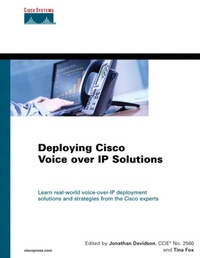
Deploying Cisco Voice over IP Solutions
1st Edition
Published on 8. November 2001
608 pages
978-1-58705-426-6 (ISBN)
Description

This is the eBook version of the printed book. If the print book includes a CD-ROM, this content is not included within the eBook version.
Learn real-world voice-over-IP deployment solutions and strategies from the Cisco experts
Deploying Cisco Voice over IP Solutions covers:
Definitive guidelines on real-world VoIP deployments, the fundamentals of the latest VoIP solutions, and a look into the future of VoIP services
Different techniques for engineering and properly sizing traffic-sensitive voice networks
Basic concepts applicable to echo analysis, echo cancellation, and locating and eliminating echoes
Various QoS features applicable to voice
Detailed information on call admission control (CAC)
Dial plan configuration recommendations on Cisco H.323 gateways and gatekeepers used to support large dial plans
Basic tasks of designing a long-distance VoIP network
The two classes of hosted voice networks: Managed Multiservice (MMS) networks and packet voice VPNs
Fax services store and forward as well as real-time relay fax services
Sample configurations and step-by-step examples to help you learn how to build a VoIP network
Deploying Cisco Voice over IP Solutions provides networking professionals the knowledge, advice, and insight necessary to design and deploy voice over IP (VoIP) networks that meet customers' needs for scalability, services, and security. Beginning with an introduction to the important preliminary design elements that need to be considered before implementing VoIP, Deploying Cisco Voice over IP Solutions also demonstrates the basic tasks involved in designing an effective service provider-based VoIP network. You'll conclude with design and implementation guidelines for some of the more popular and widely requested VoIP services, such as prepaid services, fax services, and virtual private networks (VPNs).
This book is a collaboration of Cisco Systems CCIE(r) engineers, technical marketing engineers, and systems engineers. You'll find design experience from people who have designed some of the world's largest VoIP networks.
Learn real-world voice-over-IP deployment solutions and strategies from the Cisco experts
Deploying Cisco Voice over IP Solutions covers:
Definitive guidelines on real-world VoIP deployments, the fundamentals of the latest VoIP solutions, and a look into the future of VoIP services
Different techniques for engineering and properly sizing traffic-sensitive voice networks
Basic concepts applicable to echo analysis, echo cancellation, and locating and eliminating echoes
Various QoS features applicable to voice
Detailed information on call admission control (CAC)
Dial plan configuration recommendations on Cisco H.323 gateways and gatekeepers used to support large dial plans
Basic tasks of designing a long-distance VoIP network
The two classes of hosted voice networks: Managed Multiservice (MMS) networks and packet voice VPNs
Fax services store and forward as well as real-time relay fax services
Sample configurations and step-by-step examples to help you learn how to build a VoIP network
Deploying Cisco Voice over IP Solutions provides networking professionals the knowledge, advice, and insight necessary to design and deploy voice over IP (VoIP) networks that meet customers' needs for scalability, services, and security. Beginning with an introduction to the important preliminary design elements that need to be considered before implementing VoIP, Deploying Cisco Voice over IP Solutions also demonstrates the basic tasks involved in designing an effective service provider-based VoIP network. You'll conclude with design and implementation guidelines for some of the more popular and widely requested VoIP services, such as prepaid services, fax services, and virtual private networks (VPNs).
This book is a collaboration of Cisco Systems CCIE(r) engineers, technical marketing engineers, and systems engineers. You'll find design experience from people who have designed some of the world's largest VoIP networks.
More details
Series
Edition
1. Auflage
Language
English
Place of publication
Indianapolis
United States
Publishing group
Pearson Education (US)
Target group
Professional and scholarly
File size
4,33 MB
ISBN-13
978-1-58705-426-6 (9781587054266)
Copyright in bibliographic data and cover images is held by Nielsen Book Services Limited or by the publishers or by their respective licensors: all rights reserved.
Schweitzer Classification
Other editions
Additional editions
Jonathan Davidson
Deploying Cisco Voice over IP Solutions (paperback)
Book
01/2011
Cisco Press
€79.41
Article exhausted; check different version
Jonathan Davidson
Deploying Cisco Voice over IP Solutions
Book
11/2001
Cisco Press
€73.22
Article exhausted; check different version
Person
Phil Bailey is the technical documentation program manager for early deployment Cisco IOS(r) software releases for the Knowledge Management and Delivery group at Cisco Systems.
Rommel Bajamundi is a technical marketing engineer in Service Provider Technical Marketing at Cisco Systems.
Wayne Cheung is a manager in Service Provider Technical Marketing at Cisco Systems.
Thu Dao has been employed in the Voice over IP group at Cisco Systems for four years, mainly developing voice applications.
Jonathan Davidson (CCIE No. 2560) is the manager of Service Provider Technical Marketing for Packet Voice at Cisco Systems. He is the coauthor of Voice over IP Fundamentals, published by Cisco Press.
Tina Fox is the Integration Solutions program manager for the Knowledge Management and Delivery group at Cisco Systems.
Sachin Gupta (CCIE No. 3682) is the manager of the Cisco IOS Technical Marketing group.
Christina Hattingh is a member of the Technical Marketing organization at Cisco Systems.
Ted Huff has been a technical marketing engineer in the Service Provider TME group at Cisco Systems for almost five years.
Stephen Liu (CCIE No. 2430) is a manager of Service Provider Technical Marketing at Cisco Systems.
Curt Mah (CCIE No. 3856) is a technical marketing engineer for Cisco Systems, working on VoIP and wholesale voice networks for Service Provider Technical Marketing.
Greg Mercurio is a senior software engineer at Cisco Systems.
Jeremy Pollock is a technical writer for the Cisco IOS Documentation group at Cisco Systems.
Jim Rushton is a technical writer for the Cisco IOS Documentation group at Cisco Systems.
Ravindar Shankar is a senior technical marketing engineer at Cisco Systems with a focus on voice solutions in Service Provider Technical Marketing.
Rommel Bajamundi is a technical marketing engineer in Service Provider Technical Marketing at Cisco Systems.
Wayne Cheung is a manager in Service Provider Technical Marketing at Cisco Systems.
Thu Dao has been employed in the Voice over IP group at Cisco Systems for four years, mainly developing voice applications.
Jonathan Davidson (CCIE No. 2560) is the manager of Service Provider Technical Marketing for Packet Voice at Cisco Systems. He is the coauthor of Voice over IP Fundamentals, published by Cisco Press.
Tina Fox is the Integration Solutions program manager for the Knowledge Management and Delivery group at Cisco Systems.
Sachin Gupta (CCIE No. 3682) is the manager of the Cisco IOS Technical Marketing group.
Christina Hattingh is a member of the Technical Marketing organization at Cisco Systems.
Ted Huff has been a technical marketing engineer in the Service Provider TME group at Cisco Systems for almost five years.
Stephen Liu (CCIE No. 2430) is a manager of Service Provider Technical Marketing at Cisco Systems.
Curt Mah (CCIE No. 3856) is a technical marketing engineer for Cisco Systems, working on VoIP and wholesale voice networks for Service Provider Technical Marketing.
Greg Mercurio is a senior software engineer at Cisco Systems.
Jeremy Pollock is a technical writer for the Cisco IOS Documentation group at Cisco Systems.
Jim Rushton is a technical writer for the Cisco IOS Documentation group at Cisco Systems.
Ravindar Shankar is a senior technical marketing engineer at Cisco Systems with a focus on voice solutions in Service Provider Technical Marketing.
Content
I. NETWORK DESIGN CONSIDERATIONS.
1. Understanding Traffic Analysis.
Traffic Theory Basics. Traffic Models. Selecting Traffic Models. Applying Traffic Analysis to VoIP Networks. End-to-End Traffic Analysis Example.
2. Understanding Echo Analysis.
Echo Analysis Basics. Locating an Echo. Effects of Network Elements on Echo. Echo Canceller. Customer Expectations About Echo. Service Provider Expectations About Echo. Configuring Gateways to Minimize Echo. Process for Locating and Eliminating Echoes. Echo Analysis Case Study.
3. Understanding Quality of Service for Voice over IP.
Quality of Service Requirements. Packet Classification. QoS Queuing Mechanisms. Fragmentation and Interleaving. Traffic Shaping. IP RTP Header Compression. Differentiated Services for VoIP. VoIP QoS over Leased Lines (Using PPP) Example. VoIP QoS over Frame Relay Networks Example. VoIP QoS over ATM Example. RSVP-Dynamic Classification and Admission Control.
4. Understanding Call Admission Control.
Call Admission Control. CAC Mechanisms. Local CAC Mechanisms. Measurement-Based CAC Mechanisms. Resource-Based CAC Mechanisms. Feature Combinations, Interactions, and Sequencing.
II. NETWORK DESIGN STRATEGIES.
5. Designing Static Dial Plans for Large VoIP Networks.
Components of Large H.323 Networks. Design Methodology for Large-Scale Dial Plans. H.323 Network Components in Large-Scale Dial Plans. Dial Plan Call Routing Tools and Features. Example: Use of Translation Rules, Technology Prefixes, and Dial-Peer Failover. Example: Implementing an International Dial Plan.
6. Designing a Long-DistanceVoIP Network.
Long-Distance VoIP Network Features and Benefits. Long-Distance VoIP Design Methodology. Step 1: Identify Services. Step 2: Determine Carriers or Providers. Step 3: Determine Interconnection Types. Step 4: Determine Call Topologies. Step 5: Identify Deployment Scenario. Step 6: Identify Functional Areas. Step 7: Identify Required Hardware and Software Components. Step 8: Identify Design and Scalability Issues. Step 9: Configure and Provision Components.
III. NETWORK SERVICES.
7. Managed Multiservice Networks and Packet Voice VPNs.
Managed Multiservice Networks. Peer-to-Peer Managed Multiservice Networks. Packet Voice Virtual Private Networks.
8. Fax Services.
Traditional Fax over Circuit-Switched Networks. Cisco Store and Forward Fax. T.38 Real-Time Fax and Never-Busy Fax Service.
9. Unified Messaging.
Market Scope. Unified Messaging Features. Components of a Unified Messaging System. Typical uOne Call Flows. Deploying Unified Messaging Services in a Service Provider Environment. Deploying Unified Messaging for Dial Internet Access. Deploying Unified Messaging for Dedicated Internet Access. Redundancy and Load Balancing. Unified Messaging Configuration Examples.
10. Prepaid Services.
Debit Card Application Overview. Debit Card Application Functional Call Flow. Architecture for Internally Managed Prepaid Services. Prepaid Services Configuration Guidelines. Internally Managed Prepaid Services Call Example. Using OSP for Clearinghouse Services. OSP Clearinghouse Operation and Call Flow. Architecture for OSP. OSP Clearinghouse Solution Configuration Guidelines. Troubleshooting OSP. OSP Clearinghouse Configuration Examples.
IV. APPENDIXES.
Appendix A: Erlang B Traffic Model.
Appendix B: Extended Erlang B Traffic Model.
Appendix C: TCL IVR Scripts.
1. Understanding Traffic Analysis.
Traffic Theory Basics. Traffic Models. Selecting Traffic Models. Applying Traffic Analysis to VoIP Networks. End-to-End Traffic Analysis Example.
2. Understanding Echo Analysis.
Echo Analysis Basics. Locating an Echo. Effects of Network Elements on Echo. Echo Canceller. Customer Expectations About Echo. Service Provider Expectations About Echo. Configuring Gateways to Minimize Echo. Process for Locating and Eliminating Echoes. Echo Analysis Case Study.
3. Understanding Quality of Service for Voice over IP.
Quality of Service Requirements. Packet Classification. QoS Queuing Mechanisms. Fragmentation and Interleaving. Traffic Shaping. IP RTP Header Compression. Differentiated Services for VoIP. VoIP QoS over Leased Lines (Using PPP) Example. VoIP QoS over Frame Relay Networks Example. VoIP QoS over ATM Example. RSVP-Dynamic Classification and Admission Control.
4. Understanding Call Admission Control.
Call Admission Control. CAC Mechanisms. Local CAC Mechanisms. Measurement-Based CAC Mechanisms. Resource-Based CAC Mechanisms. Feature Combinations, Interactions, and Sequencing.
II. NETWORK DESIGN STRATEGIES.
5. Designing Static Dial Plans for Large VoIP Networks.
Components of Large H.323 Networks. Design Methodology for Large-Scale Dial Plans. H.323 Network Components in Large-Scale Dial Plans. Dial Plan Call Routing Tools and Features. Example: Use of Translation Rules, Technology Prefixes, and Dial-Peer Failover. Example: Implementing an International Dial Plan.
6. Designing a Long-DistanceVoIP Network.
Long-Distance VoIP Network Features and Benefits. Long-Distance VoIP Design Methodology. Step 1: Identify Services. Step 2: Determine Carriers or Providers. Step 3: Determine Interconnection Types. Step 4: Determine Call Topologies. Step 5: Identify Deployment Scenario. Step 6: Identify Functional Areas. Step 7: Identify Required Hardware and Software Components. Step 8: Identify Design and Scalability Issues. Step 9: Configure and Provision Components.
III. NETWORK SERVICES.
7. Managed Multiservice Networks and Packet Voice VPNs.
Managed Multiservice Networks. Peer-to-Peer Managed Multiservice Networks. Packet Voice Virtual Private Networks.
8. Fax Services.
Traditional Fax over Circuit-Switched Networks. Cisco Store and Forward Fax. T.38 Real-Time Fax and Never-Busy Fax Service.
9. Unified Messaging.
Market Scope. Unified Messaging Features. Components of a Unified Messaging System. Typical uOne Call Flows. Deploying Unified Messaging Services in a Service Provider Environment. Deploying Unified Messaging for Dial Internet Access. Deploying Unified Messaging for Dedicated Internet Access. Redundancy and Load Balancing. Unified Messaging Configuration Examples.
10. Prepaid Services.
Debit Card Application Overview. Debit Card Application Functional Call Flow. Architecture for Internally Managed Prepaid Services. Prepaid Services Configuration Guidelines. Internally Managed Prepaid Services Call Example. Using OSP for Clearinghouse Services. OSP Clearinghouse Operation and Call Flow. Architecture for OSP. OSP Clearinghouse Solution Configuration Guidelines. Troubleshooting OSP. OSP Clearinghouse Configuration Examples.
IV. APPENDIXES.
Appendix A: Erlang B Traffic Model.
Appendix B: Extended Erlang B Traffic Model.
Appendix C: TCL IVR Scripts.
