

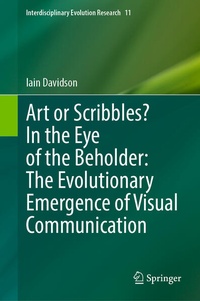
Art or Scribbles? In the Eye of the Beholder: The Evolutionary Emergence of Visual Communication
Description

The book is about how art arose; and how it became what we call art today. How did art emerge from the relationships between people and the things they produce and the ideas of producers? How do people manipulate those relationships in their own society? How do outsiders work out the ways in which those relationships were used to make art?
What is art and why are all people engaged with it in one way or another? From its very beginning, and everywhere, art has always been embedded in its cultural context-the contexts of the people who made and see it-and that context has often been ritual. The history of art confused "social and institutional changes" of view because western critics (or artists) sought to define the boundaries of art so tightly that ritual, purposeful or utilitarian works were excluded from it. In their definition, art only existed if the rituals of the original producers were stripped from the works or if the objects were appropriated away from the situation in which they were produced. The objects stripped from their context could then only be valued for their aesthetics. Art consists of relationships between people, things, and ideas in quite specific ways. Those relationships are discussed at length in this book.
The book is aimed at artists, art historians and archaeologists, but also at the general public interested in art. It is intended both for people whose interest in art comes from knowledge of the art of all continents, and for those who have no knowledge.
Reviews / Votes
"I suggest every academic request their university purchases it. . I thoroughly enjoyed reading the entire book, when usually I would seek out what I need from academic references. I highly recommend Art or Scribbles? In the Eye of the Beholder: The Evolutionary Emergence of Visual Communication. " (Dr Lynne Kelly AM, lynnekelly.com.au, March, 2026)" (Dr Lynne Kelly AM, lynnekelly.com.au, March, 2026)
"A notable strength of the book is its treatment of ambiguous images. . Art or Scribbles? is a clear and thoughtful contribution to the study of art and human history. It encourages a broader understanding of what art is and how it works. The book will be of interest to archaeologists, art historians, and others concerned with the development of human communication." (Christopher Henshilwood, Australian Archaeology, May 17, 2026)
More details
Other editions
Additional editions
Person
Iain Davidson is Emeritus Professor of the Department of Archaeology, Classics and History at the University of New England (Australia). He began his research work in Eastern Spain in 1970, studying and excavating art sites more than 12 thousand years old. He went on to a series of positions in Australia from Lecturer (1974) to Professor (1997) and retired in 2008 to take up the Chair of Australian Studies in Harvard (2008-9), teaching a course on rock art. He has worked in Cultural Heritage, including a visiting position at the Universidad de Magallanes in Punta Arenas in 2015. He has written 5 books (including this one), edited 8 others, and published more than 180 articles. He has published on animal bones, prehistoric economy, language, art, stone tools, collaboration with Aboriginal people, archaeological comparisons across the world, and culture. He has worked with several Indigenous groups in Australia since 1981, often in making recommendations about their heritage to mining companies. He is a Fellow of the Academy of Humanities and won the Rhys Jones Medal of the Australian Archaeological Association.
Content
Chapter 1: Art or Scribbles.- Chapter 2: Art is too important to be left to those who are interested in art.- Chapter 3: Art, rock art or not art.- Chapter 4: Art and communication.- Chapter 5: Graphic elements in communication.- Chapter 6: Meaning, expectations, agents and scenes.- Chapter 7: Painting by numbers. Seven Types of Ambiguity in Art.- Chapter 8: But is it Art-let me count the ways.- Chapter 9: Art and archeohistory of Sahul (the continent of greater Australia and New Guinea).- Chapter 10: a thousand words.
