

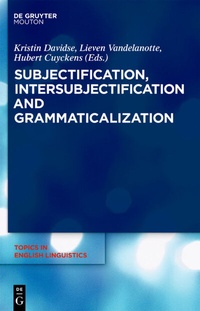
Subjectification, Intersubjectification and Grammaticalization
Description

This volume aims to arrive at a fine-grained and grammar-based understanding of the notions of (inter-)subjectivity and (inter-)subjectification in their application to grammaticalization research. In terms of linguistic theory, position is taken vis-à-vis existing approaches to (inter-)subjectification which are either too narrow or too general by addressing two questions: (i) what is the relation between (inter-)subjectivity and pragmatics, and (ii) on what grounds can subjective and intersubjective meanings be distinguished?
In the descriptive sections of the volume, these theoretical considerations are confronted with extensive analytical, and often also quantitative, study of empirical data mainly from English but also from Romance languages. The focus in these case studies is on the analytical and diachronic relations between subjectivity and intersubjectivity, with particular emphasis on the question how linguistic syntagms may shift towards the expression of meanings of which the hearer is an essential part. The domains covered include adverbials and modals, but also the noun phrase, to date a relatively under-researched area in grammaticalization studies. Together these three areas ensure broad verification of existing hypotheses about the relative order in which subjectification and intersubjectification take place.
This volume is mainly of interest to researchers and graduate students with a special interest in subjectification, intersubjectification and grammaticalization, and with a general interest in language change. The volume will also be welcomed by functional linguists (in a broad sense), since it is the first to bring eclectic functionalists' reflections to bear so explicitly on grammaticalization.
More details
Other editions
Additional editions
Persons
Content
2 - Contents [Seite 8]
3 - Introduction [Seite 10]
4 - (Inter)subjectivity and (inter)subjectification: A reassessment [Seite 38]
5 - Presupposition accommodation and language change [Seite 84]
6 - How prosody reflects semantic change: A synchronic case study of of course [Seite 112]
7 - The semantic-pragmatic development of well from the viewpoint of (inter)subjectification [Seite 164]
8 - Paths in the development of elaborative discourse markers: Evidence from Spanish [Seite 206]
9 - The emergence of the definite article: ille in competition with ipse in Late Latin [Seite 250]
10 - On the subjectification and intersubjectification paths followed by the adjectives of completeness [Seite 286]
11 - On the rise of (inter)subjective meaning in the grammaticalization of kind of/kinda [Seite 324]
12 - Better as a verb [Seite 358]
13 - (Inter)subjectification in the domain of modality and mood - Concepts and cross-linguistic realities [Seite 394]
14 - Contributors [Seite 440]
15 - Referees [Seite 442]
16 - Author index [Seite 444]
17 - Subject index [Seite 450]
