

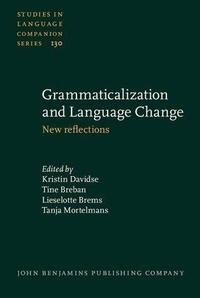
Grammaticalization and Language Change
New reflections
1st Edition
Published on 30. October 2012
VIII, 342 pages
978-90-272-7323-9 (ISBN)
Description

This collective volume focuses on the latest developments in the study of grammaticalization and related processes of change such as degrammaticalization, constructionalization, lexicalization, and petrification. It addresses topical issues relating to the motivations, sources, defining features, and outcomes of these changes. New theoretical reflections are offered on the pragmatic motivation of grammaticalization paths, process-oriented differences between grammaticalization, lexicalization and degrammaticalization, the question of gradualness and pace of grammaticalization, and deictics as a distinct source of grammaticalization. The articles describe various constructional and distributional changes affecting deictics, determiners, reflexives, clitics, nouns, affixes, adverbs and (auxiliary) verbs, mainly in the Germanic and Romance languages. The volume will be of great interest to historical linguists working on grammaticalization and related changes, and to all linguists working on the interface between morphosyntax, semantics, pragmatics and discourse.
More details
Other editions
Additional editions
Kristin Davidse | Tine Breban | Lieselotte Brems
Grammaticalization and Language Change
New reflections
Book
10/2012
John Benjamins Publishing Co
€104.94
Shipment within 10-15 days
Persons
Content
- Grammaticalization and Language Change
- Editorial page
- Title page
- LCC data
- Table of contents
- Acknowledgements
- Introduction
- 1. Preliminaries
- 2. Definitions of grammaticalization and lexicalization
- 3. Recognition criteria of grammaticalization
- 4. Outcomes and sources of grammaticalization
- 5. Motivations of grammaticalization
- 6. Contributions to this volume
- References
- Bühler's two-field theory of pointing and naming and the deictic origins of grammatical morphemes
- 1. Introduction
- 2. Bühler's two-field theory of pointing and naming and the deictic origin of grammatical morphemes
- 3. Discussion
- References
- On the origins of grammaticalization and other types of language change in discourse strategies
- 1. Explaining language change
- 2. What sets off grammaticalization?
- 2.1 Normal variability of speech?
- 2.2 How to recognize an innovation?
- 3. Different pathways of the same source construction: French adverb bien 'well'
- 3.1 Three contemporary functions
- 3.2 The rise of the modal particle bien from scalar argumentation
- 3.3 Bien in concessive complex sentences
- 3.4 The rise of bien as a discourse marker
- 4. Subjectification
- 5. Persistence
- 6. Grammaticalization vs. pragmaticalization
- 7. Conclusion
- References
- Corpora
- Lehmann's parameters revisited
- 1. Introduction
- 2. Lehmann's parameters and grammaticalization
- 2.1 Primary and secondary grammaticalization
- 2.2 Case studies
- 2.2.1 From noun to preposition
- 2.2.2 From free demonstrative to bound determiner
- 2.2.3 Parameter analysis
- 2.3 Discussion
- 3. Lehmann's parameters and degrammaticalization
- 3.1 Primary and secondary degrammaticalization
- 3.2 Defining parameters
- 4. Case studies
- 4.1 Degrammation
- 4.1.1 From modal auxiliary to lexical verb
- 4.1.2 From possessive pronoun to noun
- 4.1.3 From preposition to lexical verb.
- 4.2 Deinflectionalization
- 4.2.1 From inflectional genitive suffix to enclitic possessive determiner
- 4.2.2 From inflectional nominative suffix to derivational nominalization suffix
- 4.3 Debonding
- 4.3.1 From bound to free connective
- 4.3.2 From bound to free infinitival marker
- 4.3.3 From inflectional suffix to pronoun
- 4.3.4 From derivational suffix to independent quantifier
- 5. Discussion
- 5.1 Integrity
- 5.2 Paradigmaticity
- 5.3 Paradigmatic variability
- 5.4 Structural scope
- 5.5 Bondedness
- 5.6 Syntagmatic variability
- 6. Conclusions
- Abbreviations
- Texts
- References
- "Paradigmatic integration"
- 1. Introduction
- 2. The model of successive context-/construction types
- 3. Application of the model to other categories
- 4. Expanding the model: Paradigmatic (re-)integration
- References
- Corpora und texts used
- "The ghosts of old morphology"
- 1. Introduction
- 2. "Ghost morphology"
- 3. Treatment in the literature
- 3.1 Lexicalization
- 3.2 (End stage of) grammaticalization
- 3.3 Degrammaticalization
- 3.4 Transcategorization (recategorization)
- 3.5 Neither (de)grammaticalization nor lexicalization
- 3.6 Summary
- 4. Models for distinguishing between lexicalization and grammaticalization
- 4.1 Lehmann
- 4.2 Himmelmann
- 4.3 Brinton & Traugott
- 4.4 Construction grammar
- 5. Case studies
- 5.1 Comparative forms
- 5.2 Superlative forms
- 5.3 Adverbial dative
- 5.4 Adverbial genitive
- 5.4.1 Genitive -s
- 5.4.2 Genitive -st
- 5.4.3 -wards ~ -ward
- 5.4.4 -ways (-wise) ~ -way
- 6. Lexicalization or (de)grammaticalization?
- 6.1 Inflection vs. host
- 6.2 Derivational affix vs. host
- 7. Conclusion
- References
- Grammaticalization, constructions and the grammaticalization of constructions
- 1. Introduction
- 2. An introduction to the model
- 3. Unidirectionality clines, reanalysis and analogy
- 4. The development of some English degree modifier constructions
- 4.1 The H-constructions
- 4.2 Hella
- 5. Grammaticalization and lexicalization: two different kinds of constructionalization
- 5.1 Composite predicate constructions
- 5.2 Lexicalization of possessive phrases
- 6. Conclusions
- References
- Gradualness of grammaticalization in Romance. The position of French, Spanish and Italian
- 1. Introduction
- 2. Aspectual auxiliaries
- 3. The subjunctive
- 4. Demonstratives
- 5. Towards an explanation
- References
- Corpora
- Development of periphrastic tense and aspect constructions in Irish and Welsh
- 1. Introduction
- 2. The Celtic languages
- 3. The development of aspectual periphrasis in Irish and Welsh
- 3.1 The development of the periphrastic progressive in Irish
- 3.2 The development of perfect periphrasis in Irish
- 3.3 The development of progressive periphrasis in Welsh
- 3.4 The development of Welsh perfect periphrasis
- 4. Grammaticalization of progressive and perfect periphrasis in Irish and Welsh
- 5. Conclusion
- Abbreviations
- References
- Emergence and grammaticalization of constructions within the se me network of Spanish
- 1. Introduction
- 2. The Accidental event construction
- 3. The historical path
- 4. Stage I (12th century to 16th century)
- 4.1 The SEED construction
- 4.2 The IME construction with olvidar
- 5. Stage II (17th century to 18th century): Expansion of the IME construction
- 6. Stage III (19th century): Emergence of the AE construction
- 7. Conclusion
- References
- A discourse-based analysis of object clitic doubling in Spanish
- 1. Introduction
- 2. The status of so-called clitics in Spanish
- 3. TS hypothesis
- 4. Shortcomings of TS hypothesis
- 5. A new approach to discourse data
- 5.1 A note on the previous literature
- 5.2 The data
- 5.3 The analysis
- 6. Discussion
- 7. Conclusion
- References
- Corpora
- Appendix 1: Composition of 13th-17th c. corpus
- Appendix 2: Complete references of the sources of contemporary examples
- The many careers of negative polarity items
- Part I: Traditional careers
- 1. The ingredients of negative polarity sensitivity
- 2. Headhunting: NPI candidates
- 3. First career choices: weak and strong scalar NPIs
- 4. Getting professional: Bleaching
- 5. Career changes: Subjectification
- 6. More career changers: Reanalysis
- 7. . and bleaching, again
- Part II: Alternative careers
- 8. Escort service: Scalar particles with NPI distribution
- 9. Analogy: Snars NPIs in Dutch
- 10. NPI mimicry
- 11. Summary
- References
- Author Index
- Subject Index
