

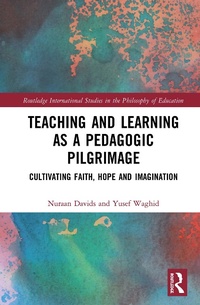
Teaching and Learning as a Pedagogic Pilgrimage
Cultivating Faith, Hope and Imagination
1st Edition
Published on 4. October 2018
136 pages
978-0-429-81504-1 (ISBN)
Description

Teaching and Learning as a Pedagogic Pilgrimage is premised on an argument that if higher education is to remain responsive to a public good, then teaching and learning must be in a perpetual state of reflection and change. It argues in defence of teaching and learning as constitutive of a pedagogic pilgrimage and draws on a range of scholars and theories to explore concepts such as transcendental journeys, belief, hope and imagination. The main objective of the book is to show how teaching and learning ought to be reconsidered in relation to that which lies beyond the parameters of the encounters, as well as that which is intrinsic to the encounters.
This book gives shape to rituals and routines of engagement and debate, before extending the limitations in deliberative pedagogic encounters to offer desirable outcomes in which both student and teacher can practice a spiritual take on teaching and learning along a continuum of ongoing action. Themes explored in the chapters include the following:
Faith and deliberative encounters
Post-human ethics of care in teaching and learning
Diffracted teaching and learning
This book will be of great interest to academics, researchers and post-graduate students in the fields of philosophy of education, and teaching and learning in the philosophy of education. It will also appeal to school and university educators, policymakers and prospective teachers.
This book gives shape to rituals and routines of engagement and debate, before extending the limitations in deliberative pedagogic encounters to offer desirable outcomes in which both student and teacher can practice a spiritual take on teaching and learning along a continuum of ongoing action. Themes explored in the chapters include the following:
Faith and deliberative encounters
Post-human ethics of care in teaching and learning
Diffracted teaching and learning
This book will be of great interest to academics, researchers and post-graduate students in the fields of philosophy of education, and teaching and learning in the philosophy of education. It will also appeal to school and university educators, policymakers and prospective teachers.
Reviews / Votes
Teaching and Learning as a Pedagogic Pilgrimage is a fascinating new contribution to educational theory and practice. The book covers a broad range of topical and exciting issues as diverse as faith, hope, wonder, imagination and post-human ethics of care in teaching and learning. It does so with poetic elegance as well as argumentative rigour. It combines critical edge with an affirmative stance toward pedagogical possibility, steering clear from drastic choices and dichotomous thinking. The book's captivating metaphors and its valuable insights will be of lasting significance for a variety of fields that intersect in their commitment to an innovative and transformative pedagogy.Marianna Papastephanou, University of Cyprus, Department of Education.
Teaching and Learning as a Pedagogic Pilgrimage articulates a scholarly and reflective focus on the role of higher education in society, in the enactment of teaching and learning. The authors in their exposition of this theme are attentive to the practice of teaching and learning vis-a-vis education encounters with the aim being, to contribute to the peaceful co-existence and flourishing of all members of society. The scholarship in this book is of the highest order and engages with recent scholarship which in turn takes existing scholarship forward. The book would be of interest to academics and students involved in the discipline of philosophy of education but would also because of its inter-disciplinary and international appeal, draw the attention of policy makers, developmental specialists and educators.
Philip Higgs, Emeritus Professor and Research Fellow, University of South Africa.
More details
Series
Edition
1. Auflage
Language
English
Place of publication
London
United Kingdom
Publishing group
Taylor & Francis Ltd
Target group
Professional and scholarly
College/higher education
File size
2,96 MB
ISBN-13
978-0-429-81504-1 (9780429815041)
Copyright in bibliographic data and cover images is held by Nielsen Book Services Limited or by the publishers or by their respective licensors: all rights reserved.
Schweitzer Classification
Other editions
Additional editions
Nuraan Davids | Yusef Waghid
Teaching and Learning as a Pedagogic Pilgrimage
Cultivating Faith, Hope and Imagination
Book
06/2020
1st Edition
Routledge
€62.60
Shipment within 15-20 days
Nuraan Davids | Yusef Waghid
Teaching and Learning as a Pedagogic Pilgrimage
Cultivating Faith, Hope and Imagination
Book
10/2018
1st Edition
Routledge
€193.50
Shipment within 15-20 days
Persons
Nuraan Davids is an associate professor of Philosophy of Education at Stellenbosch University, South Africa.
Yusef Waghid is a distinguished professor of Philosophy of Education at Stellenbosch University, South Africa.
Yusef Waghid is a distinguished professor of Philosophy of Education at Stellenbosch University, South Africa.
Content
Chapter 1 Transcending the limitations of argumentation and persuasion: Towards a renewed understanding of deliberative encounters
Chapter 2 Deliberative encounters and the quest for transcendence
Chapter 3 On faith and deliberative encounters
Chapter 4 On hope and deliberative encounters
Chapter 5 Cultivating imagination through deliberative encounters
Chapter 6 What makes a good (ethical) teacher?
Chapter 7 Towards a post-human ethics of care in teaching and learning
Chapter 8 Doctoral supervision as a process of ethical becoming
Chapter 9 Diffracted teaching and learning
Chapter 10 Teaching and learning as endeavours of power, resistance and human flourishing
Chapter 11 Reflections on our pedagogic pilgrimages
Postscript On the pilgrimage of writing
Chapter 2 Deliberative encounters and the quest for transcendence
Chapter 3 On faith and deliberative encounters
Chapter 4 On hope and deliberative encounters
Chapter 5 Cultivating imagination through deliberative encounters
Chapter 6 What makes a good (ethical) teacher?
Chapter 7 Towards a post-human ethics of care in teaching and learning
Chapter 8 Doctoral supervision as a process of ethical becoming
Chapter 9 Diffracted teaching and learning
Chapter 10 Teaching and learning as endeavours of power, resistance and human flourishing
Chapter 11 Reflections on our pedagogic pilgrimages
Postscript On the pilgrimage of writing
