

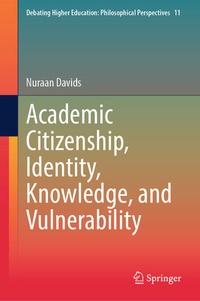
Academic Citizenship, Identity, Knowledge, and Vulnerability
Description

This book brings into contestation the idea of academic citizenship as a homogenous and inclusive space. It delves into who academics are and how they come to embody their academic citizenship, if at all. Even when academics hold similar professional standings, their citizenship and implied notions of participation, inclusion, recognition, and belonging are largely pre-determined by their personal identity markers, rather than what they do professionally. As such, it is hard to ignore not only the contested and vulnerable terrain of academic citizenship, but the necessity of unpacking the agonistic space of the university which both sustains and benefits from these contestations and vulnerabilities.
The book is influenced by a postcolonial vantage point, interested in unblocking and opening spaces, thoughts, and voices not only of reimagined embodiments and expressions of academic citizenship but of hitherto silenced and discounted forms of knowledge and being. It draws on academics' stories at various universities located in South Africa, USA, UK, Hong Kong, and the Philippines. It steps into the unexplored constructions of how knowledge is used in the deployment of valuing some forms of academic citizenship, while devaluing others. The book argues that different kinds of knowledge are necessary for both the building and questioning of theory: the more expansive our immersion into knowledge, the greater the capacities and opportunities for unlearning and relearning.
More details
Other editions
Additional editions
Person
Content
Introduction: Academic conundrums.- Academic identities and citizenship.- Academic citizenship as an agonistic space.- Identities, citizenships, and vulnerabilities.- Diversity as vulnerability.- Academics as embodiments of knowledge.- Academic citizenship as curiosity.- The vulnerability of unlearning.- Identity and transformation.- Stories as reclamations of knowledge.- Responsibility and being other-wise.- Concluding reflections: Academic citizenship, collegiality, and trust.
