

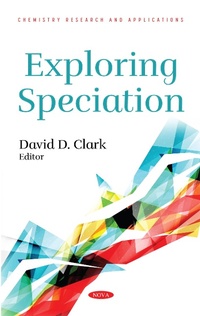
Exploring Speciation
Published on 31. August 2021
234 pages
978-1-68507-138-7 (ISBN)
Description

In chemistry, speciation refers to the distribution of an element amongst chemical species in a system. The five chapters of this book each bring a unique perspective on this type of speciation as it pertains to marine biota, x-ray fluorescence spectroscopy, and other areas of interest. Chapter One investigates the bioaccumulation of cadmium, a toxic heavy metal, in marine biota in the Egyptian coastal zones. Chapter Two scrutinizes the applications of energy and wavelength dispersive spectroscopic techniques in various materials. Chapter Three explains the phenomenon of thermoluminescence and the effect of varying readout heating rates on the dosimetric properties of TLD-100 (LiF: Mg, Ti) irradiated with 6 MV X-ray. Chapter Four focuses on the applications of different X-ray spectroscopy techniques and their use in the elemental analysis of water, coal, fly ash, and fertilizer samples. Finally, Chapter Five describes how to select the best speciation model from studies based on potentiometric measurements.
More details
Other editions
Additional editions
David D. Clark
Exploring Speciation
Book
10/2021
Nova Science Publishers Inc
€210.94
Shipment within 15-20 days
Content
- Intro
- Contents
- Preface
- Chapter 1
- Exploring Cadmium Speciation in the Aquatic Ecosystem: A Case Study
- Abstract
- 1. Introduction
- 2. Speciation of CD in the Aquatic Environment in Egyptian Coast, Case Study
- 2.1. An Overview of the Metal Pollution in the Marine Environment in Egyptian Coast
- 2.2. Speciation of Cadmium in Aquatic Environment
- 2.2.1. Cadmium in Sediment
- 2.2.1.1. Marine Sediment (Mediterranean and Red Sea)
- 2.2.1.1.1. The Egyptian Coast of the Mediterranean Sea
- 2.2.1.1.2. The Egyptian Coast of the Red Sea
- 2.2.2. Fresh Water Sediment
- 2.2.2.1. Nile River Sediments
- 2.2.2.2. Nile River Branches Sediment
- 2.2.2.3. Nile Lakes Sediments
- 2.2.2.3.1. Nasser Lake
- 2.2.2.3.2. Qarun Lake
- 2.2.3. Brackish Water Sediments (Four Nile Delta Lakes)
- 2.2.3.1. Lake Bardawil (Northern Egypt)
- 2.3. Cadmium in Aquatic Biota
- 2.3.1. Marine Environment
- 2.3.1.1. Fish
- 2.3.1.2. Marine Organisms
- 2.3.1.3. Marine Seaweed
- 2.3.2. Fresh Water Environment
- 2.3.2.1. Fresh Water Fish
- 2.3.2.2. Freshwater Organisms
- 2.3.2.3. Brackish Water Fish (Four Nile Delta Lakes)
- 2.3.2.3.1. Burullus
- 2.3.2.3.2. Edku
- 2.3.2.3.3. Manzalah
- 2.3.2.3.4. Maryout
- 2.3.2.4. The Extent of Cadmium Pollution of Marine Organisms on Egyptian Coasts
- Conclusion
- References
- Biographical Sketch
- Chapter 2
- Investigation of Photon Atom Interactions in Various Chemical Materials Employing X-Ray Spectroscopic Techniques
- Abstract
- Introduction
- Photon-Atom Interaction Processes
- Atomic Inner-Shell Photoionization
- Inner-Shell Vacancy Decay and Subsequent Processes
- Non-Radiative Transitions
- Radiative Transitions
- Physical Parameters Associated with Inner-Shell Vacancy Decay
- Mass Attenuation Coefficients
- Fluorescence, Auger, and Coster-Kronig Yields
- Vacancy Transfer Probabilities
- Fractional X-Ray Emission Rates
- X-Ray Production Cross-Sections
- Near-Edge Processes Contributing to the Absorption of Incident Photons
- Resonant Raman Scattering
- X-Ray Absorption Fine Structure (XAFS) Process
- Single Scattering
- Multiple Scattering
- Elastic Scattering
- Form Factor Formalism
- S-Matrix Calculations
- Inelastic Scattering
- Compton Scattering from Free Electrons
- Compton Scattering from Bound Electrons
- Compton Profile and Relativistic Impulse Approximation
- Effect of magnetic Field on the X-Ray Line Spectra
- Application of X-Ray Spectroscopy: A Possible Probe to Examine the Chemical Effect in Distinct Materials
- Acknowledgments
- References
- Chapter 3
- Effect of Readout Heating Rate and Correction for Temperature Lag, Effective Heating Rate and Thermal Quenching to the Response of TLD-100 (LiF: Mg, Ti)
- Abstract
- 1. Introduction
- 2. Thermoluminescence Dosimeter Readout System
- 2.1. Sample Detector Housing
- 3. Experimental Details
- 3.1. TLD Measurements Using Photon Beam
- 3.2. TLD Sorting and Calibration
- 3.3. Effect of Heating Rate on TLD-100
- 3.4. The General Order Kinetics (May and Partridge Model)
- 4. Correction for Temperature Lag, Effective Heating Rate and Thermal Quenching
- 4.1. Corrections for the Temperature Lag in TL Glow-Curve Measurements
- 4.2. The Effective Rate of Heating (ßeff)
- 4.3. Thermal Quenching
- 5. Results and Discussion
- 6. Summary
- References
- Chapter 4
- X-Ray Fluorescence Spectroscopy: Rapid Tool for the Assessment of Elemental Composition in Various Environmental Samples
- Abstract
- Introduction
- Energy Dispersive X-Ray Fluorescence Spectrometer
- Excitation Sources
- X-Ray Tube-Based Excitation Sources
- Radioisotope-Based Excitation Sources
- Various Experimental Setups
- Geometrical Setups
- EDXRF Experimental Setup
- WDXRF Experimental Setup
- Relationship between Fluorescent X-Ray Intensity and Mass of Element in the Target
- The Self-Absorption Correction Factor (ß)
- Calculations of the Area under the X-Ray Fluorescent Peak
- The Efficiency of the Detector
- Evaluation Procedure
- WDXRF Setup
- Environmental Applications of XRF Technique
- Elemental Analysis of Water Samples
- Elemental Analysis of Coal and Fly Ash Samples
- Elemental Analysis of Fertilizer Samples
- Acknowledgments
- References
- Chapter 5
- Speciation: How to Propose Models and Select the Best of Them
- Abstract
- Introduction
- Model Development Approach
- Selection of the Best Model
- Conclusion
- Acknowledgements
- References
- Index
- Blank Page
- Blank Page
