

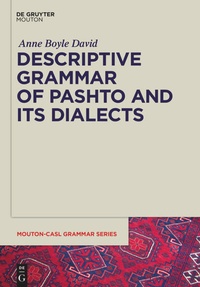
Descriptive Grammar of Pashto and its Dialects
Description

Pashto/Pushto/Pukhto is a group of varieties used by as many as 30 million people in Afghanistan and Pakistan, yet a grammar describing these varieties collectively has not been published. The CASL Pashto grammar originates from extensive use of both primary and secondary materials. It attends to features of both spoken and written forms of Pashto and exemplifies the latter generously with naturally-occurring sentences. Detailed descriptions are provided of the phonology and orthography and of the inflectional and derivational morphology applied to all major word classes, with special attention to the complex morphology of verb formation and descriptions of the multiple pronominal systems. Notes on some of the prominent syntactic constructions are provided as a descriptive basis for learners of Pashto and for those interested in syntactic properties characteristic of South Asian languages. For the first time, the highly distinctive Middle dialects, including Waziri, receive attention next to the other major dialect groups. A formal grammar focusing on the morphology is an available companion work.
More details
Other editions
Additional editions
Content
- Intro
- Foreword
- Series Editors' Preface
- Preface
- About this Grammar
- Scope of this book
- Orthography
- Tables and examples
- Abbreviations and symbols
- The Pashto Language
- Background
- Population of speakers
- History and classification
- Dialectal variation
- Phonology and Orthography
- Phonetics and phonology
- Consonants
- Inventory
- "Elegant" consonants
- Vowels
- Inventory
- Vowel transcription
- "Elegant" vowels
- Middle dialect vowels
- Stress
- Orthography
- The script
- Letters unique to Pashto
- Tables of letters and numerals
- Representation of vowels
- Word-initial vowels
- Word-internal vowels
- Word-final vowels
- Rationale for transcription system
- Orthographic variation
- Pashto Dialects
- Introduction
- Characterizing Pashto dialects
- Dialect marking in this work
- Dialect marking in tables
- Dialect marking in interlinear examples
- The four dialects of General Pashto
- International differences
- The Middle dialects
- Middle dialect vowels
- Middle dialect consonants
- Other approaches
- Two dialects
- Three dialects
- Nouns
- Inflection
- Gender
- Number
- Case
- Direct case
- Oblique case
- Ablative case
- Vocative case
- Split ergativity
- Animacy
- Inflectional affixation
- Introduction
- Stem allomorphy and other morphophonemic alternations
- Class I
- Overview
- Class I masculine nouns
- Masculine animate nouns in General Pashto
- Masculine animate nouns in Waziri
- Masculine inanimate nouns in General Pashto and Waziri
- Class I feminine nouns in General Pashto and Waziri
- General Pashto Class I feminine animate nouns
- General Pashto Class I feminine inanimate nouns
- Waziri Class I feminine nouns
- Class II
- Overview
- General Pashto Class IIa
- General Pashto Class IIb
- Class III
- Overview
- Subclassification of Class III in General Pashto
- Class IIIa
- Masculine Class IIIa nouns
- Feminine Class IIIa nouns
- Class IIIb
- Masculine Class IIIb nouns
- Feminine Class IIIb nouns
- Class III in Waziri
- Irregular nouns and irregular patterns in General Pashto
- Kinship terms
- Arabic borrowings
- Inflection and agreement of conjoined nouns
- Derivational morphology and loanwords
- Derivational morphology of nouns
- Nouns derived with suffixes
- Compounds
- Reduplication of nouns
- Loanwords
- Adjectives and Other Noun Modifiers
- Introduction
- Inflectional classes in General Pashto and Waziri
- Inflectional classes of General Pashto adjectives
- General Pashto Class I
- Case-marking suffixes
- Stem allomorphy
- Class I forms with stem allomorphy
- Class I forms without stem allomorphy
- Animacy in Class I adjectives
- General Pashto Class II
- Case-marking suffixes
- Stem allomorphy
- Class II forms with stem allomorphy
- Class II forms without stem allomorphy
- General Pashto Class III
- Class IIIa
- Class IIIb
- General Pashto Class IV (non-declining adjectives)
- Inflectional classes of Waziri adjectives
- Waziri Class I
- Waziri Class II
- Waziri Class III
- Determiners and definiteness
- Demonstrative determiners
- The indefinite determiner ??? ? /yaw/ 'one'
- Non-numerical noun quantifiers
- The quantifier ????? ? /?ol-/ 'all'
- The quantifier ??? ? /har/, ? /ar/ 'every'
- The quantifier ???? ? /he?/ 'none'
- Number names
- Cardinal numbers in Pashto
- Morphology
- Inventory
- Ordinal numbers in General Pashto and Waziri
- Reduplication of number names
- Interrogative adjectives
- Inflection of conjoined adjectives
- Derivation of adjectives
- Derivational suffixes
- Some Class I derivational suffixes
- Some Class IIIa derivational suffixes
- Some Class IV (non-declining) derivational suffixes
- Negators
- Compound adjectives
- Reduplication of adjectives
- Usage
- Attributive and predicative adjectives
- Zero-derivation of nouns from adjectives
- Comparatives and superlatives
- Adjectives as adverbs
- Pronouns
- Overview
- Strong personal pronouns
- Forms in General Pashto and Middle dialects
- Usage
- Strong possessive pronouns
- Weak personal pronouns
- Forms
- Usage
- Occurrence restrictions
- Possessive constructions
- Deictoids: ??? ? /ra/, ??? ? /d?r/, and ??? ? /w?r/
- Oblique pronominal clitics
- Directional verbal clitics
- Deictic prefixes
- Demonstratives
- Interrogative pronouns
- Indefinite pronouns
- Relative pronouns
- Expressions of coreference
- Reciprocal pronouns
- Other pro-forms
- Verbs
- Overview
- Properties of verbs
- Classifying verbs
- Verb components
- Structure of the verb
- Personal suffixes
- The infinitive
- Simplex and complex verbs
- Overview
- a-initial verbs
- Prefixed verbs
- Denominal verb constructions
- Conjugation classes
- Overview of conjugation classes
- First conjugation class in General Pashto
- First conjugation class in Middle dialects
- Second conjugation
- Third conjugation
- Forming the aorist in third conjugation verbs
- A special case of third conjugation verbs: infinitive/past participle + ????? ? /ked?´l/
- Stem classes and the four bases
- The four verb bases
- Weak verbs (one stem)
- Strong verbs (more than one stem)
- Strong verbs with two stems
- Strong verbs with three or four stems
- List of strong verbs
- The causative morpheme
- The auxiliary to be and the verbalizers ????? ? /ked?´l/ and ???? ? /kaw?´l/
- Forms of to be
- Forms of ????? ? /ked?´l/ 'to become'
- Forms of ???? ? /kaw?´l/ 'to make
- to do?'
- Participles
- Present participle
- Past participle
- Irregularities among past participles
- Simple verb constructions
- Present continuous
- Present aorist
- Past continuous
- Past aorist
- Continuous imperative
- Aorist imperative
- Continuous optative
- Aorist optative
- Compound verb constructions
- Perfect constructions
- Present perfect
- Past perfect
- Potential constructions
- Present potential
- Past potential
- Verb usage
- Uses of the verb to be
- to be as a copula
- to be as an auxiliary verb
- Simple verb constructions
- Present continuous
- Negation of present tense verbs
- Present continuous for expressing future events
- Present aorist
- Expressing the future with present aorist plus ??? ? /b?/
- Other uses of the present aorist
- Past continuous
- Past aorist
- Imperative
- Compound constructions: perfect
- Present perfect
- Past perfect
- Negation of perfect tenses
- Compound constructions: potential
- Expressing potential present events
- Expressing potential past events
- Expressing potential future events
- Negative
- Infinitives
- Infinitives as nouns
- The periphrastic passive
- Present participles
- Adpositions
- Overview
- Adpositions and case assignment
- Assignment of oblique case
- Assignment of ablative case
- Assignment of direct case
- Mixed case-marking inside objects of adpositions
- Prepositions
- The prepositions ? /d?/, /de/, /ye/, /e/ 'of'
- The General Pashto preposition ?? ? /d?/
- Complex adpositions using ?? ? /d?/
- The Middle dialect prepositions ? /de/, ? /ye/, ? /e/
- Middle dialect complex adpositions using ? /ye/
- The General Pashto preposition ??? ? /l?/ 'from'
- The preposition ??? ? /be/ 'without'
- The prepositions ??? ? /p?/, ??? ? /p?r/
- The locational ??? ? /p?/, ??? ? /p?r/ 'on'
- The instrumental ??? ? /p?/ 'with, by means of'
- The temporal ??? ? /p?/, ??? ? /p?r/ 'at, on'
- With aspectual verbs
- The preposition ??? ? /t?r/ ''up to''
- The preposition ???? ? /leka/ 'like'
- Postpositions
- Overview
- The postposition ??? ? /ta/ 'to, for'
- The postposition ???? ? /s?ra/ 'with'
- The postposition ???? ? /zidi/ 'against'
- The postposition ?? ????? ? /w?ande/ 'before'
- The postposition ?????? ? /?unde/ 'like'
- The postposition ?????? ? /bande/
- Some additional postpositions in Middle dialects
- Circumpositions
- Circumpositions with ?? ? /d?/
- General Pashto simple circumpositions with ?? ? /d?/
- Middle dialect simple circumpositions with ? /ye/, ? /e/
- Complex circumpositions with ?? ? /d?/
- General Pashto circumpositions with ??? ? /l?/
- GP simple circumpositions with ??? ? /l?/
- GP complex circumpositions with ???...?? ? /l?...na/
- Circumpositions with ??? ? /p?/
- Circumpositions with ??? ? /t?r/
- A Middle dialect circumposition with ?? ? /w?/
- Coalesced adpositional phrases
- Pro-adpositional phrases
- The adpositional phrase ???? ? /kara/ 'at the home of'
- Adposition usage
- ??? ? /na/ vs. ablative case-marking on object
- ?? ? /d?/ and strong pronoun objects
- ??? ? /p?/ and ???...????? ? /(p?...) bande/ used in a causative construction
- Omission of pronoun objects of adpositions
- Postpositions with oblique pronominal clitics
- Other Lexical Elements
- Particles
- The existential particle ???? ? /sta/
- Modal particles
- The modal clitic ??? ? /b?/
- The modal particles ??? ? /de/ and ????? ? /bayad/
- The modal particle ????? ? /?ayi/ 'may
- must'
- The optative particle ?????? ? /kaske/
- Affirmation particles
- The emphatic clitic ??? ? /xo/
- Vocative particles
- Interjections
- Adverbs
- Adverbs of time
- Adverbs of place
- Adverbs of manner
- The adverb ???? ? /s?ra/
- Adverbs of degree
- Adverbs borrowed from Arabic
- Adverbial interrogatives
- Adjectives as adverbs
- Reduplication of adverbs
- Reduplication
- Full (morphological) reduplication
- Partial reduplication: echo words
- Syntax
- Overview
- Phrasal syntax
- Noun phrases
- Adpositional phrases
- Verb phrases
- Light verb constructions
- Elements in the verbal group
- The verbal group in General Pashto
- The verbal group in Middle dialects
- Negative placement in the aorist verb phrase
- Main clause sentence types
- Declaratives
- Order of elements in declaratives
- Order of elements in ditransitive main clauses
- Locative alternation
- Adpositional phrases with oblique pronominal clitics
- Passive clauses
- Interrogatives
- Yes-or-no questions with the particle ???? ? /aya/
- Information questions with interrogative pronouns
- Affirmation questions with the particle ??? ?? ? /k? na/
- Imperatives
- The imperative verb form
- The negative imperative particle ??? ? /má/
- Generic and existential sentences with ???? ? /sta/
- Other principles of word order in main clauses
- Weak pronouns
- Particles
- Adpositional phrases in main clauses
- Interpretation of adpositional phrases headed by ?? ? /d?/
- Some subordinate clause types
- Relative clauses
- Noun complement clauses
- Verb complement clauses
- Reported speech
- Subordinate clauses as modifiers
- Subordinate clauses with time reference
- Conditional and counterfactual clauses with ??? ? /k?/ 'if'
- Subordinate clauses with ???? ? /??ka/ 'because'
- Subordinate clauses expressing result
- Subordinate clauses expressing reason
- Subordinate clauses expressing purpose
- Subordinate clauses of concession
- Periphrastic causatives
- Conjunction
- Coordinating conjunctions
- ??? ? /aw/ 'and'
- ??? ? /ya/ 'or'
- ??? ? /xo/ 'but'
- ?(??) ??? ? /(aw) bya/ 'then'
- Correlative conjunctions
- Principles of case-marking and agreement
- Tense-based case-marking and split ergativity
- Agreement of conjoined items
- Concordant adverbs
- Case-marking patterns of verbs of sensation or preference
- Four denominal verbs of sensation
- Denominal ??????- ? /xwaxeg-/ 'like, enjoy'
- Three more expressions of preference
- An unergative or middle voice construction
- Structure of this Grammar
- Overview
- Audience
- More on uses of this grammar
- The grammar as a basis for computational tools
- Building a parser and generator
- The grammar as a description
- Spell correction
- Grammar adaptation
- Manual grammar building
- Automated grammar adaptation
- Formatting the grammar for viewing
- Sources of Pashto Data
- Sources of interlinear examples taken from the web
- List of web pages mined for language data
- Bibliography
- Index
