

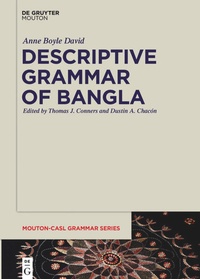
Descriptive Grammar of Bangla
Description

Bangla is spoken as the majority language in Bangladesh and the state of West Bengal in India, and as a minority language in several other Indian states. With almost 200 million native speakers, it ranks among the top ten languages in the world in number of speakers.
Based on both primary and secondary materials, the CASL Bangla grammar provides comprehensive coverage of the phonology, orthography, morphology, and syntax of Bangla. Plentiful examples of naturally-occurring sentences provide native orthography, Romanization, and morpheme-by-morpheme glossing along with free translations. Unlike many Romanizations of Bangla, our system eschews Sanskritic influence and instead reflects actual Bangla phonology. We also offer comparative information of use to linguists, highlighting features of Bangla shared with the South Asian sprachbund, such as light verb constructions, as well as those that differentiate Bangla from its Indo-Aryan relatives; for example, its unique NP structure.
Written in an accessible style from a theory-neutral perspective, this work will be of use to linguistic researchers, language scholars, and students of Bangla. A formal grammar focusing on the morphology is an available companion work.
More details
Other editions
Additional editions
Persons
Content
- Intro
- Contents
- Foreword
- Series Editors' Preface
- Preface
- 1 About this Grammar
- 1.1 Overview
- 1.2 Scope of this book
- 1.3 Tables and examples
- 1.3.1 Order of elements in a gloss
- 1.4 Abbreviations and symbols
- 2 The Bangla Language
- 2.1 Population of speakers
- 2.2 History and classification
- 2.3 Dialectal variation
- 2.4 The Bangla script
- 3 Phonology and Orthography
- 3.1 Introduction
- 3.2 Bangla phonemes
- 3.2.1 Vowels
- 3.2.2 Consonants
- 3.3 Other phonology
- 3.3.1 Phonotactics
- 3.3.1.1 Vowels
- 3.3.1.1.1 Occurrence constraints and height neutralization
- 3.3.1.1.2 Anticipatory assimilation
- 3.3.1.1.3 Progressive assimilation
- 3.3.1.1.4 Sanskritic vowel mutation
- 3.3.1.2 Consonants
- 3.3.1.3 Syllable structure
- 3.3.2 Prosody
- 3.4 Romanized transcription and Bangla orthography
- 3.4.1 Introduction: our transcription system
- 3.4.2 Orthography of Bangla vowels
- 3.4.2.1 Vowel length in the orthography
- 3.4.2.2 Vowel letters and vowel diacritics
- 3.4.2.3 The vowel letter ? and the inherent vowel
- 3.4.2.4 The vowel letter ? and its diacritic
- 3.4.3 Orthography of Bangla consonants
- 3.4.3.1 Nasals
- 3.4.3.2 Sibilants
- 3.4.3.3 Consonant conjuncts
- 3.4.3.4 ????
- 3.4.3.5 ??
- 3.5 Our transcription system
- 4 Bangla as a South Asian Language
- 4.1 Typological convergence
- 4.1.1 Phonology
- 4.1.2 Complex predicates
- 4.1.2.1 Conjunct verbs
- 4.1.2.2 Compound verbs
- 4.1.3 Oblique case-marked subjects
- 4.1.4 Reduplication & onomatopoeia
- 4.1.5 Quotatives
- 4.2 Typological divergence
- 4.2.1 Phonology
- 4.2.2 Ergativity
- 4.2.3 Classifiers
- 5 Nouns
- 5.1 Nominal categories
- 5.2 Nominal inflection
- 5.2.1 Nominal markers
- 5.2.2 Noun paradigms
- 5.2.3 A note on orthography of case markers
- 5.3 Allomorphy in noun inflection
- 5.3.1 Nominative marker allomorphy
- 5.3.1.1 Singular
- 5.3.1.2 Plural
- 5.3.2 Genitive marker allomorphy
- 5.3.2.1 Singular
- 5.3.2.2 Plural
- 5.3.3 Objective marker allomorphy
- 5.3.3.1 Singular
- 5.3.3.2 Plural
- 5.3.4 Locative marker allomorphy
- 5.4 Use of case and number markers
- 5.4.1 Nominative
- 5.4.1.1 Nominative case proper
- 5.4.1.2 Unmarked nouns
- 5.4.2 Objective
- 5.4.3 Genitive
- 5.4.4 Locative
- 5.4.5 Plural number
- 5.5 Noun derivation
- 5.5.1 Deriving nouns from adjectives
- 5.5.2 Deriving nouns from nouns
- 6 Pronouns and Other Pro-forms
- 6.1 Introduction
- 6.2 Pronominal morphology
- 6.2.1 Pronominal stems
- 6.2.2 Pronominal case-marking suffixes
- 6.2.3 Rules of stem allomorphy
- 6.3 Personal pronouns (including demonstratives)
- 6.3.1 First person pronouns
- 6.3.2 Second person pronouns
- 6.3.3 Third person pronouns
- 6.4 Relative and correlative pronouns
- 6.5 Demonstrative pronouns
- 6.6 Reflexive pronouns
- 6.7 Interrogative pronouns
- 6.8 Indefinite pro-forms
- 6.8.1 Indefinite pronouns and pro-forms
- 6.8.2 Quantifying pro-forms
- 6.8.2.1 Declinable quantifying pro-forms
- 6.8.2.2 Indeclinable quantifying pro-forms
- 7 Noun Modifiers
- 7.1 Introduction
- 7.2 Adjectives
- 7.2.1 About adjectives
- 7.2.2 Comparison of adjectives
- 7.2.2.1 Comparatives
- 7.2.2.2 Superlatives
- 7.2.3 Historically derived adjectives
- 7.2.3.1 Adjectives derived from adverbs
- 7.2.3.2 Adjectives derived from nouns
- 7.2.3.3 Adjectives derived from verbs
- 7.3 Noun modification via other parts of speech
- 7.4 Determiners
- 7.4.1 Demonstratives
- 7.4.2 Quantifiers
- 7.4.2.1 Number names
- 7.4.2.1.1 Inventory and representation
- 7.4.2.1.2 Expressions involving number names
- 7.4.2.2 Other quantifiers
- 7.4.2.2.1 Inventory
- 7.4.2.2.2 Interrogative quantifiers
- 7.4.2.2.3 Indefinite Quantifiers
- 7.4.3 Classifiers
- 7.4.3.1 Definition
- 7.4.3.2 Inventory of classifiers
- 7.4.3.2.1 -??/-?a/- ???/-?e/- ??/-?o/
- 7.4.3.2.2 /-?i/
- 7.4.3.2.3 -?? /-j?n/
- 7.4.3.2.4 /-gulo/
- 7.4.3.2.5 /-guli/
- 7.4.3.2.6 -???? /-khana/
- 7.4.3.2.7 -???? /-khani/
- 7.4.3.2.8 /-?uku/-?uk/-?ukun/-?ukuni/
- 7.4.3.3 Functions of classifiers
- 7.4.3.4 Frozen classifiers
- 7.4.3.4.1 ???? /-gacha/, -???? /-gachi/
- 7.4.3.4.2 -???? /-fala/, -???? /-fali/
- 8 Other Word Classes and Processes
- 8.1 Interrogative words
- 8.2 Adverbs
- 8.3 Postpositions and prepositions
- 8.3.1 Postpositions
- 8.3.1.1 Postpositions requiring the genitive case
- 8.3.1.2 Postpositions requiring no particular case
- 8.3.1.3 Postpositions requiring the objective case
- 8.3.1.4 Postpositions with optional genitive case
- 8.3.2 Prepositions
- 8.4 Conjunctions
- 8.4.1 Coordinating conjunctions
- 8.4.2 Subordinating conjunctions
- 8.5 Particles or clitics
- 8.5.1 The particle -? /-i/
- 8.5.2 The particle -? /-o/
- 8.5.3 The particle /to/
- 8.5.4 The particle ?? /ba/
- 8.5.5 The particle /je/
- 8.5.6 The particle ??/ja/
- 8.5.7 The interrogative particle ?? /ki/
- 8.6 Reduplication
- 8.6.1 Reduplication of whole words
- 8.6.1.1 Repetition of verbs
- 8.6.1.2 Repetition of other parts of speech
- 8.6.1.3 Reduplicative expressives
- 8.6.2 Partial reduplication
- 8.6.2.1 Partial reduplication with initial consonant insertion
- 8.6.2.2 Partial reduplication with final vowel change
- 8.7 Lengthened consonants
- 9 Verbs
- 9.1 Inflectional features
- 9.1.1 Verbal categories
- 9.1.2 Personal, tense, and aspect suffixes
- 9.1.3 Verbal stem allomorphy
- 9.2 Verb conjugation classes
- 9.2.1 Class 1: (C)VC-
- V ? /a/
- 9.2.2 Class 2: (C)aC-
- 9.2.3 Class 3: (C)V-
- V ? a
- 9.2.4 Class 4: (C)a-
- 9.2.5 Class 5: (C)?(i)- or (C)a(i)-
- 9.2.6 Class 6: (C)VCa- or (C)Vwa-
- 9.2.7 Class 7: (C)VCCa- or (C)VVCa- ("three-letter" verbs)
- 9.3 Verb paradigms
- 9.3.1 Simple present
- 9.3.1.1 Morphology of the simple present
- 9.3.1.2 Uses of the simple present
- 9.3.2 Present imperative
- 9.3.2.1 Morphology of the present imperative
- 9.3.2.2 Uses of the present imperative
- 9.3.3 Present imperfect
- 9.3.3.1 Morphology of the present imperfect
- 9.3.3.2 Uses of the present imperfect
- 9.3.4 Present perfect
- 9.3.4.1 Morphology of the present perfect
- 9.3.4.2 Uses of the present perfect
- 9.3.5 Simple future
- 9.3.5.1 Morphology of the simple future
- 9.3.5.2 Uses of the simple future
- 9.3.6 Future imperative
- 9.3.6.1 Morphology of the future imperative
- 9.3.6.2 Uses of the future imperative
- 9.3.7 Simple past
- 9.3.7.1 Morphology of the simple past
- 9.3.7.2 Uses of the simple past
- 9.3.8 Conditional/past habitual
- 9.3.8.1 Morphology of the conditional/past habitual
- 9.3.8.2 Uses of the conditional/past habitual
- 9.3.9 Past imperfect
- 9.3.9.1 Morphology of the past imperfect
- 9.3.9.2 Uses of the past imperfect
- 9.3.10 Past perfect
- 9.3.10.1 Morphology of the past perfect
- 9.3.10.2 Uses of the past perfect
- 9.4 Irregular verbs
- 9.4.1 ??- /ach-/ 'to be present, exist'
- 9.4.2 /dewa/ 'to give'
- 9.4.3 /newa/ 'to take'
- 9.4.4 ?- /n?-/ 'not to be, not to exist'
- 9.4.5 ?????/jawa/ 'to go'
- 9.4.6 ??? /asa/ 'to come'
- 9.5 Non-finite forms
- 9.5.1 Perfect participle
- 9.5.1.1 Morphology of perfect participles
- 9.5.1.2 Uses
- 9.5.2 Imperfect participle
- 9.5.2.1 Morphology of imperfect participles
- 9.5.2.2 Uses
- 9.5.3 Conditional participle
- 9.5.3.1 Morphology of the conditional participle
- 9.5.3.2 Uses
- 9.5.4 Verbal noun
- 9.5.4.1 Morphology of verbal nouns
- 9.5.4.1.1 Common form
- 9.5.4.1.2 Alternate form
- 9.5.4.2 Uses
- 9.6 Causatives
- 9.6.1 Morphology of causatives
- 9.6.2 Causatives of pseudo-causative verbs
- 9.6.3 Triple causatives
- 9.7 Negation
- 9.7.1 ?? /na/
- 9.7.1.1 As a negator of verbs
- 9.7.1.2 Other uses of ?? /na/:
- 9.7.2 /nei/ 'is not'
- 9.7.3 ?- /n?-/ 'not to be, not to exist' (the negative copula)
- 9.7.4 ?? /ni/ (the perfect negative)
- 9.7.5 ???? /nara/
- 10 Syntax
- 10.1 Word order and clause structure
- 10.1.1 Scrambling
- 10.1.2 The two be verbs
- 10.1.2.1 ??- /ach-/ 'be'
- 10.1.3 Questions
- 10.1.3.1 Question marker
- 10.1.3.2 Wh-phrases
- 10.1.3.2.1 Wh-phrase structure
- 10.2 Noun phrase structure
- 10.2.1 Word order
- 10.2.1.1 Adjective placement
- 10.2.2 Headless noun phrases
- 10.2.3 Definiteness marking
- 10.2.4 Quantifiers and classifiers
- 10.2.4.1 Bare nouns
- 10.2.4.1.1 Nouns with and without classifiers
- 10.2.4.1.2 Floating quantifiers
- 10.2.4.2 "The whole"
- 10.2.4.3 Indefinite number
- 10.2.5 Associative plurals
- 10.3 Verbal phrase structure
- 10.3.1 Valency
- 10.3.1.1 Passives
- 10.3.1.2 Causatives
- 10.3.2 Light verb constructions
- 10.3.2.1 Subjects and light verbs
- 10.3.2.2 Scrambling
- 10.3.2.3 Light verb inventory
- 10.3.3 Conjunct verbs
- 10.3.3.1 Uses of conjunct verbs
- 10.3.3.2 Selection
- 10.3.4 Imperfect participles
- 10.3.4.1 Other uses of the imperfect participle
- 10.4 Postpositions
- 10.5 Subordinate clauses
- 10.5.1 Perfect participles as subordinators
- 10.5.2 Conditionals
- 10.5.3 Relative and correlative clauses
- 10.5.3.1 Modifying nouns
- 10.5.4 Complement clauses
- 10.5.5 Other subordinate clauses
- 10.6 Non-canonical case-marking
- 10.6.1 Oblique subjects vs. nominative subjects
- 10.6.2 ????/laga/ 'to strike'
- 10.6.3 Oblique and nominative pairs
- 10.6.4 Expressing possession with an oblique subject
- 10.6.5 Deontic modals
- 10.6.6 Objective case
- 10.7 Negation
- References Cited
- A The Digital Grammar
- A.1 Overview
- A.2 Audience
- A.3 More on uses of this grammar
- A.3.1 The grammar as a basis for computational tools
- A.3.1.1 Building a parser and generator
- A.3.2 The grammar as a description
- A.4 Spell correction
- A.5 Grammar adaptation
- A.5.1 Manual grammar building
- A.5.2 Automated grammar adaptation
- A.6 Formatting the grammar for viewing
- B Unicode Representation
- B.1 Diacritics
- B.2 Normalization
- Index
