

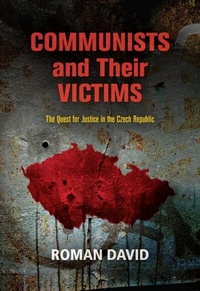
Communists and Their Victims
The Quest for Justice in the Czech Republic
1st Edition
Published on 14. March 2018
280 pages
978-0-8122-9498-9 (ISBN)
Description

In Communists and Their Victims, Roman David identifies and examines four classes of justice measures-retributive, reparatory, revelatory, and reconciliatory-to discover which, if any, rectified the legacy of human rights abuses committed during the communist era in the Czech Republic. Conducting interviews, focus groups, and nationwide surveys between 1999 and 2015, David looks at the impact of financial compensation and truth-sharing on victims' healing and examines the role of retribution in the behavior and attitudes of communists and their families. Emphasizing the narratives of former political prisoners, secret collaborators, and former Communist Party members, David tests the potential of justice measures to contribute to a shared sense of justice and their ability to overcome the class structure and ideological divides of a formerly communist regime.
Complementing his original research with analysis of legal judgments, governmental reports, and historical records, David finds that some justice measures were effective in overcoming material and ideological divides while others obstructed victims' healing and inhibited the transformation of communists. Identifying "justice without reconciliation" as the primary factor hampering the process of overcoming the past in the Czech Republic, Communists and Their Victims promotes a transformative theory of justice that demonstrates that justice measures, in order to be successful, require a degree of reconciliation.
Complementing his original research with analysis of legal judgments, governmental reports, and historical records, David finds that some justice measures were effective in overcoming material and ideological divides while others obstructed victims' healing and inhibited the transformation of communists. Identifying "justice without reconciliation" as the primary factor hampering the process of overcoming the past in the Czech Republic, Communists and Their Victims promotes a transformative theory of justice that demonstrates that justice measures, in order to be successful, require a degree of reconciliation.
Reviews / Votes
"David's findings should be required reading for everyone interested in postconflict and postrepression justice, and his methodology supplies a template that could and should be replicated elsewhere." (Times Literary Supplement) "Roman David has written a perceptive and wise book on transitional justice in Eastern Europe that transcends his focus, the postcommunist Czech Republic, in time and place . . . [A] refreshing contrast to perspectives dominating transitional justice research and analyses and a myth-shattering contribution to this field . . . It is exemplary for its nuanced perspective and detail, and this is exactly the quality that makes it myth shattering." (American Journal of Sociology) "Utilizing an effective and critical combination of quantitative and qualitative methods, Roman David presents the first comprehensive case study of a postconflict or postrepression country that goes beyond description and platitudes." (Harvey M. Weinstein, University of California, Berkeley) "Roman David interviewed communists and political prisoners-two groups whose experiences are vital to understanding both the communist regime and the democratic responses to it. Communists and Their Victims is a valuable and important contribution." (Nadya Nedelsky, Macalester College)More details
Series
Language
English
Place of publication
Pennsylvania
United States
Target group
College/higher education
Illustrations
26 illus.
ISBN-13
978-0-8122-9498-9 (9780812294989)
Copyright in bibliographic data and cover images is held by Nielsen Book Services Limited or by the publishers or by their respective licensors: all rights reserved.
Schweitzer Classification
Other editions
Additional editions
Book
05/2018
University of Pennsylvania Press
€79.00
Shipment within 10-20 days
Person
Roman David is Professor of Sociology and Social Policy at Lingnan University in Hong Kong. He is author of Lustration and Transitional Justice: Personnel Systems in the Czech Republic, Hungary, and Poland, also available from the University of Pennsylvania Press.
Content
Preface
List of Acronyms
Introduction
PART I. HISTORICAL AND SOCIOLEGAL CONTEXT
Chapter 1. The Communist Regime in Czechoslovakia: Were People Coerced?
Chapter 2. Justice After Transition: Retributive, Revelatory, Reparatory, and Reconciliatory Measures
PART II. JUSTICE AT THE POLES OF SOCIETY
Chapter 3. Did Justice Measures Heal Victims? Compensation, Truth, and Reconciliation in the Lives of Political Prisoners
Chapter 4. Did Justice Measures Transform Communists? Personal and Intergenerational Transformation
PART III. JUSTICE IN A POLARIZED SOCIETY
Chapter 5. Could Justice Measures Transform the Divided Society? Experimental Evidence About Justice and Reconciliation
Chapter 6. Did Justice Measures Transform the Divided Society? Class and Ideological Divides
Conclusion: From Observations to the Transformative Theory of Justice
Notes
Bibliography
Index
Acknowledgments
List of Acronyms
Introduction
PART I. HISTORICAL AND SOCIOLEGAL CONTEXT
Chapter 1. The Communist Regime in Czechoslovakia: Were People Coerced?
Chapter 2. Justice After Transition: Retributive, Revelatory, Reparatory, and Reconciliatory Measures
PART II. JUSTICE AT THE POLES OF SOCIETY
Chapter 3. Did Justice Measures Heal Victims? Compensation, Truth, and Reconciliation in the Lives of Political Prisoners
Chapter 4. Did Justice Measures Transform Communists? Personal and Intergenerational Transformation
PART III. JUSTICE IN A POLARIZED SOCIETY
Chapter 5. Could Justice Measures Transform the Divided Society? Experimental Evidence About Justice and Reconciliation
Chapter 6. Did Justice Measures Transform the Divided Society? Class and Ideological Divides
Conclusion: From Observations to the Transformative Theory of Justice
Notes
Bibliography
Index
Acknowledgments
