

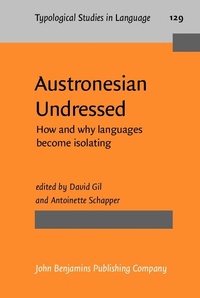
Austronesian Undressed
How and why languages become isolating
1st Edition
Published on 21. October 2020
520 pages
978-90-272-6053-6 (ISBN)
Description

Many Austronesian languages exhibit isolating word structure. This volume offers a series of investigations into these languages, which are found in an "e;isolating crescent"e; extending from Mainland Southeast Asia through the Indonesian archipelago and into western New Guinea. Some of the languages examined in this volume include Cham, Minangkabau, colloquial Malay/Indonesian and Javanese, Lio, Alorese, and Tetun Dili. The main purpose of this volume is to address the general question of how and why languages become isolating, by examination of a number of competing hypotheses. While some view morphological loss as a natural process, others argue that the development of isolating word structure is typically driven by language contact through various mechanisms such as creolization, metatypy, and Sprachbund effects. This volume should be of interest not only to Austronesianists and historians of Insular Southeast Asia, but also to grammarians, typologists, historical linguists, creolists, and specialists in language contact.
More details
Other editions
Additional editions
Book
10/2020
John Benjamins Publishing Co
€130.94
Shipment within 10-15 days
Content
- Intro
- Austronesian Undressed
- Editorial page
- Title page
- Copyright page
- Dedication page
- Table of contents
- Preface
- Introduction
- References
- Chapter 1. What does it mean to be an isolating language?: The case of Riau Indonesian
- 1. Introduction: The challenge of orthography
- 2. The notions of wordhood and Isolating Language
- 2.1 Morphology vs. syntax
- 2.2 The wordhood debate
- 2.3 Isolating languages
- 3. A case study: Riau Indonesian
- 3.1 Riau Indonesian
- 3.2 Wordhood in Riau Indonesian
- 3.3 Sources of evidence
- 3.4 Rounding up the evidence
- 4. Riau Indonesian in typological perspective
- Acknowledgements
- References
- Chapter 2. The loss of affixation in Cham: Contact, internal drift and the limits of linguistic history
- 1. The loss of affixation in Cham languages: Overview and previous proposals
- 2. Affixation in Cham inscriptions and manuscripts
- 2. Affixation in Cham inscriptions and manuscripts
- 3. Contact, learnability and the initial reduction of affixation
- 4. Iambicity, monosyllabisation and the loss of affixation
- 5. The loss of affixation: Contact versus internal restructuring
- 6. Conclusion: Revisiting contact and learnability
- Acknowledgements
- References
- Chapter 3. Dual heritage: The story of Riau Indonesian and its relatives
- 1. Introduction
- 2. Previous accounts
- 2.1 Pidgin Malay derived
- 2.2 Creole
- 2.3 Non-hybrid conventionalised second language
- 2.4 Ethnicity, register and geography
- 3. The sociohistorical landscape
- 3.1 Heartland varieties
- 3.2 Transplanted varieties
- 4. The linguistic landscape
- 4.1 Riau Indonesian and other Malay/Indonesian Koinés
- 4.2 Malay/Indonesian Koinés and other varieties of Malay/Indonesian
- 4.3 Malay/Indonesian and other Malayic varieties
- 4.4 Malayic varieties and other languages of Western Nusantara
- 4.5 Languages of Western Nusantara and other Mekong-Mamberamo languages
- 4.6 Languages of Western Nusantara and other Austronesian languages
- 5. The story of Riau Indonesian and its relatives
- 5.1 Act 1: Two separate heritages
- 5.2 Act 2: The coming together
- 5.3 Act 3: A new hybrid identity
- 6. Conclusion
- Acknowledgements
- References
- Chapter 5. Javanese undressed: 'Peripheral' dialects in typological perspective
- 1. Introduction
- 1.1 Javanese variation
- 1.2 Javanese dialects in typological perspective in the MSEA Sprachbund
- 2. Fieldwork, data collection, method
- 3. Selected features in MSEA and Javanese dialects
- 3.1 Central Javanese
- 3.2 Banten
- 3.3 Banyumasan
- 3.4 Pesisir Lor
- 3.5 Tengger
- 3.6 Osing
- 4. Discussion
- 4.1 Central vs. peripheral varieties of Javanese
- 4.2 Javanese in typological perspective
- 4.3 Javanese in diachronic perspective
- 5. Conclusion
- Acknowledgements
- References
- Chapter 6. Are the Central Flores languages really typologically unusual?
- 1. Introduction
- 2. Theoretical background
- 2.1 The Mekong-Mamberamo language area
- 2.2 McWhorter's view of isolating languages
- 2.3 McWhorter's definition of linguistic complexity
- 2.4 McWhorter's proposed historical scenario
- 3. Introduction to the languages of Flores
- 3.1 Languages of West Flores: Manggarai
- 3.2 Languages of East Flores: Sika, Lamaholot
- 3.3 Languages of Central Flores: Lio, Ende, Nage, Keo, Ngadha, Rongga
- 4. Central Flores languages have typical Mekong-Mamberamo typology
- 4.1 The passing gesture
- 4.2 Repeated dental clicks expressing amazement
- 4.3 Conventionalised greeting with "where?"
- 4.4 'eye day' to 'sun' lexicalisation
- 4.5 d/t place of articulation asymmetry
- 4.6 Numeral classifiers
- 4.7 Verby adjectives
- 4.8 Basic SVO constituent order
- 4.9 Iamitive perfects
- 4.10 'Give' causatives
- 4.11 Low differentiation of adnominal attributive constructions
- 4.12 Weakly developed grammatical voice
- 4.13 Isolating word structure
- 4.14 Short words
- 4.15 Low grammatical-morpheme density
- 4.16 Optional thematic-role flagging
- 4.17 Optional TAM marking
- 4.18 Summary: Mekong-Mamberamo features in Central Flores languages
- 5. Additional evidence from the Central Flores numeral system
- 6. Historical proposal for Central Flores languages
- 7. Conclusion
- Acknowledgements
- References
- Chapter 7. From Lamaholot to Alorese: Morphological loss in adult language contact
- 1. Introduction
- 2. The morphological profile of pre-Alorese
- 2.1 Lewoingu-Lamaholot and Alorese inflectional morphology
- 2.2 Lewoingu-Lamaholot and Alorese derivational morphology
- 2.3 Summary: The morphology of pre-Alorese
- 3. When, why, and how pre-Alorese became isolating
- 3.1 Dating the migration of pre-Alorese to Pantar Island
- 3.2 Alorese as a language of trade and interethnic communication
- 3.3 Alorese was acquired by adult speakers
- 4. Conclusions
- Acknowledgements
- Funding
- References
- Chapter 8. Double agent, double cross?: Or how a suffix changes nature in an isolating language: dór in Tetun Dili
- 1. Introduction
- 2. Historical background
- 3. Portuguese nominal loans with dór
- 4. Door with single Tetun roots
- 5. Three-unit sequences
- 6. Use and creativity
- 7. Alternative strategies for agentive terms
- 8. Word class
- 9. Word status
- Phonology
- Spelling
- A lexeme door?
- 10. Borrowability of door
- 11. The double life of Portuguese dor in Tetun
- 12. Conclusion
- References
- Chapter 9. The origins of isolating word structure in eastern Timor
- 1. Introduction
- 2. McWhorter's complexity
- 3. McWhorter's explanation of isolating word structure in Timor languages
- 4. Austronesian languages in Timor
- 4.1 Verbal agreement prefixes
- 4.2 Derivational prefixes and associated complexification
- 4.3 Possessive morphology and possessive classes
- 4.4 Synchronic metathesis
- 4.5 Numeral agreement
- 5. Papuan languages of Timor
- 5.1 Person agreement prefixes
- 5.2 Animacy and agreement
- 5.3 Locative and applicative prefixes
- 5.4 Initial verb root mutations
- 5.5 Derivational suffixal morphology
- 5.6 Morphological and suppletive number marking
- 6. The comparative picture of complexity in the languages of Timor and surrounds
- 7. Discussion
- Acknowledgements
- References
- Chapter 10. Becoming Austronesian: Mechanisms of language dispersal across Southern Island Southeast Asia and the collapse of Austronesian morphosyntax
- 1. Introduction: The spread of Austronesian languages across Island Southeast Asia
- 2. The unnaturalness of isolation
- 3. Southern Southeast Asia
- 4. Accounting for language distributions
- 5. Conclusions
- Acknowledgements
- Funding
- References
- Chapter 11. Concluding reflections
- 1. Introduction
- 1.1 Purpose
- 1.2 Isolating languages as unnatural
- 1.3 Grounds for my hypothesis
- 2. Riau Indonesian
- 2.1 Proto-Malayic and Proto-Malayo-Polynesian affixation is fatal to the Mekong-Mamberamo scenario
- 2.2 Why is Malayic so modestly inflected overall?
- 2.3 If Riau Indonesian is a Sprachbund language, why is it so unmixed?
- 2.4 Are there actually dialects of other Indonesian languages as structurally reduced as Riau Indonesian?
- 2.5 A note on the Jambi varieties
- 2.6 An alternative story
- 3. Flores
- 3.1 The Mekong-Mamberamo scenario leaves more questions than answers
- 3.2 Why are West and East Flores languages more inflected?
- 3.3 Mekong-Mamberamo traits and transferred numerals are compatible with adult acquisition
- 3.4 Central Flores languages are not pidginised Sulawesi ones
- 4. East Timor
- 4.1 Fossilised derivation
- 4.2 The inflection question
- 4.3 Signs of adult acquisition in Waima'a, Naueti, Tokodede, and Kemak
- 4.4 Papuan languages
- 4.5 Different paths to the same mountaintop?
- 5. A note on Chamic
- 6. Conclusion
- References
- Index
