

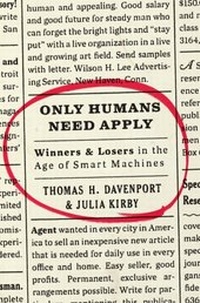
Only Humans Need Apply
Description

An invigorating, thought-provoking, and positive look at the rise of automation that explores how professionals across industries can find sustainable careers in the near future.
Nearly half of all working Americans could risk losing their jobs because of technology. It's not only blue-collar jobs at stake. Millions of educated knowledge workers-writers, paralegals, assistants, medical technicians-are threatened by accelerating advances in artificial intelligence.
The industrial revolution shifted workers from farms to factories. In the first era of automation, machines relieved humans of manually exhausting work. Today, Era Two of automation continues to wash across the entire services-based economy that has replaced jobs in agriculture and manufacturing. Era Three, and the rise of AI, is dawning. Smart computers are demonstrating they are capable of making better decisions than humans. Brilliant technologies can now decide, learn, predict, and even comprehend much faster and more accurately than the human brain, and their progress is accelerating. Where will this leave lawyers, nurses, teachers, and editors?
In Only Humans Need Apply, Thomas Hayes Davenport and Julia Kirby reframe the conversation about automation, arguing that the future of increased productivity and business success isn't either human or machine. It's both. The key is augmentation, utilizing technology to help humans work better, smarter, and faster. Instead of viewing these machines as competitive interlopers, we can see them as partners and collaborators in creative problem solving as we move into the next era. The choice is ours.
This landmark book provides a roadmap for thriving in the age of smart machines, showing professionals and business leaders how to:
- An Optimistic Automation Strategy: Move beyond the fear of job loss. Learn why augmentation-not replacement-is the key to success and how to reframe smart machines as partners, not competitors.
- The Future for Knowledge Workers: Understand the three eras of automation and see why this new wave of AI is different, threatening educated professionals from paralegals to medical technicians.
- Augmentation in Practice: Discover how humans and computers can combine their strengths to achieve outcomes neither could accomplish alone, leading to greater productivity and more fulfilling work.
- Five Actionable Steps: Choose your path forward. Explore five clear strategies-Stepping Up, Stepping Aside, Stepping In, Stepping Narrowly, and Stepping Forward-to build a sustainable and valuable career alongside AI.
All prices
More details
Other editions
Additional editions
Persons
Thomas H. Davenport is the President's Distinguished Professor in Management and Information Technology at Babson College, the cofounder of the International Institute for Analytics, a fellow of the MIT Initiative on the Digital Economy, and a senior advisor to Deloitte Analytics. He teaches analytics and big data in executive programs at Babson, Harvard Business School, MIT Sloan School, and Boston University, and is the author or coauthor of seventeen books.
Content
- Intro
- Dedication
- Contents
- Introduction
- 1. Are Computers Coming After Your Job?
- 2. Just How Smart Are Smart Machines?
- 3. Don't Automate, Augment
- 4. Stepping Up
- 5. Stepping Aside
- 6. Stepping In
- 7. Stepping Narrowly
- 8. Stepping Forward
- 9. How You'll Manage Augmentation
- 10. Utopia or Dystopia? How Society Must Adapt to Smart Machines
- Acknowledgments
- Notes
- Index
- About the Authors
- Also by Thomas H. Davenport and Julia Kirby
- Copyright
- About the Publisher
