

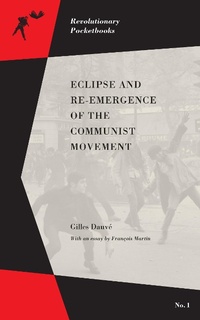
Eclipse and Re-Emergence of the Communist Movement
Description

In the years following 1968, a number of people involved in the most radical aspects of the French general strike felt the need to reflect on their experiences and to relate them to past revolutionary endeavors. This meant studying previous attempts and theories, namely those of the post-1917 German-Dutch and Italian Communist Left. The original essays included here were first written between 1969 and 1972 and circulated amongst left communist and worker circles.
But France was not the only country where radicals sought to contextualize their political environment and analyze their own radical pasts. Over the years these three essays have been published separately in various languages and printed as books in both the United States and the UK with few changes. This third English edition is updated to take into account the contemporary political situation; half of the present volume is new material.
The book argues that doing away with wage-labor, class, the State, and private property is necessary, possible, and can only be achieved by a historical break, one that would certainly differ from October 1917… yet it would not be a peaceful, gradual, piecemeal evolution either. Like their historical predecessors-Marx, Rosa Luxemburg, Anton Pannekoek, Amadeo Bordiga, Durruti, and Debord-the authors maintain a belief in revolution.
More details
Other editions
Additional editions
Persons
Born in 1947 Gilles Dauvé has worked as a translator and a schoolteacher. He is the author of essays and books on the Russian, German, and Spanish revolutions, and on democracy, fascism, war, morals, crisis, and class. In English, his texts What Is Situationism? and Fascism/Anti-Fascism (both written under the pseudonym Jean Barrot) have led a legendary existence in the samizdat pamphlet underground.
Content
- Front Cover
- Title Page
- Half Title
- Copyright
- Contents
- Preface to the Japanese Edition of No. 1 and No. 2 of Le Mouvement Communiste
- Foreword to the 1974 Black & Red Edition
- Foreworld: Out of the Future (1997)
- 1. The Untraceable
- 2. Wall Street v. Berlin Wall
- 3. 1968 and All That
- 4. Working Man's Blues
- 5. High Hopes...
- Chapter 1: Capitalism and Communism
- 1. Wage-Labour as a Social Relation
- 2. "Value" as a Destroyer ... and Promoter of Community
- 3. Commodity
- 4. Capital
- 5. A World of Companies
- 6. Bureaucratic (or "State") Capitalism
- 7. Crisis
- 8. Proletariat and Revolution
- 9. Communism as the End of Economy and Work
- 10. Communisation
- 11. States and How to Get Rid of Them
- 12. Democracy?
- 13. Break on through (to the Other Side)
- Chapter 2: The Class Struggle and Its Most Characteristic Aspects in Recent Years
- 1. May 1968, France
- 2. Strikes and Workers' Struggles Since 1968
- 3. The Two Most Characteristic Aspects of the Strikes
- 4. Forms of Action Which Cannot Be Recuperated: Sabotage and "Down-timing"
- 5. Parties and Unions in the Face of the Communist Perspective
- Chapter 3: A Crash Course in Ultra-Leftology
- 1. Out of the Past
- 2. Beyond Words and Beyond Belief
- 3. The German-Dutch Left
- 4. Bordiga
- 5. The Salient Point
- Chapter 4: Leninism and the Ultra-Left
- 1. Party or Council?
- 2. Managing What?
- 3. The Historical Limit of the Ultra-Left
- Chapter 5: Value, Time, and Communism: Re-reading Marx
- 1. The Origin of Value
- 2. Work Abolished, or Work as Our Prime Want?
- 3. Time as Measure
- 4. Community Planning
- 5. Council Communism and Labour Time
- 6. Bordiga's Critique
- 7. Does Value Abolish Itself?
- 8. Marx as a Marxist
- Chapter 6: The Bitter Victory of Councilism
- Chapter 7: Postlude
- 1. Revolutionary Optimism and Historical Determinism
- 2. What Heritage Do We Renounce?
- 3. "Class": What Class?
- 4. Surge
- 5. The Proletariat as a Contradiction
- Notes
- About the Authors
