

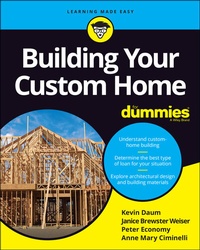
Building Your Custom Home For Dummies
Description

If you find yourself dreaming of the perfect patio, the ideal kitchen, and inviting rooms where you love to spend time, it might just be time to start building! With Building Your Custom Home For Dummies, you won't have to feel intimidated as you plan, finance, and oversee construction on your new oasis. You'll learn what it takes to build a custom home, including which pros to call and when. This updated edition also covers the latest in real estate and home construction trends, including smart homes, green building, and banking options.
It's more important than ever to live in a home that's truly how you want it, truly your own. Now is the perfect time to get started--if you're still in the dreaming stage, this book will help you identify your style and articulate your vision. If you're further along in the process, you'll benefit from checklists and pointers on reviewing architects' plans, evaluating contractor bids, flipping the home you build, and more.
* The latest guidance on building a beautiful home on any budget
* New ideas for high-tech homes with low carbon footprints
* Step-by-step instructions for securing financing, hiring architects, and finding reliable contractors
* Advice on how to invest your home-building budget wisely and plan for the future
Building Your Custom Home For Dummies takes you from finding the perfect homesite through laying the foundation to framing and finishing--in the friendly Dummies style you can trust.
More details
Other editions
Additional editions
Persons
Janice Brewster Weiser has written extensively on custom homes and is a former editor of Log Home Living magazine.
Peter Economy is a Wall Street Journal best-selling business author and ghostwriter of more than 100 books.
Anne Mary Ciminelli is an author, editor, and ghostwriter.
Content
Part 1: Getting Started with Custom-Home Building 5
Chapter 1: The Custom-Home Process in a Nutshell 7
Chapter 2: Preparing for the Process 21
Chapter 3: The Land Grab: Selecting the Perfect Site 39
Chapter 4: Defining Your House Style 61
Part 2: Assembling Your Team 81
Chapter 5: Architects and Design: Time Spent Is Money Saved 83
Chapter 6: Engineers and City Folk: Approval Bureaucracy Made Somewhat Easy 109
Chapter 7: All the King's Men: The Contractor and Their Cohorts 125
Part 3: All You Need Is Dough: Financing Your Custom Home 141
Chapter 8: Cash Is King: Borrowing to Your Advantage 143
Chapter 9: Knowledge Is Power: What You Don't Know about Construction Loans Can Hurt You 157
Chapter 10: Qualifying: It's the Bank's Way or the Highway 179
Chapter 11: Show Me the Money: Flowing Cash through the Project 203
Part 4: Hammers and Nails: Overseeing the Construction Process 219
Chapter 12: Excavation and Foundation: Getting a Solid Start 221
Chapter 13: Framing and Rough: So Much Goes behind Those Walls! 237
Chapter 14: Heading for the Finish: The Devil's in the Details 261
Part 5: All the After Stuff 287
Chapter 15: Making a House a Home: Moving In, Furnishing, and Using Smart Tech 289
Chapter 16: Taking It Outside: The Art of Landscaping and Hardscaping 297
Chapter 17: Making Your Nest Egg Financially Sound 313
Part 6: The Part of Tens 321
Chapter 18: Ten Common Custom-Home Mistakes and How to Avoid 'Em 323
Chapter 19: Ten Great Ways to Lower Construction Costs 329
Chapter 20: Ten Common Stuck-in-the-Middle Problems and Their Fixes 337
Chapter 21: Ten Ways to Build Sustainably 345
Chapter 22: Ten Helpful Custom-Home Resources 353
Index 359
Chapter 1
The Custom-Home Process in a Nutshell
IN THIS CHAPTER
Getting ready for the custom-home process
Considering the finances
Understanding all the steps and time involved
Deciding whether to be your own contractor
Many people, at some time in their lives, want to own a custom home. Some people are attracted to the thought of designing and creating something big from scratch. Others want to live in a new home that meets their specific needs instead of a house that looks like every other home on the block. Some people begin the custom-home process by accident when they find a piece of land that inspires them.
According to the National Association of Home Builders, more than 20 percent of new homes in the United States are custom homes. That means more than 175,000 custom homes are built every year. For each person building a custom home, several people are in the process of designing one. So, you're in excellent company with many people dreaming about moving into a home designed and built just for them. Custom homes are popular, so tons of resources are available to help you through the process.
But, like Rome, your new home won't be built in a day. The custom-home process is lengthy, emotional, and expensive, without much consistency to it. Face it: Custom homes require custom work, and plenty of it! This work makes building a custom home challenging, and yet that extra work is what makes your project unique to you. You may feel overwhelmed at times, but by trusting in the experience of the professionals you engage in your project and keeping this invaluable book by your side, you can have a manageable project that delivers the custom home you've been dreaming of.
Where Do You Start? Preparing to Build Your Home
Believe it or not, the custom-home process really has no standard starting place. There are some logical entry points, such as finding land, but most often people start with a designed house they've had in mind for a long time. Where you start isn't important; what is important is for you to make sure that you've taken all the necessary steps to give yourself the best chance for success. The following list includes some questions you need to consider before committing time and money to this project:
- Where do I want to live?
- How long do I want to live in this house?
- How will I find land? (See Chapter 3.)
- How much money do I have to spend on this project? (See Chapters 8, 9, and 10.)
- How much extra time do I have to put into this project? (See Chapter 2.)
- How do I find the right resources to design my house? (See Chapter 4.)
- How do I find the right resources to build my house? (See Chapters 2 and 7.)
- Is my relationship strong enough to survive this process? (See your therapist.)
Don't make the assumption that any one person can give you all the information you need to prepare for this process. Contractors have one perspective on the process, and architects may have a completely different one. Do your homework and interview as many people as you can who have been involved in the process. By talking to professionals and consumers and asking them to share their experiences, you can begin to get a clearer picture of the process ahead.
Kevin recommends to all his clients that they get organized before beginning the process. Sit down and assess how much time you can put aside each week to focus on the project. Consider making a specific day each week your day for working on custom-home stuff. Also, clear a space in your office or den to be "Custom-Home Central." This way you always know where to find what you need for your project. (You can find other organizing tips for your project in Chapter 2.)
Money Makes the World Go Round: Paying for Your Home
We talk a lot about money in this book, and with good reason. Custom homes require plenty of it. Your new home will probably be the most expensive item you've ever purchased. In fact, it may be the most expensive item you'll ever buy in your entire life. Custom homes cost more than production or tract homes because the materials aren't bought in quantities and the labor hired includes individual craftspeople. The results are worth it, however, and will last lifetimes.
Many people find it a challenge to get past the large checks they're writing. If you decide to use an architect, even the first check to the architect will probably exceed the biggest check you've ever written. The key to success with money in a custom-home project is putting it in the right perspective. If your budget is $500,000, then what each piece costs isn't important as long as all the pieces combined total $500,000 or less.
When you buy a new car, you don't argue over how much you spent for the alternator or the exhaust system. You look for the car to meet the price of your overall budget. Use the same logic when buying your custom home. Look for the best price on each item, but look at it in perspective to the entire budget. You'll do better on some items and worse on others, but as long as it fits your finances, you're in good shape.
Asking yourself about affordability
Of course, you've heard horror stories about custom-home projects that have gone seriously over budget. They go over budget for many reasons, but usually the main culprit is that the homeowners didn't spend enough time determining what they can afford. Obviously, if you're building well below your means, going over budget is easily rectified by using your own cash. But running out of money is the number-one cause of custom-home disasters. Before you start the custom-home process, you seriously need to consider the following:
- What can you physically pay? Take stock of your cash on hand, equity in real estate, and available cash from other resources. Make a firm decision on how much money you're willing to put toward the project. Chapter 8 can be a big help. You also need to get a rough idea of how much borrowing power you have to help establish a limit for your budget when added to your available cash. Make sure you consult with a financial adviser. We provide tools and Kevin's expert financing assessments in Chapters 9 and 10.
- What can you emotionally pay? Just because you have the money and the borrowing power doesn't mean you really want to spend it all. Think carefully and discuss with your spouse what your limits are for making payments and how much liquidity (cash) you need in the bank to help you sleep at night when all is said and done. Make sure you take into account tax deductions and interest earned on investments when analyzing your monthly cash flow. After you've found your emotional limit, you can design your project to fit your comfort zone.
- What's your cushion and tolerance for risk? As we say again and again throughout this book, building a custom home is a complex process. You need to consider many variables beyond your control and then realize that the project can go over budget even if you do everything right. You can certainly get good solid estimates, but ultimately you won't know what this home will cost until it's finished and you total up the receipts. Make sure you've addressed the "what if?" issues thoroughly. Talk about how you'll cover things financially if the market turns sour - devaluing your property - or the cost of materials rise. Decide what safety money (such as your retirement fund) you're willing or unwilling to tap into.
The more you talk about financial issues related to your custom-home project, the more likely you are to resolve problems before they happen. Optimism in a custom-home project can get you into trouble every time. The best approach is to examine every possible risk and make contingency plans for every potential problem.
Them that has the gold makes the rules: If you finance, the bank will dictate process
Most people don't have all the money for a custom home sitting in their bank accounts. Even if they did, putting it all into the project wouldn't be a good idea, as we explain in Chapter 8. Like it or not, you'll probably have a financial partner in this project in the form of a construction lender or bank. The good news is, construction lenders have the same objectives you do:
- They want to make loans for custom-home projects. (That's how they make money.)
- They want the house to be completed on time.
- They want the house to be completed on budget.
- They want the house to be completed in a workmanlike manner.
Furthermore, the following tidbits can save you some arguments and frustrations when working with construction lenders:
- They don't believe a house is worth exactly what it costs.
- A larger loan makes you a riskier borrower, not a better customer.
- You aren't entitled to any loan.
- They aren't required by law to loan you any money.
- They dictate how the money is handled throughout the process.
Accept the fact that if you want to use a lender's money, you have to play by their rules. Most of these rules weren't made arbitrarily. They're designed to protect the...
