

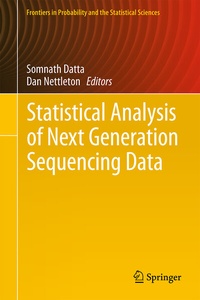
Statistical Analysis of Next Generation Sequencing Data
Description

Reviews / Votes
From the book reviews:
"This book is an excellent collection of 20 chapters presenting the state of art (as of 2014) of algorithms developed for the analysis of next generation sequencing (NGS) data. . This book is a valuable and well-timed collection of articles on the statistical methods that can be applied on NGS data. Even if no prior NGS knowledge is required, the book is addressed mainly to researchers at postgraduate and post-doc levels." (Irina Ioana Mohorianu, zbMATH, Vol. 1297, 2014)
More details
Other editions
Additional editions
Persons
About the editors:
Somnath Datta is Professor and Vice Chair of Bioinformatics and Biostatistics at the University of Louisville. He is Fellow of the American Statistical Association, Fellow of the Institute of Mathematical Statistics, and Elected Member of the International Statistical Institute. He has contributed to numerous research areas in Statistics, Biostatistics and Bioinformatics.
Dan Nettleton is Professor and Laurence H. Baker Endowed Chair of Biological Statistics in the Department of Statistics at Iowa State University. He is Fellow of the American Statistical Association and has published research on a variety of topics in statistics, biology, and bioinformatics.
Content
Statistical Analyses of Next Generation Sequencing Data: An Overview.- Using RNA-seq Data to Detect Differentially Expressed Genes.- Differential Expression Analysis of Complex RNA-seq Experiments Using edgeR.- Analysis of Next Generation Sequencing Data Using Integrated Nested Laplace Approximation (INLA).- Design of RNA Sequencing Experiments.- Measurement, Summary, and Methodological Variation in RNA-sequencing.- Functional PCA for differential expression testing with RNA-seq data.- Mapping of Expression Quantitative Trait Loci using RNA-seq Data.- The Role of Spike-In Standards in the Normalization of RNA-seq.- Cluster Analysis of RNA-sequencing Data.- Classification of RNA-seq Data.- Isoform Expression Analysis Based on RNA-seq Data.- RNA Isoform Discovery Through Goodness of Fit Diagnostics.- MOSAiCS-HMM: A Model-based Approach for Detecting Regions of Histone Modifications from ChIP-seq Data.- Hierarchical Bayesian Models for ChIP-Seq Data.- Genotype Calling and Haplotype Phasing from Next Generation Sequencing Data.- Analysis of Metagenomic Data.- Detecting Copy Number Changes and Structural Rearrangements using DNA Sequencing.- Statistical Methods for the Analysis of Next Generation Sequence Data from Paired Tumor-Normal Samples.- Statistical Considerations in the Analysis of Rare Variants.
