

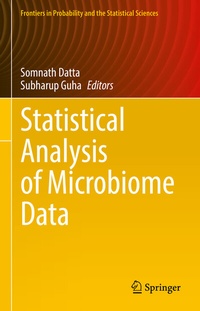
Statistical Analysis of Microbiome Data
Description

Microbiome research has focused on microorganisms that live within the human body and their effects on health. During the last few years, the quantification of microbiome composition in different environments has been facilitated by the advent of high throughput sequencing technologies. The statistical challenges include computational difficulties due to the high volume of data; normalization and quantification of metabolic abundances, relative taxa and bacterial genes; high-dimensionality; multivariate analysis; the inherently compositional nature of the data; and the proper utilization of complementary phylogenetic information. This has resulted in an explosion of statistical approaches aimed at tackling the unique opportunities and challenges presented by microbiome data.
This book provides a comprehensive overview of the state of the art in statistical and informatics technologies for microbiome research. In addition to reviewing demonstrably successful cutting-edge methods, particular emphasis is placed on examples in R that rely on available statistical packages for microbiome data. With its wide-ranging approach, the book benefits not only trained statisticians in academia and industry involved in microbiome research, but also other scientists working in microbiomics and in related fields.
More details
Other editions
Additional editions
Persons
Somnath Datta is Professor of Biostatistics and a preeminence hire in Genomic Medicine at the University of Florida. He is Fellow of the American Statistical Association, Fellow of the Institute of Mathematical Statistics, and Elected Member of the International Statistical Institute. He has contributed to numerous research areas in Statistics, Biostatistics and Bioinformatics.
Subharup Guha is Associate Professor of Biostatistics at the University of Florida. His current research areas of interest are Bayesian nonparametric methods, clustering, classification, Markov chain Monte Carlo algorithms, causal inferences, and high-dimensional data analysis. The applications have included cancer genomics, image processing, microbiomics, and connectomics.
