

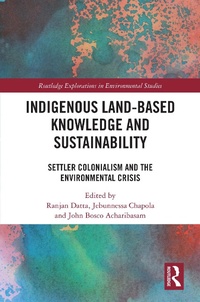
Indigenous Land-Based Knowledge and Sustainability
Settler Colonialism and the Environmental Crisis
1st Edition
Published on 9. September 2024
208 pages
978-1-040-13501-3 (ISBN)
Description

This edited volume explores the crucial intersections between Indigenous Land-Based Knowledge (ILK), sustainability, settler colonialism, and the ongoing environmental crisis.
Contributors from cross-cultural communities, including Indigenous, settlers, immigrants, and refugee communities, discuss why ILK and practice hold great potential for tackling our current environmental crises, particularly addressing the settler colonialism that contributes towards the environmental challenges faced in the world. The authors offer insights into sustainable practices, biodiversity conservation, climate change adaptation, and sustainable land management and centre Indigenous perspectives on ILK as a space to practise, preserve, and promote Indigenous cultures. With case studies spanning topics as diverse as land acknowledgements, land-based learning, Indigenous-led water governance, and birth evacuation, this book shows how our responsibility for ILK can benefit collectively by fostering a more inclusive, sustainable, and interconnected world. Through the promotion of Indigenous perspectives and responsibility towards land and community, this volume advocates for a shift in paradigm towards more inclusive and sustainable approaches to environmental sustainability.
This volume will be of great interest to students and scholars of environmental sociology, postcolonial studies, and Indigenous studies.
Contributors from cross-cultural communities, including Indigenous, settlers, immigrants, and refugee communities, discuss why ILK and practice hold great potential for tackling our current environmental crises, particularly addressing the settler colonialism that contributes towards the environmental challenges faced in the world. The authors offer insights into sustainable practices, biodiversity conservation, climate change adaptation, and sustainable land management and centre Indigenous perspectives on ILK as a space to practise, preserve, and promote Indigenous cultures. With case studies spanning topics as diverse as land acknowledgements, land-based learning, Indigenous-led water governance, and birth evacuation, this book shows how our responsibility for ILK can benefit collectively by fostering a more inclusive, sustainable, and interconnected world. Through the promotion of Indigenous perspectives and responsibility towards land and community, this volume advocates for a shift in paradigm towards more inclusive and sustainable approaches to environmental sustainability.
This volume will be of great interest to students and scholars of environmental sociology, postcolonial studies, and Indigenous studies.
More details
Series
Edition
1. Auflage
Language
English
Place of publication
London
United Kingdom
Publishing group
Taylor & Francis Ltd
Target group
College/higher education
Professional and scholarly
Illustrations
1 Tables, black and white; 12 Halftones, black and white; 12 Illustrations, black and white
ISBN-13
978-1-040-13501-3 (9781040135013)
Copyright in bibliographic data and cover images is held by Nielsen Book Services Limited or by the publishers or by their respective licensors: all rights reserved.
Schweitzer Classification
Other editions
Additional editions
Ranjan Datta | Jebunnessa Chapola | John Bosco Acharibasam
Indigenous Land-Based Knowledge and Sustainability
Settler Colonialism and the Environmental Crisis
Book
05/2026
1st Edition
Routledge
€57.50
Shipment within 10-20 days

Ranjan Datta | Jebunnessa Chapola | John Bosco Acharibasam
Indigenous Land-Based Knowledge and Sustainability
Settler Colonialism and the Environmental Crisis
Book
10/2024
Taylor & Francis
Unfortunately, price unknown
Available (delivery time upon request)
Ranjan Datta | Jebunnessa Chapola | John Bosco Acharibasam
Indigenous Land-Based Knowledge and Sustainability
Settler Colonialism and the Environmental Crisis
Book
09/2024
1st Edition
Routledge
€231.50
Shipment within 10-20 days
Persons
Ranjan Datta is a Canada Research chair in Community Disaster Research at the Department of Humanities, Mount Royal University, Calgary, Alberta, Canada. Ranjan's research interests include advocating for critical anti-racist perspectives on community disaster research, Indigenous environmental sustainability, community-led climate change solutions, and decolonial community research. His current research program is supported by his existing network of Indigenous, visible minority immigrants and refugees, Black communities, scholars, students, practitioners, and professionals in Canada and beyond. In Datta's community service activities, he has been involved with social well-being and justice movements.
Jebunnessa Chapola serves as a SSHRC postdoctoral fellow at the Johnson Shoyama Graduate School of Public Policy, University of Regina, Canada. Dr. Jebunnessa Chapola is a settler woman of colour trained as an anti-racist, decolonial feminist educator. Her research spans environmental reconciliation, decolonial feminist research, transnational feminism, anti-racist theory, and Indigenous women-led climate change solutions, reflecting her commitment to cross-cultural responsibility, gender equity, social justice, and environmental resilience.
John Bosco Acharibasam is a SSHRC postdoctoral fellow at Mount Royal University in Canada and is dedicated to addressing social and environmental justice concerns within Black and other marginalized communities. His overarching research objective is to mitigate environmental vulnerabilities and health disparities among Black, Indigenous, and marginalized populations. As an immigrant scholar, John recognizes the imperative of fostering cross-cultural connections among BIPOC communities in Saskatchewan, Canada. His scholarly pursuits encompass decolonizing methodologies, climate change, public health, and anti-racism initiatives.
Jebunnessa Chapola serves as a SSHRC postdoctoral fellow at the Johnson Shoyama Graduate School of Public Policy, University of Regina, Canada. Dr. Jebunnessa Chapola is a settler woman of colour trained as an anti-racist, decolonial feminist educator. Her research spans environmental reconciliation, decolonial feminist research, transnational feminism, anti-racist theory, and Indigenous women-led climate change solutions, reflecting her commitment to cross-cultural responsibility, gender equity, social justice, and environmental resilience.
John Bosco Acharibasam is a SSHRC postdoctoral fellow at Mount Royal University in Canada and is dedicated to addressing social and environmental justice concerns within Black and other marginalized communities. His overarching research objective is to mitigate environmental vulnerabilities and health disparities among Black, Indigenous, and marginalized populations. As an immigrant scholar, John recognizes the imperative of fostering cross-cultural connections among BIPOC communities in Saskatchewan, Canada. His scholarly pursuits encompass decolonizing methodologies, climate change, public health, and anti-racism initiatives.
Content
Editors
Contributors
Chapter 1: Introduction - Ranjan Datta, Jebunnessa Chapola and John Bosco Acharibasam
Chapter 2: Walking in My Tipuna Steps: Land-based Resurgence with Women Stories in Aotearoa, New Zeeland - Kerri Cleaver
Chapter 3: Traditional Storytelling as Land-based Heritage: Reflections from Indigenous Perspectives in Northern Malawi - Jean Kayira and Tamara Mkandawire
Chapter 4: Soulfully in Movement on the Land, as a Shiibaashka'igan Expressionist: Embodied Knowing and Anishinaabe Dance - Karen Pheasant-Neganigwane
Chapter 5: Indigenous Land Sovereignty and Food Security in Saskatchewan, Canada - Marlin Legare
Chapter 6: Land-based Learning and Its Implications for Preserving Traditional Ecological Knowledge in Ghana - Raphael Ane Atanga, John Bosco Acharibasam, Sampson Kwasi Jachan, Mawuli Kwasi Gafli and Godfred Adjei Poku
Chapter 7: Land-Based Learning as a Methodology for Understanding Indigenous Water Governance - John Bosco Acharibasam, Ranjan Datta, Margot Hurlbert and Angelina Weenie
Chapter 8: The Impact of the Climate Crisis on Forced Migration among Indigenous Communities in the Chittagong Hill Tracts (CHT) of Bangladesh - Arifatul Kibria and Ranjan Datta
Chapter 9: Traditional Bengali Land-based Beadwork - A Form of Creating Belongingness for a Racialized Immigrant Woman in Canada - Bipasha Mondol and Ranjan Datta
Chapter 10: Taking Responsibility in Land-based Learning from a Racialized Woman's Perspective in Canada - Navi Toor
Chapter 11: Decolonizing the Meaning of Land Acknowledgement: From and within Treat 7 Indigenous Perspectives, Canada - Ryan Whitford
Chapter 12: Conservation Ethos of Indigenous Munda Community vis a vis Land Grabbing Battles in Bangladesh's Sundarban Mangroves - Sujoy Subroto and Conny Davidsen
Chapter 13: Unlearning to Relearning: Journey in Co-creating Space for Decolonization and Reconciliation - Makayla Krause
Chapter 14: Creating Safe and Inclusive Spaces for Communities at Risk to Be Involved in Land-based Eco-action - Baneen Al-Sachit
Chapter 15: Responsibility in Indigenous Land-based Knowledge and Environmental Sustainability - Ranjan Datta, Jebunnessa Chapola and John Bosco Acharibasam
Index
Contributors
Chapter 1: Introduction - Ranjan Datta, Jebunnessa Chapola and John Bosco Acharibasam
Chapter 2: Walking in My Tipuna Steps: Land-based Resurgence with Women Stories in Aotearoa, New Zeeland - Kerri Cleaver
Chapter 3: Traditional Storytelling as Land-based Heritage: Reflections from Indigenous Perspectives in Northern Malawi - Jean Kayira and Tamara Mkandawire
Chapter 4: Soulfully in Movement on the Land, as a Shiibaashka'igan Expressionist: Embodied Knowing and Anishinaabe Dance - Karen Pheasant-Neganigwane
Chapter 5: Indigenous Land Sovereignty and Food Security in Saskatchewan, Canada - Marlin Legare
Chapter 6: Land-based Learning and Its Implications for Preserving Traditional Ecological Knowledge in Ghana - Raphael Ane Atanga, John Bosco Acharibasam, Sampson Kwasi Jachan, Mawuli Kwasi Gafli and Godfred Adjei Poku
Chapter 7: Land-Based Learning as a Methodology for Understanding Indigenous Water Governance - John Bosco Acharibasam, Ranjan Datta, Margot Hurlbert and Angelina Weenie
Chapter 8: The Impact of the Climate Crisis on Forced Migration among Indigenous Communities in the Chittagong Hill Tracts (CHT) of Bangladesh - Arifatul Kibria and Ranjan Datta
Chapter 9: Traditional Bengali Land-based Beadwork - A Form of Creating Belongingness for a Racialized Immigrant Woman in Canada - Bipasha Mondol and Ranjan Datta
Chapter 10: Taking Responsibility in Land-based Learning from a Racialized Woman's Perspective in Canada - Navi Toor
Chapter 11: Decolonizing the Meaning of Land Acknowledgement: From and within Treat 7 Indigenous Perspectives, Canada - Ryan Whitford
Chapter 12: Conservation Ethos of Indigenous Munda Community vis a vis Land Grabbing Battles in Bangladesh's Sundarban Mangroves - Sujoy Subroto and Conny Davidsen
Chapter 13: Unlearning to Relearning: Journey in Co-creating Space for Decolonization and Reconciliation - Makayla Krause
Chapter 14: Creating Safe and Inclusive Spaces for Communities at Risk to Be Involved in Land-based Eco-action - Baneen Al-Sachit
Chapter 15: Responsibility in Indigenous Land-based Knowledge and Environmental Sustainability - Ranjan Datta, Jebunnessa Chapola and John Bosco Acharibasam
Index
