

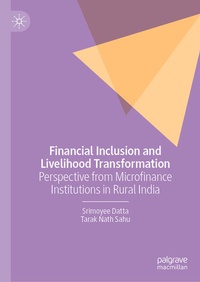
Financial Inclusion and Livelihood Transformation
Description

This book explores the role and effect of Microfinance Institutions (MFIs) with different dimensions. It is being supported with strong empirical evidence into various parameters of MFIs directed towards inclusive finance and the transformation journey of livelihoods of its beneficiaries.
It also incorporates empirical evidence with the perception of both beneficiaries and non-beneficiaries. Starting its journey toward the path of comprehending how MFIs make their footprint among the excluded population in the selected areas, it incorporates the different outcomes of MFI lending like credit utilisation patterns, income generation, and employability. As financial stability helps to break out the vicious cycle of poverty, this book emphasises the self-dependent element for the beneficiaries and their households.
It addresses the important issue of the female counterparts in society. It shows how the MFIs work actively to generate female empowerment from multiple dimensions among the selected communities. It addresses key issues to consider for inclusive policy formulation, especially for backward communities in the backward areas and gives a realistic scenario of the MFI activities, their interactions with the respondents, the various outcomes, and areas for further developments, etc. This book is beneficial for academicians, researchers, and policymakers.
More details
Other editions
Additional editions
Persons
Dr. Srimoyee Datta is presently working as an Assistant Professor in Department of Business Administration, Sidho Kanho Birsha University. She has over 17 years of academic experience in various institutes. She has been awarded Ph.D. from Vidyasagar University, West Bengal. She has published various research articles in various reputed national and international journals published by reputed publishers.
Dr. Tarak Nath Sahu
is currently working as an Associate Professor of Commerce and Head, Department of Business Administration, Vidyasagar University, Midnapore. He has over 16 years of postgraduate teaching and research experience in the field of finance and financial economics. Dr. Sahu, a gold medalist at both graduate and post-graduate levels, has authored five books and edited ten books. He has published more than hundred fifty research articles in reputed national and international journals.
Content
Chapter 1: Introduction.- Chapter 2: Financial inclusion, microfinance institutions and women empowerment: overview and literatures.- Chapter 3: Perception of borrowers and non-borrowers towards mfis.- Chapter 4: Credit utilization pattern of the borrowers.- Chapter 5: Microfinance and employability.- Chapter 6: Performance analysis of the active mfis.- Chapter 7: Role of mfis towards empowering the women.- Chapter 8: Identification of determinants influencing the economic, psychological and social empowerment of the female borrowers.- Chapter 9: Summary and conclusion.
