

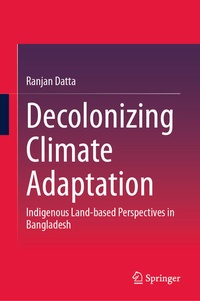
Decolonizing Climate Adaptation
Description

This volume critically examines the intersection of settler colonialism and human-created disasters affecting many Indigenous and minority communities in Bangladesh. Through a rigorous exploration of both historical and contemporary contexts, it shows how colonial and postcolonial policies have excavated community vulnerabilities, intensified environmental degradation, and intensified disaster risks.
Drawing on community-led case studies and centering Indigenous voices, the book advocates for decolonial approaches to disaster adaptation, emphasizing Indigenous and local sovereignty, traditional environmental knowledge, and self-determined leadership in addressing climate crises. It highlights sustainable and culturally interconnected strategies such as forest conservation, land-based agriculture, and community-led adaptation planning.
This volume is a critical resource for scholars, students, and practitioners working in environmental policy, climate adaptation, conservation, Indigenous studies, gender studies, environmental sustainability, and ethnic studies. It contributes to an urgent and timely conversation about how to reimagine disaster adaptation through relational, land-based, and decolonial frameworks.
More details
Other editions
Additional editions
Person
Ranjan Datta, PhD, is the Canada Research Chair in Community Disaster Research in the Department of Humanities at Mount Royal University, Calgary, Alberta, Canada. He serves as a Senior Scientist for both the International Science Council (ISC) and the United Nations Environment Programme (UNEP), and is a Senior Research Fellow with the Earth System Governance Research Network at Utrecht University, Netherlands. Ranjan's research interests include community-led disaster research, advancing anti-racist and decolonial methodologies, critical climate crisis resilience studies, and cross-cultural community-engaged research. He is committed to assuming responsibilities in anti-racist scholarship and decolonial practices within disaster and climate studies. He has made significant contributions to academic discourse, authoring over 95 peer-reviewed journal articles and book chapters. His literary contributions also include the authorship of four books and the editing of five scholarly volumes. Additionally, he has led a special issue in an academic journal focused on decolonial research, traditional story-sharing, Indigenist community-based participatory action research, and the complexities of Indigenous land, water, and sustainability.
Content
Settler Colonialism and human-created Disaster in Indigenous communities Bangladesh.- Rethinking disaster research from Indigenous land-based perspectives in Bangladesh.- Decolonizing Climate Crisis and adaptation strategies from Munda Indigenous communities in Coastal Areas in Bangladesh.- Decolonizing the meanings of disaster and it's impacts on Indigenous communities in Chittagong Hill Tracts (CHT), Bangladesh.- Women's self-determination and Change adaptation strategies within Munda Indigenous communities in Bangladesh.- Climate Change and Munda Indigenous Youth Perspectives Coastal Area in Bangladesh.- Land-based Spirituality can help to create climate crisis adaptability in Coastal Area Rakhine Indigenous communities in Bangladesh.- Indigenous land-rights as climate and disaster resiliency in Bangladesh.
