

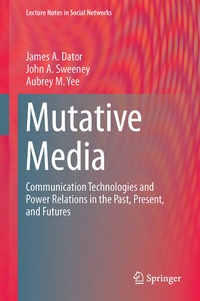
Mutative Media
Description

Mutative Media is a sweeping examination of how communication technologies have contributed to changes in people's thoughts and actions, and thus in the power structures of societies, in the past, at present, and in four alternative futures.
We start by surveying what is generally known about the emergence of human language and speech that has enabled humans to extend their organizing abilities beyond that of other hominids. We then review research on the emergence of signs, symbols, and eventually writing, which led to new ways of thinking, acting, and organizing in scribal societies and vastly extended human influence globally. We consider the impact of the printing press in Europe, the Middle East, China, and Korea that led to various ways of thinking and organizing in modern societies, and conclude our historical survey with a discussion of the emergence and impact of electric and electronic communication technologies from the nineteenth century to the present.
After a brief overview of what "futures studies" is and is not, based on our extensive experience in the field, we present four generic alternative futures, and discuss a prototype of a hybrid, mixed-reality game designed to enable players to experience the power and potential of new communication technologies within four very different environments and conditions. We think you will be intrigued by our surprising findings and what they may mean for future generations!
More details
Other editions
Additional editions
Persons
Jim Dator, PhD, is Professor and Director, Hawaii Research Center for Futures Studies, Department of Political Science, University of Hawaii at Manoa. He is Adjunct Professor, School of Architecture, UHM; on the Faculty of the International Space University, Strasbourg, France and former President of the World Futures Studies Federation.
John A. Sweeney is a PhD Candidate in the Department of Political Science at the University of Hawaii at Manoa where he also serves as a Graduate Researcher at the Hawaii Research Center for Futures Studies.
Aubrey M. Yee is a PhD Candidate in the Department of Political Science at the University of Hawaii at Manoa where she also serves as a Graduate Researcher at the Hawaii Research Center for Futures Studies.
