

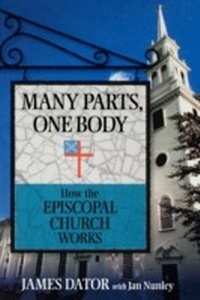
Many Parts, One Body
Description

The dioceses of San Joaquin, Pittsburgh, Fort Worth, and Quincy voted to secede from the Episcopal Church. The bishop of Pittsburgh was deposed for abandonment of communion, with several other bishops removed from ministry in the Episcopal Church after declaring their alignment with other provinces of the Anglican Communion. The diocese of Virginia is in the midst of protracted legal battles with parishes seeking to leave with property, with Virginia lower courts issuing rulings reflecting minority interpretation of The Episcopal Church governance.
What's going on, who's in charge, and what about real-property assets?
In order to determine the locus of authority within the Episcopal Church, political scientist James Dator carefully analyzed the three main styles of constitutional government -confederal, federal, and unitary - and applied them to the Episcopal Church in his 1959 dissertation. Now, working with religious journalist Jan Nunley, who added current legal cases and canonical updates, Dr. Dator's research offers newfound currency and prescient applicability. Topics include a thorough examination of the Episcopal Church's Constitution and Canons, 1782 to present, plus the structure, executive powers, and governing roles of its various parts.
All prices
More details
Other editions
Additional editions
Persons
Content
- Intro
- Title
- Copyright
- Contents
- Preface: The Future Has a Long Fuse
- Preface to the Original Work
- Chapter 1. What Difference Does It Make?
- The Controversy
- Unitary, Federal, and Confederal Government Defined
- Resolving the Controversy
- Chapter 2. The Constitution and Canons
- The Church in America in 1776
- Plans for Reconstituting the Church
- Conventions to Reconstitute the Church
- The Constitution of 1789
- The Canons of 1789
- How the Constitution Was Enacted
- How the Constitution May Be Amended
- Conclusions
- Separation of Powers?
- Chapter 3. The Structure of General Convention
- Overview
- Who Are the Members?
- Whom Do They Represent?
- How Do They Vote?
- Is General Convention Bicameral?
- Conclusions
- Chapter 4. Executive, Administrative, and Judicial Powers
- What Are Bishops?
- Bishops' Jurisdiction, Mission, Selection, and the General Church
- The Presiding Bishop
- The Executive Council
- Finances
- The Judicial System
- Chapter 5. Provinces, Dioceses, and the General Church
- Provinces
- Dioceses
- May Dioceses Nullify or Secede?
- The Church in the Confederate States
- Admitting New Dioceses
- Who Is a Member of the Church?
- Chapter 6. Summary and Conclusions
- The Written Constitution
- General Convention
- Executive and Judiciary
- Membership
- Locus of Sovereignty
- Final Conclusion
- Bibliography
- Appendix
- I. Controversy Concerning the Source of Canon Law
- The Ancient Canons Do Apply to the Episcopal Church
- Hoffman's View
- "The Ancient Canons"
- Analogy to Common Law
- Summary of Hoffman's Position
- The Ancient Canons Do Not Apply to the Episcopal Church
- Andrews's View
- Opinion of Kevin and Brydon
- The Importance of This Controversy
- II. The Constitution of the Confederate Episcopal Church
- The Official Draft of October 1861
- The Accepted Constitution
- III. The Reformed Episcopal Church
- The Constitution of the Reformed Episcopal Church
- IV. Notes and Comments on the Church's Government
- On the Name of the Church
- On Church Parties
- On Parish Government
- On "Divided Votes" in the House of Deputies
- On the Use of the Word "Mission"
- Quotations Showing Conflicting Opinions Regarding the Meaning of the Constitution Enacted in 1789
- Quotations Showing Conflicting Opinions Regarding the Extent of General Conventions Power
- Official Church Acts Showing the Relationship of the Episcopal Church to the Church of England
- Civil Court Cases Involving the Episcopal Church
