

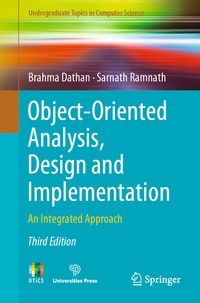
Object-Oriented Analysis, Design and Implementation
Description

This new edition demonstrates a modeling-based approach to object-oriented development. It is a significant and comprehensive revision of the book. While the central focus remains the same as in previous editions, the reader will notice substantial improvements in the presentation.
Salient features
- All expected background materials are now in one chapter, making it easier for both the teacher and the learner.
- The treatment of modeling concepts and UML diagrams is both broader and deeper.
- Securing the software is considered in the design and implementation phases.
- The design is evaluated for bad smells, which are corrected by refactoring.
- Implementation is carried out in both JavaFX and Swing.
- Software reuse is dealt with in much greater depth. The role of substitutability is examined and explained in this context.
- Comparison of the finite state machine and use case models is provided.
- A procedure to assist readers in analysis and design using the finite state machine model is included.
More details
Other editions
Additional editions
Persons
Brahma Dathan is Professor Emeritus in the Computer Science Department at the Metropolitan State University, Minnesota, USA. He obtained his B.S. in Engineering with special focus on electronics and communication from the University of Kerala, M.Tech. in Computer Science from the Indian Institute of Technology Madras and Ph.D. in Computer Science from the University of Pittsburgh.
Sarnath Ramnath is Professor in the Computer Science and Information Technology Department at St. Cloud State University, Minnesota, USA. He received his B.Tech. and M.Tech. degrees from the Indian Institute of Technology Delhi and his Ph.D. in Computer Science from SUNY, Buffalo. His areas of interest include algorithm analysis and design, data structures, computational geometry and object-oriented software design.
Content
Preface to the third edition.- Introduction.- Basics of object-oriented programming.- Modeling object-oriented systems.- Analysing a system.- Designing a system.- Implementing a system.- Designing for reuse.- Modelling with finite state machines.- Interactive systems and the model-view-controller Architecture.- A deeper look into inheritance.- Appendix Java esentials.- Index.
