

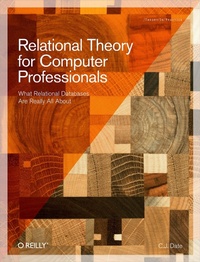
Relational Theory for Computer Professionals
Description

All of today's mainstream database products support the SQL language, and relational theory is what SQL is supposed to be based on. But are those products truly relational? Sadly, the answer is no. This book shows you what a real relational product would be like, and how and why it would be so much better than what's currently available.
With this unique book, you will:
- Learn how to see database systems as programming systems
- Get a careful, precise, and detailed definition of the relational model
- Explore a detailed analysis of SQL from a relational point of view
There are literally hundreds of books on relational theory or the SQL language or both. But this one is different. First, nobody is more qualified than Chris Date to write such a book. He and Ted Codd, inventor of the relational model, were colleagues for many years, and Chris's involvement with the technology goes back to the time of Codd's first papers in 1969 and 1970. Second, most books try to use SQL as a vehicle for teaching relational theory, but this book deliberately takes the opposite approach. Its primary aim is to teach relational theory as such. Then it uses that theory as a vehicle for teaching SQL, showing in particular how that theory can help with the practical problem of using SQL correctly and productively.
Any computer professional who wants to understand what relational systems are all about can benefit from this book. No prior knowledge of databases is assumed.
More details
Other editions
Additional editions
Content
- Intro
- About the Author
- Contents
- Preface
- Part I: Foundations
- Chapter 1: Basic Database Concepts
- Chapter 2: Relations and Relvars
- Chapter 3: Keys, Foreign Keys, and Related Matters
- Chapter 4: Relational Operators I
- Chapter 5: Relational Operators II
- Chapter 6
- Constraints and Predicates
- Chapter 7: The Relational Model
- Part II: Transactions and Database Design
- Chapter 8: Transactions
- Chapter 9: Database Design
- Part III: SQL
- Chapter 10: SQL Tables
- Chapter 11: SQL Operators I
- Chapter 12: SQL Operators II
- Chapter 13: SQL Constraints
- Chapter 14: SQL vs. the Relational Model
- Appendixes
- Appendix A: A Tutorial D Grammar
- Appendix B: TABLE_DUM and TABLE_DEE
- Appendix C: Set Theory
- Appendix D: Relational Calculus
- Appendix E: A Guide to Further Reading
- Index
