

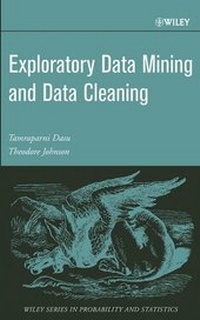
Exploratory Data Mining and Data Cleaning
Description

Reviews / Votes
"Statisticians not conversant with today's statistical take on DQshould read this book...and be stimulated to do importantresearch in DQ." (Journal of the American StatisticalAssociation, March 2006) "...uniquely integrates several approaches for data cleaningand exploration..." (Journal of Statistical Computation& Simulation, April 2004) "...provides a uniquely integrated approach...for serious dataanalysts everywhere..." (Zentralblatt Math, Vol. 1027,2004)More details
Other editions
Additional editions

Persons
Content
1 Exploratory Data Mining and Data Cleaning: An Overview.
1.1 Introduction.
1.2 Cautionary Tales.
1.3 Taming the Data.
1.4 Challenges.
1.5 Methods.
1.6 EDM.
1.6.1 EDM Summaries - Parametric.
1.6.2 EDM Summaries - Nonparametric.
1.7 EndtoEnd Data Quality (DQ).
1.7.1 DQ in Data Preparation.
1.7.2 EDM and Data Glitches.
1.7.3 Tools for DQ.
1.7.4 EndtoEnd DQ: The Data Quality Continuum.
1.7.5 Measuring Data Quality.
1.8 Conclusion.
2 Exploratory Data Mining.
2.1 Introduction.
2.2 Uncertainty.
2.2.1 Annotated Bibliography.
2.3 EDM: Exploratory Data Mining.
2.4 EDM Summaries.
2.4.1 Typical Values.
2.4.2 Attribute Variation.
2.4.3 Example.
2.4.4 Attribute Relationships.
2.4.5 Annotated Bibliography.
2.5 What Makes a Summary Useful?
2.5.1 Statistical Properties.
2.5.2 Computational Criteria.
2.5.3 Annotated Bibliography.
2.6 DataDriven Approach - Nonparametric Analysis.
2.6.1 The Joy of Counting.
2.6.2 Empirical Cumulative Distribution Function (ECDF).
2.6.3 Univariate Histograms.
2.6.4 Annotated Bibliography.
2.7 EDM in Higher Dimensions.
2.8 Rectilinear Histograms.
2.9 Depth and Multivariate Binning.
2.9.1 Data Depth.
2.9.2 Aside: DepthRelated Topics.
2.9.3 Annotated Bibliography.
2.10 Conclusion.
3 Partitions and Piecewise Models.
3.1 Divide and Conquer.
3.1.1 Why Do We Need Partitions?
3.1.2 Dividing Data.
3.1.3 Applications of Partitionbased EDM Summaries.
3.2 AxisAligned Partitions and Data Cubes.
3.3 Nonlinear Partitions.
3.3.1 Annotated Bibliography.
3.4 DataSpheres (DS).
3.4.1 Layers.
3.4.2 Data Pyramids.
3.4.3 EDM Summaries.
3.4.4 Annotated Bibliography.
3.5 Set Comparison Using EDM Summaries.
3.5.1 Motivation.
3.5.2 Comparison Strategy.
3.5.3 Statistical Tests for Change.
3.5.4 Application - Two Case Studies.
3.5.5 Annotated Bibliography.
3.6 Discovering Complex Structure in Data with EDM Summaries.
3.6.1 Exploratory Model Fitting in Interactive Response Time.
3.6.2 Annotated Bibliography.
3.7 Piecewise Linear Regression.
3.7.1 An Application.
3.7.2 Regression Coefficients.
3.7.3 Improvement in Fit.
3.7.4 Annotated Bibliography.
3.8 OnePass Classification.
3.8.1 QuantileBased Prediction with Piecewise Models.
3.8.2 Simulation Study.
3.8.3 Annotated Bibliography.
3.9 Conclusion.
4 Data Quality.
4.1 Introduction.
4.2 The Meaning of Data Quality.
4.2.1 An Example.
4.2.2 Data Glitches.
4.2.3 Gaps in Time Series Records.
4.2.4 Conventional Definition.
4.2.5 Times Have Changed.
4.2.6 Annotated Bibliography.
4.3 Updating DQ Metrics: Data Quality Continuum.
4.3.1 Data Gathering.
4.3.2 Data Delivery.
4.3.3 Data Monitoring.
4.3.4 Data Storage.
4.3.5 Data Integration.
4.3.6 Data Retrieval.
4.3.7 Data Mining/Analysis.
4.3.8 Annotated Bibliography.
4.4 The Meaning of Data Quality Revisited.
4.4.1 Data Interpretation.
4.4.2 Data Suitability.
4.4.3 Dataset Type.
4.4.4 Attribute Type.
4.4.5 Application Type.
4.4.6 Data Quality - A Many Splendored Thing.
4.4.7 Annotated Bibliography.
4.5 Measuring Data Quality.
4.5.1 DQ Components and Their Measurement.
4.5.2 Combining DQ Metrics.
4.6 The DQ Process.
4.7 Conclusion.
4.7.1 Four Complementary Approaches.
4.7.2 Annotated Bibliography.
5 Data Quality: Techniques and Algorithms.
5.1 Introduction.
5.2 DQ Tools Based on Statistical Techniques.
5.2.1 Missing Values.
5.2.2 Incomplete Data.
5.2.3 Outliers.
5.2.4 Time Series Outliers: A Case Study.
5.2.5 GoodnessofFit.
5.2.6 Annotated Bibliography.
5.3 Database Techniques for DQ.
5.3.1 What is a Relational Database?
5.3.2 Why Are Data Dirty?
5.3.3 Extraction, Transformation, and Loading (ETL).
5.3.4 Approximate Matching.
5.3.5 Database Profiling.
5.3.6 Annotated Bibliography.
5.4 Metadata and Domain Expertise.
5.4.1 Lineage Tracing.
5.4.2 Annotated Bibliography.
5.5 Measuring Data Quality?
5.5.1 Inventory Building - A Case Study.
5.5.2 Learning and Recommendations.
5.6 Data Quality and Its Challenges.
