

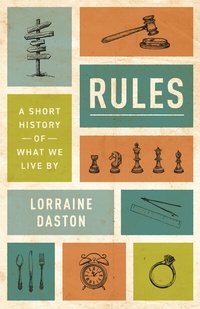
Rules
A Short History of What We Live By
1st Edition
Published on 6. July 2022
384 pages
978-0-691-23918-7 (ISBN)
Description

A panoramic history of rules in the Western world
Rules order almost every aspect of our lives. They set our work hours, dictate how we drive and set the table, tell us whether to offer an extended hand or cheek in greeting, and organize the rites of life, from birth through death. We may chafe under the rules we have, and yearn for ones we don't, yet no culture could do without them. In Rules, historian Lorraine Daston traces their development in the Western tradition and shows how rules have evolved from ancient to modern times. Drawing on a rich trove of examples, including legal treatises, cookbooks, military manuals, traffic regulations, and game handbooks, Daston demonstrates that while the content of rules is dazzlingly diverse, the forms that they take are surprisingly few and long-lived.
Daston uncovers three enduring kinds of rules: the algorithms that calculate and measure, the laws that govern, and the models that teach. She vividly illustrates how rules can change-how supple rules stiffen, or vice versa, and how once bothersome regulations become everyday norms. Rules have been devised for almost every imaginable activity and range from meticulous regulations to the laws of nature. Daston probes beneath this variety to investigate when rules work and when they don't, and why some philosophical problems about rules are as ancient as philosophy itself while others are as modern as calculating machines.
Rules offers a wide-angle view on the history of the constraints that guide us-whether we know it or not.
Rules order almost every aspect of our lives. They set our work hours, dictate how we drive and set the table, tell us whether to offer an extended hand or cheek in greeting, and organize the rites of life, from birth through death. We may chafe under the rules we have, and yearn for ones we don't, yet no culture could do without them. In Rules, historian Lorraine Daston traces their development in the Western tradition and shows how rules have evolved from ancient to modern times. Drawing on a rich trove of examples, including legal treatises, cookbooks, military manuals, traffic regulations, and game handbooks, Daston demonstrates that while the content of rules is dazzlingly diverse, the forms that they take are surprisingly few and long-lived.
Daston uncovers three enduring kinds of rules: the algorithms that calculate and measure, the laws that govern, and the models that teach. She vividly illustrates how rules can change-how supple rules stiffen, or vice versa, and how once bothersome regulations become everyday norms. Rules have been devised for almost every imaginable activity and range from meticulous regulations to the laws of nature. Daston probes beneath this variety to investigate when rules work and when they don't, and why some philosophical problems about rules are as ancient as philosophy itself while others are as modern as calculating machines.
Rules offers a wide-angle view on the history of the constraints that guide us-whether we know it or not.
More details
Other editions
Person
Lorraine Daston is director emerita of the Max Planck Institute for the History of Science (MPIWG) in Berlin, visiting professor in the Committee on Social Thought at the University of Chicago, and a permanent fellow at the Berlin Institute for Advanced Study. Her books include Classical Probability in the Enlightenment (Princeton).
Content
- Cover
- Contents
- List of Illustrations
- 1. Introduction: The Hidden History of Rules
- Clues to a Hidden History
- Rules as Both Paradigms and Algorithms
- Universals and Particulars
- A History of the Self-Evident
- 2. Ancient Rules: Straightedges, Models, and Laws
- Three Semantic Clusters
- The Rule Is the Abbot
- Following Models
- Conclusion: Rules between Science and Craft
- 3. The Rules of Art: Head and Hand United
- The Understanding Hand
- Thick Rules
- Rules at War
- Cookbook Knowledge
- Conclusion: Back and Forth, Betwixt and Between
- 4. Algorithms before Mechanical Calculation
- The Classroom
- What Was an Algorithm?
- Generality without Algebra
- Computing before Computers
- Conclusion: Thin Rules
- 5. Algorithmic Intelligence in the Age of Calculating Machines
- Mechanical Rule-Following: Babbage versus Wittgenstein
- "First Organize, Then Mechanize": The Human-Machine Workflow
- Mechanical Mindfulness
- Algorithms and Intelligence
- Conclusion: From Mechanical to Artificial Intelligence
- 6. Rules and Regulations
- Laws, Rules, and Regulations
- Five Hundred Years of Rule Failure: The War on Fashion
- Rules for an Unruly City: Policing the Streets of Enlightenment Paris
- Rules that Succeed Too Well: How and How Not to Spell
- Conclusion: From Rules to Norms
- 7. Natural Laws and Laws of Nature
- The Grandest Rules of All
- Natural Law
- Laws of Nature
- Conclusion: Universal Legality
- 8. Bending and Breaking Rules
- At the Limit
- Casuistry: Hard Cases and Tender Consciences
- Equity: When the Law Commits Injustice
- Prerogative and States of Exception: Rulers and the Rule of Law
- Conclusion: Which Came First, the Rule or the Exception?
- Epilogue: More Honored in the Breach
- Acknowledgments
- Notes
- Bibliography
- Index
