

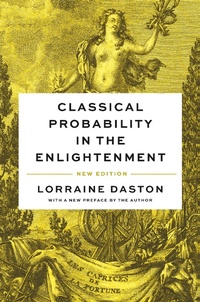
Classical Probability in the Enlightenment, New Edition
1st Edition
Published on 15. November 2023
456 pages
978-0-691-24851-6 (ISBN)
Description

An award-winning history of the Enlightenment quest to devise a mathematical model of rationality
What did it mean to be reasonable in the Age of Reason? Enlightenment mathematicians such as Blaise Pascal, Jakob Bernoulli, and Pierre Simon Laplace sought to answer this question, laboring over a theory of rational decision, action, and belief under conditions of uncertainty. Lorraine Daston brings to life their debates and philosophical arguments, charting the development and application of probability theory by some of the greatest thinkers of the age. Now with an incisive new preface, Classical Probability in the Enlightenment traces the emergence of new kind of mathematics designed to turn good sense into a reasonable calculus.
What did it mean to be reasonable in the Age of Reason? Enlightenment mathematicians such as Blaise Pascal, Jakob Bernoulli, and Pierre Simon Laplace sought to answer this question, laboring over a theory of rational decision, action, and belief under conditions of uncertainty. Lorraine Daston brings to life their debates and philosophical arguments, charting the development and application of probability theory by some of the greatest thinkers of the age. Now with an incisive new preface, Classical Probability in the Enlightenment traces the emergence of new kind of mathematics designed to turn good sense into a reasonable calculus.
More details
Other editions
Additional editions
Lorraine Daston
Classical Probability in the Enlightenment, New Edition
Book
08/2023
Princeton University Press
€33.00
Shipment within 10-20 days
Person
Lorraine Daston is director emerita of the Max Planck Institute for the History of Science (MPIWG) in Berlin, visiting professor in the Committee on Social Thought at the University of Chicago, and a permanent fellow at the Berlin Institute for Advanced Study. Her books include Rules: A Short History of What We Live By (Princeton).
Content
- Cover
- Contents
- Preface to the 2023 Edition
- Preface and Acknowledgments
- Introduction
- Chapter One. The Prehistory of the Classical Interpretation of Probability: Expectation and Evidence
- 1.1 Introduction
- 1.2 Quantitative and Qualitative Probabilities
- 1.3 Expectation, Equity, and Aleatory Contracts
- 1.4 Degrees of Certainty and the Hierarchy of Proofs
- 1.5 Conclusion
- Chapter Two. Expectation and the Reasonable Man
- 2.1 Introduction
- 2.2 Expectation as Reasonableness
- 2.3 The Debate over Expectation
- 2.4 Conclusion
- Chapter Three. The Theory and Practice of Risk
- 3.1 Introduction
- 3.2 Risk before Probability Theory
- 3.3 The Mathematical Theory of Risk
- 3.4 Risk after Probability Theory
- 3.5 Conclusion
- Chapter Four. Associationism and the Meaning of Probability
- 4.1 Introduction
- 4.2 Probability, Experience, and Belief
- 4.3 The Dissociation of Objective and Subjective Probabilities
- 4.4 Conclusion
- Chapter Five. The Probability of Causes
- 5.1 Introduction
- 5.2 Bernoulli's Theorem and the Urn Model of Causation
- 5.3 Bayes' Theorem and the Problem of Induction
- 5.4 The Calculus of Induction
- 5.5 Conclusion
- Chapter Six. Moralizing Mathematics
- 6.1 Introduction
- 6.2 The Moral Sciences
- 6.3 Testimony and the Probability of Miracles
- 6.4 The Probability of Judgments
- 6.5 Conclusion
- Epilogue. The Decline of the Classical Theory
- Bibliography
- Index
