

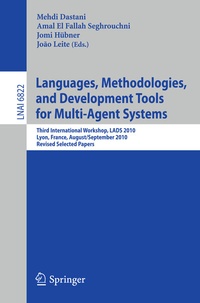
Languages, Methodologies, and Development Tools for Multi-Agent Systems
Third International Workshop, LADS 2010, Lyon, France, August 30--September 1, 2010, Revised Selected Papers
Published on 6. September 2011
IX, 153 pages
978-3-642-22723-3 (ISBN)
Description

This book constitutes the thoroughly refereed post-workshop proceedings of the Third International Workshop on Languages, Methodologies, and Development Tools for Multi-Agent Systems, LADS 2010, held in Lyon, France, in August/September 2010, as part of MALLOW, a federation of workshops on Multi-Agent Logics, Languages, and Organizations.
The 8 revised full papers presented were carefully selected during two rounds of reviews from 11 initial submissions. The papers address issues related to theories, methodologies, models and approaches that are needed to facilitate the development of multi-agent systems ensuring their predictablity and verification.
More details
Other editions
Additional editions
Mehdi Dastani | Amal El Fallah Seghrouchni | Jomi Hübner
Languages, Methodologies, and Development Tools for Multi-Agent Systems
Third International Workshop, LADS 2010, Lyon, France, August 30--September 1, 2010, Revised Selected Papers
Book
09/2011
Springer
€53.49
Shipment within 7-9 days
Persons
Content
- Title
- Preface
- Organization
- Table of Contents
- OperettA: Organization-Oriented Development Environment
- Introduction
- Organization Modeling: The OperA Framework
- The Organization Model
- The Social Structure
- The Interaction Structure
- The Normative Structure
- The Communication Structure
- OperettA Environment
- OperettA Components
- Connectivity to System Level
- Design Guidelines
- Conclusions
- References
- Towards Efficient Multi-agent Abduction Protocols
- Introduction
- Abductive Reasoning
- Preliminaries
- Abductive Hypothesis
- Computation through Hypothesis Finding
- Distributed Abduction
- Problem Setting
- Bilateral Interaction
- Group of Agents
- Improving Efficiency
- Incremental Consistency Check
- Language Focus
- Experiments
- Case Study
- Other Problems
- Results
- Conclusion
- References
- Validation of Agile Workflows Using Simulation
- Introduction
- Related Work
- Validation Approach
- Goals of the Test System
- Requirements for Automated Testing
- Workflow Management System
- Client Application
- Simulation System Components
- Workflow Management System Architecture
- Client-Side Workflow Model
- Scenarios
- Example Use Case
- Summary and Future Enhancements
- References
- Augmenting Agent Platforms to Facilitate Conversation Reasoning
- Introduction
- Related Work
- ACRE Overview
- Conversation Management
- Identifying Candidate Conversations
- Identifying Candidates for New Conversations
- Advancing the Conversation
- The ACRE XML Format
- Importing Protocols
- Variable Bindings
- ACRE Conversation Example
- Language Integration in Agent Factory
- Protocol Manager
- Conversation Manager
- Agent/ACRE Interface
- Conclusions and Future Work
- References
- Exploiting Agent-Oriented Programming for Developing Future Internet Applications Based on the Web: The JaCa-Web Framework
- Introduction
- Agent-Oriented Programming with JaCa
- Programming the Agents
- Programming the Environment
- Multi-agent System View: Putting Agents and Artifacts Together
- Applying JaCa to the Web: The JaCa-Web Framework
- Developing Future Internet Web-Based Applications: Challenges
- An Agent-Oriented Programming Approach Based on JaCa
- Key Points
- JaCa-Web: Implementation Details
- A Case Study
- Application Design
- Implementation
- Related and Future Work
- Conclusion
- References
- JaCa-Android: An Agent-Based Platform for Building Smart Mobile Applications
- Introduction
- Agent-Oriented Programming for Mainstream Application Development - The JaCa Approach
- Programming Smart Mobile Applications with JaCa
- Programming Mobile Applications: Complexities
- An Agent-Oriented Approach Based on JaCa
- Evaluation through Practical Examples
- Related Works
- Open Issues and Future Work
- Conclusion
- References
- An Alternative Approach for Reasoning about the Goal-Plan Tree Problem
- Introduction
- Constraint-Based Approach
- Goal-Plan Trees
- Modelling a Goal-Plan Tree
- Consumable-Resource Reasoning
- Positive Interaction Reasoning
- Negative Interference Reasoning
- Experimental Results
- Reasoning about Consumable Resources
- Reasoning about Positive Interaction
- Reasoning about Negative Interference
- Combined Reasoning
- Conclusions and Future Work
- References
- Intention Change via Local Assignments
- Introduction
- A logic of Time, Action and Mental Attitudes
- Syntax
- Semantics
- Axiomatization
- Local Assignments
- Syntax
- Semantics
- Axiomatization
- Discussion
- Intention and Plan Dynamics in L+
- Application
- Related Work and Perspectives
- References
- Author Index
