

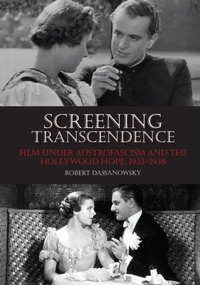
Screening Transcendence
Film Under Austrofascism and the Hollywood Hope, 1933-1938
1st Edition
Published on 1. May 2018
444 pages
978-0-253-03424-3 (ISBN)
Description

During the 1930s, Austrian film production companies developed a process to navigate the competing demands of audiences in Nazi Germany and those found in broader Western markets. In Screening Transcendence, film historian Robert Dassanowsky explores how Austrian filmmakers during the Austrofascist period (1933-1938) developed two overlapping industries: "Aryanized" films for distribution in Germany, its largest market, and "Emigrantenfilm," which employed emigre and Jewish talent that appealed to international audiences.
Through detailed archival research in both Vienna and the United States, Dassanowsky reveals what was culturally, socially, and politically at stake in these two simultaneous and overlapping film industries. Influenced by French auteurism, admired by Italian cinephiles, and ardently remade by Hollywood, these period Austrian films demonstrate a distinctive regional style mixed with transnational influences.
Combining brilliant close readings of individual films with thoroughly informed historical and cultural observations, Dassanowsky presents the story of a nation and an industry mired in politics, power, and intrigue on the brink of Nazi occupation.
Through detailed archival research in both Vienna and the United States, Dassanowsky reveals what was culturally, socially, and politically at stake in these two simultaneous and overlapping film industries. Influenced by French auteurism, admired by Italian cinephiles, and ardently remade by Hollywood, these period Austrian films demonstrate a distinctive regional style mixed with transnational influences.
Combining brilliant close readings of individual films with thoroughly informed historical and cultural observations, Dassanowsky presents the story of a nation and an industry mired in politics, power, and intrigue on the brink of Nazi occupation.
Reviews / Votes
Highly recommended.(Choice)
Screening Transcendence is so rich and informative that a short review can barely do justice to this important and interesting monograph. There is no doubt that this is a book that everyone interested in Austria during the 1930s should read.
(Journal of Austrian Studies)
Screening Transcendence undoubtedly constitutes a major contribution to the study of Austrian Cinema.....This little known episode in film history which Dassanowsky has uncovered ... tells of the unfolding drama of the Austrians' attempt to work with Hollywood studios in an effort to escape German pressure. He attributes the failure of an Austrian-Hollywood partnership to the American industry's commercial interests and its fear of offending German markets, as well as the strong German influence in Hollywood. Screening Transcendence does a great service by introducing this era to English-reading audiences... utterly fascinating....
(Contemporary Austrian Studies) Dassanowsky's carefully researched book provides an excellent account of Austrian film from those years and also forms, thanks to the inclusion of titles and production details of films from the era, a good basis for further research.
(FILMBLATT) The author is at home in both the European and the American cultural worlds, and he utilizes this to best advantage in his book. Anyone seeking an expert presentation of the particular influence Austrian film culture has had on Hollywood is well served by this meticulous and richly detailed work.
(German Studies Review) Robert Dassanowsky's Screening Transcendence provides the most comprehensive English-language examination to date of the complex and often neglected top of cinema under the Austrofascist regime of 1933 to 1938.
(Monatshefte)
All prices
More details
Language
English
Place of publication
Bloomington, IN
United States
Target group
Professional and scholarly
Product notice
Reflowable
Illustrations
62 b&w illus.
ISBN-13
978-0-253-03424-3 (9780253034243)
Copyright in bibliographic data and cover images is held by Nielsen Book Services Limited or by the publishers or by their respective licensors: all rights reserved.
Schweitzer Classification
Other editions
Additional editions
Robert Dassanowsky
Screening Transcendence
Film Under Austrofascism and the Hollywood Hope, 1933-1938
Book
05/2018
Indiana University Press
€59.50
Shipment within 10-20 days
Person
Robert Dassanowsky is Professor of German/Austrian Studies and Film at the University of Colorado, Colorado Springs. He is author of Austrian Cinema: A History, and editor of World Film Locations: Vienna, and Quentin Tarantino's Inglourious Basterds: A Manipulation of Metafilm. He is also an independent film producer.
Content
Acknowledgements
Foreword
Part I: Structures
1. System of Faith and Aesthetics of Loss: Austrian Cultural Politics in the First Republic and the Christian Corporate State
2. Scopic Regimes: Notes on Newsreel and Culture Film Production, the Legacy of Baroque and Fin de Siecle Vienna, and Political Catholicism in Public Spectacle
3. Against Nazism and with Catholicism? Two Film Industries and the Jewish Filmmaker's Conundrum
Part II: Genres and Types
4. Cinema Baroque: Reconsidering the Willi Forst/Walter Reisch Viennese Film Genre and its Trans/National/ist Value
5. Projecting Transcendence: Emigrantenfilm, the Church, and the Construction of a Catholic-Political Identity in Singende Jugend and Der Pfarrer von Kirchfeld
6. Gendering the Crusade: Female Types and Sexuality in Feature Film
7. Tales of the Patriarchy: Of Cavaliers, Cads, and the Common Man
8. Reasonable Fantasies: Cine-Operetta, the Saengerfilm, and Sociocritical Music Film
9. New Order Out of Chaos: The Austrian Screwball and Hybrid Comedy
10. Contemporary Conflicts: Experimentalism, Controversy, and the Question of National Film Style
11. Snow Blinded: The Alps versus Vienna in Film at the End of the Regime
Part III: Locations
12. From Rome to the Hollywood Hope: Shared Aesthetics, the 1936/37 Vienna-Hollywood Co-Production Plan, and Cine-Economic Brinkmanship with Berlin
Epilogue
Filmography: List of Austrian Feature Films 1933-1938
Bibliography
Index
Foreword
Part I: Structures
1. System of Faith and Aesthetics of Loss: Austrian Cultural Politics in the First Republic and the Christian Corporate State
2. Scopic Regimes: Notes on Newsreel and Culture Film Production, the Legacy of Baroque and Fin de Siecle Vienna, and Political Catholicism in Public Spectacle
3. Against Nazism and with Catholicism? Two Film Industries and the Jewish Filmmaker's Conundrum
Part II: Genres and Types
4. Cinema Baroque: Reconsidering the Willi Forst/Walter Reisch Viennese Film Genre and its Trans/National/ist Value
5. Projecting Transcendence: Emigrantenfilm, the Church, and the Construction of a Catholic-Political Identity in Singende Jugend and Der Pfarrer von Kirchfeld
6. Gendering the Crusade: Female Types and Sexuality in Feature Film
7. Tales of the Patriarchy: Of Cavaliers, Cads, and the Common Man
8. Reasonable Fantasies: Cine-Operetta, the Saengerfilm, and Sociocritical Music Film
9. New Order Out of Chaos: The Austrian Screwball and Hybrid Comedy
10. Contemporary Conflicts: Experimentalism, Controversy, and the Question of National Film Style
11. Snow Blinded: The Alps versus Vienna in Film at the End of the Regime
Part III: Locations
12. From Rome to the Hollywood Hope: Shared Aesthetics, the 1936/37 Vienna-Hollywood Co-Production Plan, and Cine-Economic Brinkmanship with Berlin
Epilogue
Filmography: List of Austrian Feature Films 1933-1938
Bibliography
Index
