

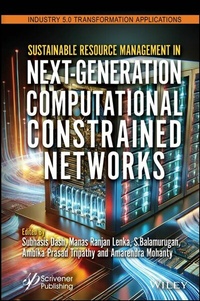
Sustainable Resource Management in Next-Generation Computational Constrained Networks
Description

The book provides essential insights into cutting-edge networking technologies that not only enhance performance and efficiency but also address critical sustainability challenges in an increasingly connected world.
The landscape of networking and computational technologies is rapidly evolving, driven by the increasing demand for efficient and sustainable resource management. The advent of next-generation technologies such as 5G and 6G has marked a significant leap in enabling high-capacity, low-latency communication and massive connectivity. These advancements are crucial for supporting the growing number of connected devices and complex applications they run, particularly in environments with limited processing, memory, and energy capabilities.
Sustainable Resource Management in Next-Generation Computational Constrained Networks provides insight into the advancements of recent cutting-edge networking technologies that cater to society's needs more efficiently, meeting the expectations of sustainable resource management in computationally constrained networks. By exploring the practical applications of various next-generation technologies, the book addresses critical challenges such as scalability, interoperability, energy efficiency, and security. This knowledge equips professionals with the tools to enhance network performance, optimize resource management, and develop innovative solutions for sustainable and efficient computational networks, ultimately contributing to the advancement of technology and societal well-being.
Readers will find this book:
- Provides thorough reviews on a wide range of cutting-edge network technologies contributing to resource management in computationally constrained networks;
- Explores the role of various network technologies for the development of sustainable applications;
- Details architectural viewpoints of integrating emerging network technologies with real-world applications to manage network resources efficiently;
- Highlights challenges in integrating the latest network technologies with sustainable real-world applications;
- Discusses real-world case studies of various network technologies in leveraging sustainable resource management for the fulfillment of different industrial and societal needs.
Audience
Software engineers, electronic engineers, and policymakers in the networking and security domain.
More details
Other editions
Additional editions
Persons
Subhasis Dash, PhD is an assistant professor in the School of Computer Engineering at the Kalinga Institute of Industrial Technology with over 22 years of teaching experience. His research interests include wireless sensor networks, distributed computing, and operating systems.
Manas Ranjan Lenka, PhD is an assistant professor in the School of Computer Engineering, at the Kalinga Institute of Industrial Technology with over 18 years of experience. His current research focuses on wireless sensor networks, mobile wireless networks, Internet of Things, and blockchain.
S. Balamurugan, PhD is the Director of Intelligent Research Consultancy Services and serves as a consultant for many other companies and start-ups. He has published over 70 books, 300 articles in national and international journals and conferences, and 300 patents. His research interests include artificial intelligence, machine learning, soft computing algorithms, and robotics and automation.
Ambika Prasad Tripathy is a senior technical leader with Cisco's Network Security Business Unit with over 17 years of experience. He has worked in the network industry to standardize Yang-based subscription mechanisms and their applications. He specializes in Sigtran, 3G, 4G core networks, switching and routing, telemetry, and datacenter, network, and cloud security.
Amarendra Mohanty is a senior engineer at the Intel Corporation in India with over 17 years of research experience. He has worked for a number of leading companies in the computer science field, including Intel, VMWare, TCS, and Aricent. His specializations include network security, network virtualization, data center networking, routing and switching, and 3G wireless networks in the development and QA fields.
Content
Preface xv
1 Enhancing Digital Learning Pedagogy for Lecture Video Recommendation Using Brain Wave Signal 1
Rabi Shaw, Simanjeet Kalia and Sourabh Mohanty
1.1 Introduction 2
1.2 Related Work 4
1.2.1 E-Learning, M-Learning, and T-Learning 4
1.2.2 Involvement of Networking Reforms in Education 6
1.2.3 Literature Review for Use of NeuroSky Headset in Education Domain 6
1.3 Background 10
1.4 Dataset 10
1.5 Proposed Method and Result 11
1.5.1 Collaborative Filtering Using Brain Signal-Induced Preferences 11
1.5.1.1 Neurophysiological Experiment 11
1.5.1.2 Deducing Preferences from Brain Signals 14
1.5.2 Proposed Methodology for FlipRec Model 16
1.5.2.1 Module for Data Preparation 16
1.5.2.2 FlipRec: Preferred Recommendation Model 19
1.5.3 Using Brain Signal Technology, a Cognitively Aware Lecture Video Recommendation System in Flipped Learning 20
1.5.3.1 Finding Successful Cognitive States with a Clustering Method 20
1.5.3.2 Feature Derivation for Estimating Attention 22
1.6 Result Analysis 23
1.7 Conclusion and Future Research 25
References 25
2 Blockchain-Based Sustainable Supply Chain Management 31
Anuja Ajay, Saji M. S. and Subhasis Dash
2.1 Introduction 32
2.1.1 Significance of Blockchain for SCM 34
2.1.2 Introduction to Blockchain Interoperability 35
2.2 Blockchain for Supply Chain Management 35
2.2.1 Characteristics and Requirements of Blockchain-Based Supply Chain 37
2.2.1.1 Characteristics of Supply Chain 37
2.2.1.2 Requirements of Supply Chain 40
2.2.2 Blockchain-Based Data Sharing for Supply Chain 41
2.2.3 Access Control and Trust Management in Blockchain- Based SCM 43
2.2.3.1 Access Control Mechanisms in SCM 43
2.2.3.2 Trust Management in Supply Chain 44
2.3 Interoperability in Blockchain 45
2.3.1 Overview of Blockchain Interoperability Approaches 45
2.3.1.1 Public Connectors 45
2.3.1.2 Blockchain of Blockchains (BoB) 46
2.3.1.3 Hybrid Connectors 46
2.3.2 Gateways for Interoperability and Manageability 48
2.3.3 Interoperability Approaches 49
2.4 Design Considerations and Open Challenges 50
2.5 Summary 51
2.5.1 Advantages of Blockchain for SSCM 51
2.6 Scope of Future Work Emphasis 52
References 53
3 Revolutionizing Aquaculture With the Internet of Things (IoT): An Insightful Learning 59
Arpita Nayak, Atmika Patnaik, Ipseeta Satpathy, Veena Goswami and B.C.M. Patnaik
3.1 Introduction 60
3.2 Environmental Monitoring via IoT for Sustainable Aquaculture 63
3.3 The Primacy of IoT in Enhancing Fish Health Monitoring 67
3.4 Delving Into IoT: Improving Agricultural Water Quality Management 70
3.5 Connecting the Dots: Using IoT Fish Behavior Monitoring to Improve Aquaculture Practices 74
3.6 The Worldwide Deployment of IoT in Aquaculture: Advantages and Success Factors 79
3.7 Conclusion 81
Acknowledgment 81
References 81
4 Energy Consumption Optimization in Wireless Sensor Networks 87
Avik Das, Shatyaki Ghosh and Arindam Basak
4.1 Introduction 87
4.1.1 WSN Application and Hardware Characteristics 90
4.2 MAC Layer Approaches 93
4.2.1 IEEE 802.15.4 Standard along with the ZigBee Technology 94
4.2.2 Different Other MAC Approaches 95
4.3 Routing Approaches 98
4.4 Transmission Power Control Approaches 99
4.5 Autonomic Approaches 102
4.6 Application of ZigBee in a WSN 105
4.7 WSN with Cloud Computing 106
4.8 Final Considerations and Future Directions 109
References 110
5 Airline Prediction Using Customer Feedback and Rating Using Machine Learning and Deep Learning 115
Ch Sambasiva Rao, Pabbathi Manobhi Ram, Viswanadhapalli Siva and Motakatla Satya Sai Krishna Reddy
5.1 Introduction 116
5.1.1 Customer Ratings and Recommendation 116
5.2 Literature Survey 117
5.3 System Design 119
5.4 Methodology 120
5.4.1 Modules 120
5.4.1.1 Data Collection 120
5.4.1.2 Review-Based Airline Prediction 120
5.4.1.3 Rating-Based Airline Prediction 121
5.5 Algorithm Used: Random Forest, Convolutional Neural Network, and AdaBoost 121
5.5.1 Random Forest System 121
5.5.2 Convolutional 1D Neural Network-Based Training 122
5.5.2.1 Sequential Model 122
5.5.2.2 Add 1D Convolutional Layer 123
5.5.2.3 Adding 1D Max Pooling Layer 123
5.5.2.4 Adding Dense Layer 123
5.5.2.5 Neural Network Training 123
5.5.3 AdaBoost Algorithm 124
5.6 Experimental Results and Evaluations 125
5.7 Screenshots 126
5.8 Conclusion 130
References 130
6 The Breakthrough of Future Delivery: Delivery Robots 133
Ayushi Gupta
6.1 Introduction 133
6.2 Related Work 136
6.3 Evolution of Delivery Robot 138
6.4 Working Principal/Model of Delivery Robots 141
6.5 Benefits of Delivery Robots 143
6.6 Applications of Delivery Robots 149
6.7 Development Projects 153
6.8 Challenging Issues with Delivery Robots 158
6.9 Conclusion and Future Work 165
References 166
7 Emergence of Cloud Computing in IoT Applications 169
Priyanshu Sonthalia and Doddi Puneet
7.1 Introduction 170
7.1.1 Characteristics of Cloud Computing 170
7.1.2 Types of Cloud Deployment Models 171
7.1.3 Categories of Cloud Computing Architectures 172
7.1.4 Types of Cloud Service Models 173
7.2 Benefits of IoT and Cloud Integration 174
7.2.1 Scalability and Elasticity of Cloud Resources for Managing IoT Data 174
7.2.2 Reduced Infrastructure Costs with Cloud-Based Solutions 174
7.2.3 Improved Accessibility and Availability of IoT Services with Cloud Deployment 175
7.2.4 Enhanced Processing Power and Analytics Capabilities with Cloud Computing 175
7.2.5 Reduced Time to Market and Increased Innovation with Cloud-Based IoT Development 175
7.3 Cloud-Based IoT Architecture 175
7.3.1 Four Layers of Cloud-Based IoT Architecture 175
7.3.2 Role of Gateways in Linking IoT Devices to the Cloud 176
7.3.3 Overview of Cloud-Based IoT Platforms and Services 177
7.3.4 Cloud-Based IoT Standards and Protocols, such as MQTT, CoAP, AMQP, and HTTP 177
7.4 Cloud-Based IoT Applications 180
7.5 Challenges in IoT Cloud Integration 181
7.5.1 Security Risks and Challenges Associated with Cloud-Based IoT Solutions 181
7.5.2 Latency and Bandwidth Constraints of IoT Systems Hosted in the Cloud 181
7.5.3 Interoperability Issues Between Different IoT Devices and Cloud Platforms 182
7.5.4 Legal and Regulatory Challenges Associated with IoT Using Cloud Solutions 182
7.6 Open Issues and Research Directions 182
7.6.1 Future Trends and Developments in Cloud-Based IoT Solutions 182
7.6.2 Opportunities for Research in Cloud-Based IoT Solutions 182
7.6.3 Overview of Emerging Cloud-Based IoT Standards and Protocols 183
7.7 Case Study 1: Smart Home Automation Using Cloud-Based IoT 183
7.8 Case Study 2: Industrial IoT Optimization Using Cloud-Based IoT 184
7.9 Conclusion 185
References 186
8 Conceptual Assessment of Sensory Networks and Its Functional Aspects 189
Barat Nikhita, Siddhant Prateek Mahanayak and Kunal Anand
8.1 Introduction 189
8.2 Evolution of IoT 191
8.2.1 Phase 1: Early Adopters (Pre-2010) 192
8.2.2 Phase 2: Connectivity and Smart Devices (2010-2015) 193
8.2.3 Phase 3: Big Data and Cloud Computing (2015 to Present) 194
8.2.4 Phase 4: Artificial Intelligence and Edge Computing (Present and Future) 195
8.3 Features of IoT 196
8.4 Architectural Framework of IoT 199
8.4.1 Device Layer 200
8.4.2 Network Layer 201
8.4.3 Platform Layer 202
8.4.4 Application Layer 203
8.5 Components of IoT 204
8.6 Applications of IoT 206
8.7 Case Study 211
8.7.1 Overview of Barcelona Smart City Project 211
8.7.2 Methodology 212
8.8 Conclusion 213
References 214
9 System Security Using Artificial Intelligence and Reduction of Data Breach 221
M. Avrit, G. P. Siranjeevi, Shruti Mishra, Sandeep Kumar Satapathy, Priyanka Mishra, Pradeep Kumar Mallick and Gyoo Soo Chae
9.1 Introduction 222
9.2 Related Work 224
9.3 Methodology 224
9.3.1 Implementation of Socket Programming Concept 224
9.3.2 Machine Learning 225
9.3.3 Deep Learning 225
9.3.4 Human Assistance 225
9.4 Proposed Model 225
9.5 Experimental Result/Result Analysis 227
9.6 Conclusion and Future Work 231
References 231
10 Mitigating DDoS Attacks: Empowering Network Infrastructure Resilience with AI and ML 233
Teja Pasonri, Saurav Singh, Vedant Shirapure, Sandeep Kumar Satapathy, Sung-Bae Cho, Shruti Mishra and Pradeep Kumar Mallick
10.1 Introduction 234
10.1.1 Categories of DDoS Attack 235
10.1.1.1 SYN Flood Attacks 235
10.1.1.2 UDP Flood Attacks 235
10.1.1.3 MSSQL Attacks 235
10.1.1.4 LDAP Attacks 235
10.1.1.5 Portmap Attacks 236
10.1.1.6 NetBIOS Attacks 236
10.1.2 Harnessing Machine Learning for DDoS Threat Detection 236
10.1.3 AI Models for DDoS Threat Detection 236
10.1.4 Beyond Classification: AI for Real-Time Detection and Mitigation 237
10.1.5 Collaboration and Knowledge Sharing 237
10.2 Related Work 237
10.3 Methodology 239
10.3.1 Pseudocode-1: Jupyter Project Code 240
10.3.2 Pseudocode-2: Project KNN Model 241
10.3.3 Hyperparameter Tuning and Evaluation 242
10.3.4 Enhancing Model Accuracy 242
10.3.5 Ping Request and DDoS Attack 242
10.4 Proposed Model 243
10.5 Experimental Result/Result Analysis 245
10.5.1 Demo of DDoS Attack 245
10.5.2 Packet Sniffing and Detecting Traffic 246
10.5.3 Accuracy Graph 246
10.5.4 Precision Graph 247
10.6 Conclusion/Future Work 248
References 248
11 CyberEDU: An Interactive Educational Tool for DDoS Attack Simulation and Prevention 251
Pulkit Srivastava, Vedant Shah, Priyanshu Singh, Sandeep Kumar Satapathy, Sung-Bae Cho, Shruti Mishra and Pradeep Kumar Mallick
11.1 Introduction 252
11.2 Related Work 255
11.3 Methodology 257
11.4 Proposed Model 260
11.5 Experimental Result/Result Analysis 263
11.6 Conclusion and Future Work 267
References 267
12 Resource Management and Performance Optimization in Constraint Network Systems 269
Amarendra Kumar Mohanty
12.1 Introduction 270
12.2 Resource Allocation Principles 271
12.3 Network Capacity and Utilization 274
12.4 Performance Optimization Strategies 280
12.4.1 Resource Management in Physical Networks 281
12.4.2 Resource Management in Virtual Networks 297
12.4.3 Resource Management in Software-Defined Networking (SDN) 300
12.5 Real-World Applications 302
12.5.1 Data Plane Development Kit Libraries 306
12.5.2 Virtual Machine Device Queues (VMDQ) 309
12.6 Conclusion and Future Directions 311
References 312
13 Resource-Constrained Network Management Using Software-Defined Networks 315
Sayan Bhattacharyya, Manas Ranjan Lenka and Subhasis Dash
13.1 Introduction 315
13.2 Software-Defined Network Architecture and Its Key Components 317
13.2.1 Application Plane 319
13.2.1.1 Network Application 320
13.2.1.2 Language-Level Virtualization 320
13.2.2 Control Plane 320
13.2.2.1 Network Operating System (NOS) 320
13.2.2.2 Network Hypervisor 320
13.2.3 Data Plane 321
13.2.3.1 Network Infrastructure 321
13.2.4 SDN Protocols 321
13.2.4.1 Northbound Protocol 321
13.2.4.2 Southbound Protocol 322
13.2.4.3 Eastbound Protocol 322
13.2.4.4 Westbound Protocol 323
13.2.5 SDN Workflows 324
13.3 Challenges and Opportunities of SDN in Resource- Constrained Scenarios 326
13.4 State-of-the-Art Techniques and Tools for Efficient Network Resource Management in SDN Environments 327
13.5 Performance of the Existing Techniques and Tools with Use Case 329
13.6 Conclusion and Future Scope 330
References 331
14 Vehicles Smoke Monitoring Using Internet of Things and Machine Learning 337
Dhavakumar P. and Selvakumar Samuel
14.1 Introduction 337
14.2 Vehicle CO 2 Emissions 338
14.2.1 Impacts of CO 2 Emissions 339
14.3 Recommended Solutions with Internet of Things 340
14.3.1 IoT System and CO 2 Sensors 340
14.3.2 Benefits of the IoT System 342
14.3.3 Air Quality Monitoring System (AQMS) 343
14.4 ml Algorithms 346
14.4.1 K-Means Algorithm (KM) 346
14.4.2 Decision Tree Algorithm (DT) 347
14.4.3 Naive Bayes Algorithm (NB) 347
14.4.4 Controlling Carbon Unlimited Flow Operation with Machine Learning Approach (CULTML) 347
14.5 Proposed System Architectures and Designs 348
14.5.1 Vehicular Unit 349
14.5.2 Software Unit 350
14.5.3 Road Transport Office (RTO) Unit 351
14.6 Logical Design of the Proposed System 352
14.6.1 Summation Detector Using Artificial Intelligence 352
14.6.2 Digit Recognition 352
14.7 Experimental Results 354
14.8 Physical Design of the Proposed System 356
14.9 Conclusion 357
References 357
15 Enhancing Home Security through IoT Innovation: Recommendations for Biometric Door Lock System to Deter Break-Ins 359
Muhammad Ehsan Rana, Kamalanathan Shanmugam, Lim Enya and Hrudaya Kumar Tripathy
15.1 Introduction 360
15.2 Literature Review 361
15.2.1 Home Security Concerns in Malaysia 362
15.2.2 Introduction to Biometric Solutions 363
15.2.3 Enhancing Biometrics with Machine Learning 364
15.2.4 Biometrics in the Realm of Smart Home Security 365
15.2.5 Review of Existing Commercial Systems 367
15.2.5.1 Samsung Smart Door Lock 367
15.2.5.2 Philips EasyKey 369
15.2.5.3 Comparison of Systems 371
15.3 Recommendations for the Implementation of the Proposed Biometric Door Lock System 372
15.3.1 Software Requirements 373
15.3.2 Key Hardware Requirements 374
15.3.2.1 Arduino Nano 374
15.3.2.2 DFRobot HuskyLens 375
15.3.2.3 DFRobot UART Fingerprint Scanner 375
15.3.2.4 Five-Volt Single-Channel Relay Module 376
15.3.2.5 12VDC Solenoid Lock 376
15.3.3 Workflow of the Proposed System 376
15.3.4 Key Features of the Proposed System 378
15.3.5 Testing the Biometric Door Lock System 380
15.3.5.1 Fingerprint Authentication Test 380
15.3.5.2 Facial Recognition Test 381
15.3.5.3 Dual Authentication Test 382
15.3.5.4 Access Log Test 384
15.3.5.5 Mobile Application Integration Test 385
15.3.5.6 Scalability Test 386
15.3.5.7 Accuracy Result Analysis 387
15.4 Conclusion and Future Recommendations 389
References 390
Index 393
Preface
The exponential growth of the internet and the increasing interconnectedness of devices worldwide have revolutionized our daily lives and resource management. As we navigate this technological surge, the imperative for sustainable resource management intensifies. This book provides an in-depth exploration of the latest advancements in networking technologies that meet these sustainability challenges.
The material herein explores the transformative potential of 6G and 5G technologies, which are set to overhaul our communication networks with their increased capacities, extensive connectivity, and low-latency features. These next-generation networks are crucial for enabling significant automation, thereby reducing energy demands and processing requirements. Additionally, the book examines the Internet of Things (IoT) and its industrial counterpart, Industrial IoT (IIoT), for their ability to revolutionize industrial cyber-physical systems. Despite IoT's vast potential, its adoption has been curtailed by scalability, interoperability, and security issues. The discussion extends to how robust IIoT solutions can effectively tackle these challenges.
A focal point of the book is blockchain technology, which ensures robust end-to-end security in IoT environments, safeguarding against central attacks even if individual entry points are compromised. It also covers the roles of software-defined networking (SDN) and network function virtualization (NFV) in enhancing network scalability and facilitating dynamic service configurations. Moreover, the significance of mobile edge computing is highlighted, bringing computational power closer to data sources to boost real-time application performance while reducing latency and bandwidth usage.
The value of this book lies not only in its technological insights but also in its practical applications and real-world impacts, spanning intelligent homes, data centers, e-health, and smart cities. These technologies optimize resource management in computationally constrained networks, enhancing environmental sustainability and societal well-being. Targeted at a diverse readership of researchers, academicians, and industry professionals, the book provides a comprehensive understanding of current technological trends and their potential to drive sustainable resource management. It offers a detailed analysis of challenges and solutions, aiming to inspire further research and development in sustainable and efficient networking technologies. We hope this book serves as a valuable resource and a source of inspiration for those interested in the nexus of technology and sustainability, encouraging collaborative efforts and innovative thinking to forge a more sustainable future for our globally connected world.
Chapter 1 examines the use of Neurosky Mindwave Mobile 2 (NMM2) to monitor students' cognitive activity in educational settings, enhancing learning through personalized video recommendations based on brain wave signals, with data analysis from institutions like the National Institutes of Technology Rourkela to optimize engagement and educational outcomes. Chapter 2 explores the integration of blockchain technology in supply chain management, emphasizing its role in enhancing transparency, traceability, and efficiency, addressing IoT security, and promoting sustainability through decentralized approaches and blockchain interoperability. Chapter 3 delves into the transformative impact of IoT on the aquaculture industry, using sensors, cameras, and RFID tags to collect and analyze real-time data on fish behavior and environmental conditions, significantly improving efficiency, reducing losses, and enhancing the sustainability of fish farming practices.
Chapter 4 delves into consumption optimization in Wireless Sensor Networks (WSNs), crucial for prolonging network lifetime and enhancing performance. It discusses strategies such as energy-efficient routing with protocols like LEACH and PEGASIS, data aggregation to reduce redundancy, duty cycling to save energy, and advanced methods like energy harvesting and adaptive algorithms to further optimize consumption, ensuring sustainable WSN operations.
Chapter 5 explores the significant reliance of U.S. consumers on online reviews and testimonials before making purchases, with 82% reading reviews and 40% doing so frequently. The chapter details a study that analyzed data from online airline reviews using advanced machine learning techniques like random forests and Convolutional Neural Networks (CNNs). The predictive analysis, based on over 3000 instances from www.airlinequality.com, aimed to identify the most suitable airlines from customer feedback, demonstrating how machine learning can enhance customer satisfaction and decision-making in the airline industry.
Chapter 6 discusses the accelerated shift towards online shopping and the rising need for contactless delivery solutions spurred by the COVID-19 pandemic. It provides a comprehensive overview of delivery robots, their adoption boosted by their ability to minimize human contact, reduce manpower, and decrease pollution. The chapter examines their development, functionality, and the challenges they face, highlighting their role in the Emerging Disruptive Technologies for Society 5.0 initiative and their effective use across various industries globally. It posits that as technologies evolve, delivery robots will play a crucial role in the future of logistics and transportation, enhancing goods delivery efficiency and safety, and fostering the creation of smarter, more sustainable societies.
Chapter 7 explores the integration of cloud computing with IoT, emphasizing how cloud services like SaaS, PaaS, and IaaS manage large volumes of IoT data. It discusses cloud-based IoT standards and protocols like MQTT and HTTP, and illustrates their applications in sectors like healthcare and agriculture. The chapter also highlights challenges such as security risks and presents case studies on smart home automation and industrial IoT, suggesting future research in edge computing and serverless processing.
Chapter 8 examines sensory networks within the IoT framework, focusing on their impact on industries like smart homes and healthcare. It details the role of IoT in enhancing functionalities such as home security and energy management with renewable sources. Challenges like interoperability and security are addressed, alongside the increasing role of wearable devices and edge computing in expanding IoT capabilities.
Chapter 9 discusses integrating AI with cloud security to combat data breaches, emphasizing the use of deep learning for malware detection and intrusion prevention. It outlines the importance of minimizing human error and advocates for a self-learning AI system to enhance security intelligence and protection of sensitive data. Strategies include deploying AI-operated servers and utilizing deep learning to strengthen cloud security defenses and ensure resilience against cyber threats.
Chapter 10 addresses the escalating threat of Distributed Denial of Service (DDoS) attacks and the innovative use of AI and machine learning to enhance network resilience. Researchers analyze DDoS attack patterns to develop countermeasures that improve real-time detection and mitigation, ensuring the integrity and accessibility of web infrastructures.
Chapter 11 introduces CyberEDU, a practical educational tool for simulating and preventing DDoS attacks, bridging the gap between theoretical knowledge and practical application. This tool enhances the skills of professionals and students, equipping them to effectively combat DDoS threats and contributing to a more prepared and aware cybersecurity workforce.
Chapter 12 explores effective resource management techniques in network systems constrained by limited resources. It discusses the optimization of bandwidth, buffer space, and computational assets to enhance network performance, minimize latency, and meet diverse performance objectives, providing crucial insights for practitioners and researchers navigating the complexities of network optimization.
Chapter 13 discusses the evolution of network architectures through software-defined networking (SDN), which separates network control from data forwarding to enhance flexibility and efficiency. It provides a detailed overview of SDN, including its architecture, components, and workflow, and examines its role in improving management in resource-constrained networks (RCNs). Additionally, the chapter explores SDN's integration with IoT and 5G, aiming to familiarize newcomers with its transformative impact on modern networking.
Focusing on reducing vehicle emissions to combat global warming, Chapter 14 introduces an innovative system combining IoT and a CNN-SVM hybrid machine learning model. This system analyzes emission streams to identify high-polluting vehicles and prompts regulatory actions. By enhancing real-time monitoring and alert mechanisms, it supports environmental sustainability and energy efficiency in transportation, presenting a proactive solution to control emissions and mitigate air pollution.
Addressing the rising crime rates in Malaysia, this research integrates IoT technology with biometric systems to bolster home security. It proposes a biometric door lock system using fingerprint and facial recognition to prevent unauthorized access, while considering sustainable resource management in smart home systems. Chapter 15 highlights the advantages of biometric authentication and the importance of refining these systems to enhance residential security, advocating for the integration of...
