

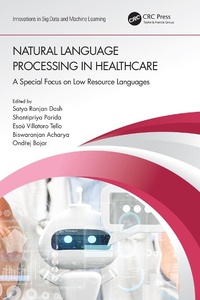
Natural Language Processing In Healthcare
A Special Focus on Low Resource Languages
1st Edition
Published on 13. September 2022
312 pages
978-1-000-62469-4 (ISBN)
Description

Natural Language Processing In Healthcare: A Special Focus on Low Resource Languages covers the theoretical and practical aspects as well as ethical and social implications of NLP in healthcare. It showcases the latest research and developments contributing to the rising awareness and importance of maintaining linguistic diversity. The book goes on to present current advances and scenarios based on solutions in healthcare and low resource languages and identifies the major challenges and opportunities that will impact NLP in clinical practice and health studies.
More details
Series
Edition
1. Auflage
Language
English
Place of publication
London
United Kingdom
Publishing group
Taylor & Francis Ltd
Target group
College/higher education
Professional and scholarly
Product notice
Reflowable
Illustrations
59 Tables, black and white; 29 Line drawings, black and white; 5 Halftones, black and white; 34 Illustrations, black and white
ISBN-13
978-1-000-62469-4 (9781000624694)
Copyright in bibliographic data and cover images is held by Nielsen Book Services Limited or by the publishers or by their respective licensors: all rights reserved.
Schweitzer Classification
Other editions
Additional editions
Satya Ranjan Dash | Shantipriya Parida | Esau Villatoro Tello
Natural Language Processing In Healthcare
A Special Focus on Low Resource Languages
Book
10/2024
1st Edition
CRC Press
€85.70
Shipment within 15-20 days
Satya Ranjan Dash | Shantipriya Parida | Esau Villatoro Tello
Natural Language Processing In Healthcare
A Special Focus on Low Resource Languages
Book
09/2022
1st Edition
CRC Press
€241.00
Shipment within 15-20 days
Persons
Dr. Ondrej Bojar is a lead scientist in the field of Machine Translation in the Czech Republic. He works as an associate professor at the Institute of Formal and Applied Linguistics at Charles University. Machine translation has been in the center of his research interests since 2005, early in his Ph.D. studies. He has been regularly participating and since 2013 co-organizing WMT shared tasks with a specific focus on translation into Czech. His system has dominated English-Czech translation in the years 2013-2015, before deep learning and neural networks fundamentally changed the field. Ondrej's main focus now is a little broader and entails machine learning in general with explicit aims towards meaning representation and natural language understanding, including speech processing.
Dr. Satya Ranjan Dash is a computer professional, with his research interest in machine learning, deep learning with NLP, Computational Biology, and Biomedical domain. He is currently working as an associate professor at KIIT University, India. His current research includes Natural Language Processing, particularly text summarization, topic detection, language detection, machine translation for low resource languages.
Dr. Shantipriya Parida works as a Post-doctoral researcher at Idiap Research Institute, Switzerland since Feb 2019. His current research includes Natural Language Processing, particularly text summarization, topic detection, language detection, machine translation for Indian languages, multi-modal machine translation, and corpus development for low resource Indian language. Before Idiap, he was working as a Post-doctoral researcher with Prof. Ondrej Bojar at Charles University, Prague working on Machine Translation, and Deep Learning. He has expertise in Machine Learning, AI, Computational Neuroscience, Product Development, System/Solution Architecture. He is an organizing committee member for Workshop on Asian Translation WAT2019 and WAT2020. Along with Prof. Ondrej Bojar organized the WAT2019 Multimodal-Translation Task. He also serves as a program committee member for the LREC 2020 Workshop on Indian Language Data: Resources and Evaluation (WILDRE).
Dr. Esau Villatoro holds a tenure position at the Universidad Autonoma Metropolitana campus Cuajimalpa (UAM-C) in Mexico City. Currently, he is an academic visitor at Idiap Research Institute in Martigny Switzerland. His main research interests are related to Natural Language Processing, particularly authorship analysis, and non-thematic text categorization. He is an active member of several research groups and NLP organizations: the Language and Reasoning research Group at UAM-C, the Laboratory of Language Technologies at the National Institute of Astrophysics, Optics and Electronics, the Mexican Association for Natural Language Processing (AMPLN), the Hispano-American Network for Automatic Human Language Processing (RedHisTAL) and the Mexican Academy of Computer Science (AMEXCOMP).
Biswa Ranjan Acharya is an academic currently associated with Kalinga Institute of Industrial Technology Deemed to be University along with pursuing a Ph.D. in computer application from Veer Surendra Sai University of Technology (VSSUT), Burla, Odisha, India. He has received MCA in 2009 from IGNOU, New Delhi, India and M.Tech in Computer Science and Engineering in the year of 2012 from Biju Pattanaik University of Technology (BPUT), Odisha, India. He is also associated with various educational and research societies like IEEE, IACSIT, CSI, IAENG, and ISC. He has 2 years of industry experience as a software engineer, a total of 10 years of experience in both academia of some reputed universities like Ravenshaw University and the software development field. He is currently working on research area multiprocessor scheduling along with different fields like Data Analytics, Computer Vision, Machine Learning, and IoT. He published some research articles in internationally reputable journals as well as serving as a reviewer.
Dr. Satya Ranjan Dash is a computer professional, with his research interest in machine learning, deep learning with NLP, Computational Biology, and Biomedical domain. He is currently working as an associate professor at KIIT University, India. His current research includes Natural Language Processing, particularly text summarization, topic detection, language detection, machine translation for low resource languages.
Dr. Shantipriya Parida works as a Post-doctoral researcher at Idiap Research Institute, Switzerland since Feb 2019. His current research includes Natural Language Processing, particularly text summarization, topic detection, language detection, machine translation for Indian languages, multi-modal machine translation, and corpus development for low resource Indian language. Before Idiap, he was working as a Post-doctoral researcher with Prof. Ondrej Bojar at Charles University, Prague working on Machine Translation, and Deep Learning. He has expertise in Machine Learning, AI, Computational Neuroscience, Product Development, System/Solution Architecture. He is an organizing committee member for Workshop on Asian Translation WAT2019 and WAT2020. Along with Prof. Ondrej Bojar organized the WAT2019 Multimodal-Translation Task. He also serves as a program committee member for the LREC 2020 Workshop on Indian Language Data: Resources and Evaluation (WILDRE).
Dr. Esau Villatoro holds a tenure position at the Universidad Autonoma Metropolitana campus Cuajimalpa (UAM-C) in Mexico City. Currently, he is an academic visitor at Idiap Research Institute in Martigny Switzerland. His main research interests are related to Natural Language Processing, particularly authorship analysis, and non-thematic text categorization. He is an active member of several research groups and NLP organizations: the Language and Reasoning research Group at UAM-C, the Laboratory of Language Technologies at the National Institute of Astrophysics, Optics and Electronics, the Mexican Association for Natural Language Processing (AMPLN), the Hispano-American Network for Automatic Human Language Processing (RedHisTAL) and the Mexican Academy of Computer Science (AMEXCOMP).
Biswa Ranjan Acharya is an academic currently associated with Kalinga Institute of Industrial Technology Deemed to be University along with pursuing a Ph.D. in computer application from Veer Surendra Sai University of Technology (VSSUT), Burla, Odisha, India. He has received MCA in 2009 from IGNOU, New Delhi, India and M.Tech in Computer Science and Engineering in the year of 2012 from Biju Pattanaik University of Technology (BPUT), Odisha, India. He is also associated with various educational and research societies like IEEE, IACSIT, CSI, IAENG, and ISC. He has 2 years of industry experience as a software engineer, a total of 10 years of experience in both academia of some reputed universities like Ravenshaw University and the software development field. He is currently working on research area multiprocessor scheduling along with different fields like Data Analytics, Computer Vision, Machine Learning, and IoT. He published some research articles in internationally reputable journals as well as serving as a reviewer.
Content
Chapter 1. A Clinical Practice by Machine Translation on Low Resource Languages, Chapter 2. Feature Analysis and Classification of Impaired Language Caused by Brain Injury, Chapter 3. Natural Language Processing for Mental Disorders: an Overview, Chapter 4. Healthcare Nlp Infrastructure for the Greek Language, Chapter 5. Formalizing the Recognition of Medical Domain Multiword Units, Chapter 6. Healfavor: Machine Translation Enabled Healthcare Chat Based Application, Chapter 7. Development of a Machine Translation System for Promoting the Use of a Low Resource Language in the Clinical Domain: the Case of Basque, Chapter 8. Clinical Nlp for Drug Safety, Chapter 9. Language- and Domain-independent Approach to Automatic Detection of Covid-19 Fake News, Chapter 10. Employing Computational Linguistics to Improve Patient-provider Secure Email Exchange: the Eclippse Study
