

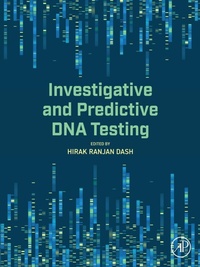
Investigative and Predictive DNA Testing
Published on 5. November 2025
600 pages
978-0-443-30129-2 (ISBN)
Description

Investigative and Predictive DNA Testing delves into the cutting-edge of DNA analysis, presenting a comprehensive guide that unlocks the potential of DNA in solving complex cases. This book stands as a vital resource for students, practitioners, and researchers in fields such as biology, zoology, medicine, anthropology, microbiology, and genetics. Designed for those with a basic understanding of biological sciences, it is particularly beneficial for graduate, post-graduate, and research level students. The book explores the evolution of DNA analysis, focusing on predictive methods and investigative leads such as ancestry, lineage, and phenotype.Each chapter, contributed by internationally renowned experts, highlights the transformative role of artificial intelligence and machine learning in enhancing the accuracy and utility of DNA analysis. The book is comprised of various sections, starting with fundamental concepts of investigative and predictive DNA analysis, followed by technological advancements in the field, and concluding with the challenges and future concerns of DNA analysis. It serves as an indispensable tool for anyone looking to expand their knowledge and skills in DNA analysis, making it a must-read for the scientific community.
- Describes the fundamentals of investigative and predictive approaches for forensic applications
- Explains the technological advances in forensic DNA analysis
- Includes real case studies related to predictive DNA analysis
- Provides futuristic use and applications of predictive forensic DNA analysis
- Uses real time images for easy understanding
More details
Other editions
Additional editions
Hirak Ranjan Dash
INVESTIGATIVE AND PREDICTIVE DNA
Book
11/2025
Academic Press
€161.50
Shipment within 15-20 days
Content
Part IModule I: Conventional forensic DNA analysis1. Fundamentals and principles of forensic DNA analysis2. Autosomal short tandem repeat analysis and its usefulness in forensic DNA analysis3. Detection and identification of forensically relevant body fluids4. Analysis of mitochondrial DNA and its aid in forensic investigation5. Law and practice of forensic DNA profiling in India: Perspectives and challengesPart IIModule II: Technological advancements in forensic DNA analysis6. Understanding Rapid DNA and its application7. Rapidly mutating Y-short tandem repeats in forensic DNA analysis8. The use of biallelic genetic markers in forensic DNA analysis9. Epigenetics and its application in forensic analysis10. Microbial DNA in forensic science: a tool for predicting postmortem interval11. Probabilistic genotyping techniques and their applications12. Applications of genetics in archaeological investigations: exploring human migration and genetic evolution in Indian subcontinent13. Digital polymerase chain reaction: a revolution in forensic DNA analysis14. Role of nanotechnology in forensic DNA analysis15. Advancements in wildlife forensics16. Usefulness of microsatellite markers in forensic botany17. DNA barcoding as a useful tool in the identification of endangered plants18. Prenatal paternity testing and forensic applications of noninvasive prenatal paternity testing technology19. Secondary transfer and its involvement in forensic investigation
Part IIIModule III: Predictive forensic DNA analysis20. Molecular autopsy for analysis of sudden unexplained death cases21. Artificial intelligence and machine learning in forensic DNA analysis22. Prediction of Y-chromosome lineages from Y-SNPs and Y-STRs for generating investigative leads23. Prediction of externally visible characteristics and its role in forensic investigation24. The advent of investigative genetic genealogy25. Application of next-generation sequencing techniques in generating investigation leads
Part IVModule IV: Challenges and concerns in forensic DNA analysis26. Quality assurance and quality control in forensic science: from evidence collection to laboratory analysis27. Ethical issues in forensic DNA analysis28. DNA profiling and databases in criminal investigations: privacy-related issues and challenges29. Challenges in interpretation of compromised cases by DNA profiling30. Challenges of DNA fingerprinting in mass disaster victim investigations31. Forensic implications of polymerase chain reaction inhibitors32. Assessment of the reliability and reproducibility of forensic DNA profiling results33. Applications of digital polymerase chain reaction in environment and forensic chemistry
