

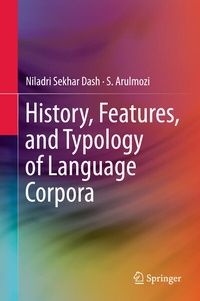
History, Features, and Typology of Language Corpora
Description

This book has several important features: it discusses many technical issues of the field in a lucid manner; contains extensive new diagrams and chartsfor easy comprehension; and presents discussions in simplified English to cater to the needs of non-native English readers. This is an important resource authored by academics who have many years of experience teaching and researching corpus linguistics. Its focus on Indian languages and on English corpora makes it applicable to students of graduate and postgraduate courses in applied linguistics, computational linguistics and language processing in South Asia and across countries where English is spoken as a first or second language.
More details
Other editions
Additional editions
Persons
Niladri Sekhar Dash
, PhD, is Associate Professor in the Linguistic Research Unit of the Indian Statistical Institute, Kolkata. He has been working on Corpus Linguistics, Language Technology, Natural Language Processing, Language Documentation and Digitization, Computational Lexicography, Computer Assisted Language Teaching, and Manual and Machine Translation for over two decades. He has to his credit 15 research monographs and 160 research papers in peer-reviewed international and national journals, anthologies, and conference proceedings. He has delivered lectures and taught courses as an invited scholar at more than 30 universities and institutes in India and abroad. He has acted as a consultant for several organizations working on Language Technology and Natural Language Processing. Dr. Dash is the Principal Investigator for 5 language technology projects funded by the Government of India and the Indian Statistical Institute, Kolkata. He is the Editor-in-Chief of the Journal of Advanced Linguistic Studies - a peer-reviewed international journal of linguistics; and Editorial Board Member of 5 international journals. He is member of several linguistics associations across the world and a regular Ph.D. thesis adjudicator for several Indian universities. At present Dr. Dash is working on a Digital Pronunciation Dictionary for Bangla, Hindi-Bangla Parallel Translation Corpus Generation, Endangered Language Documentation and Digitization, POS Tagging and Chunking, Word Sense Disambiguation, Manual and Machine Translation, and Computer Assisted Language Teaching, etc. Details of Dr. Dash are at https://sites.google.com/site/nsdashisi/home/
S. Arulmozi
, PhD, is Assistant Professor at the Centre for Applied Linguistics and Translation Studies (CALTS), University of Hyderabad, India. He has previously taught at the Dravidian University, Kuppam; acted as Guest Faculty at CALTS, University of Hyderabad; worked as Research Staff at the Anna University, Chennai; as Project Fellow at the Tamil University, Thanjavur; and as Language Assistant-Tamil at the Central Institute of Indian Languages, Mysore. Dr. Arulmozi has been working on Corpus Linguistics for some years and has been trained professionally in WordNet. He has successfully carried out projects on Corpus Linguistics and WordNet funded by the Government of India and has also conducted a workshop on language technology at the University of Malaya, Kuala Lumpur, Malaysia. To his credit, he has 1 research monograph and 15 research papers in peer-reviewed international and national journals, edited volumes, and conference proceedings.
Content
1. Definition of Corpus.- 2. Features of Corpus.- 3. Genre of Text.- 4. Nature of Data.- 5. Type and Purpose of Text.- 6. Nature of Text Application.- 7. Parallel Translation Corpus.- 8. Web Text Corpus.- 9. Pre-Digital Corpora (Part-I).- 10. Pre-Digital Language Corpora (Part-2).- 11. Digital Text Corpora (Part-I).- 12. Digital Text Corpora (Part-II).- 13. Digital Speech Corpora.- 14. Utilization of Language Corpora.- 15. Limitations of Language Corpora.
