

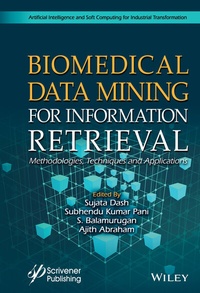
Biomedical Data Mining for Information Retrieval
Description

This book not only emphasizes traditional computational techniques, but discusses data mining, biomedical image processing, information retrieval with broad coverage of basic scientific applications.
Biomedical Data Mining for Information Retrieval comprehensively covers the topic of mining biomedical text, images and visual features towards information retrieval. Biomedical and health informatics is an emerging field of research at the intersection of information science, computer science, and healthcare and brings tremendous opportunities and challenges due to easily available and abundant biomedical data for further analysis. The aim of healthcare informatics is to ensure the high-quality, efficient healthcare, better treatment and quality of life by analyzing biomedical and healthcare data including patient's data, electronic health records (EHRs) and lifestyle. Previously, it was a common requirement to have a domain expert to develop a model for biomedical or healthcare; however, recent advancements in representation learning algorithms allows us to automatically to develop the model. Biomedical image mining, a novel research area, due to the vast amount of available biomedical images, increasingly generates and stores digitally. These images are mainly in the form of computed tomography (CT), X-ray, nuclear medicine imaging (PET, SPECT), magnetic resonance imaging (MRI) and ultrasound. Patients' biomedical images can be digitized using data mining techniques and may help in answering several important and critical questions relating to healthcare. Image mining in medicine can help to uncover new relationships between data and reveal new useful information that can be helpful for doctors in treating their patients.
Audience
Researchers in various fields including computer science, medical informatics, healthcare IOT, artificial intelligence, machine learning, image processing, clinical big data analytics.
More details
Other editions
Additional editions
Persons
Sujata Dash received her PhD in Computational Modeling from Berhampur University, Orissa, India in 1995. She is an associate professor in P.G. Department of Computer Science & Application, North Orissa University, at Baripada, India. She has published more than 80 technical papers in international journals, conferences, book chapters and has authored 5 books.
Subhendu Kumar Pani received his PhD from Utkal University Odisha, India in 2013. He is working as Professor in the Krupajal Computer Academy, BPUT, Odisha, India.
S. Balamurugan is the Director-Research and Development, Intelligent Research Consultancy Services(iRCS), Coimbatore, Tamilnadu, India. His PhD is in Infomation Technology and he has published 45 books, 200+ international journals/conferences and 35 patents.
Ajith Abraham received PhD in Computer Science from Monash University, Melbourne, Australia in 2001. He is Director of Machine Intelligence Research Labs (MIR Labs) which has members from 100+ countries. Ajith's research experience includes over 30 years in the industry and academia. He has authored / co-authored over 1300+ publications (with colleagues from nearly 40 countries) and has an h-index of 86+.
Content
Preface xv
1 Mortality Prediction of ICU Patients Using Machine Learning Techniques 1
Babita Majhi, Aarti Kashyap and Ritanjali Majhi
1.1 Introduction 2
1.2 Review of Literature 3
1.3 Materials and Methods 8
1.3.1 Dataset 8
1.3.2 Data Pre-Processing 8
1.3.3 Normalization 8
1.3.4 Mortality Prediction 10
1.3.5 Model Description and Development 11
1.4 Result and Discussion 15
1.5 Conclusion 16
1.6 Future Work 16
References 17
2 Artificial Intelligence in Bioinformatics 21
V. Samuel Raj, Anjali Priyadarshini, Manoj Kumar Yadav, Ramendra Pati Pandey, Archana Gupta and Arpana Vibhuti
2.1 Introduction 21
2.2 Recent Trends in the Field of AI in Bioinformatics 22
2.2.1 DNA Sequencing and Gene Prediction Using Deep Learning 24
2.3 Data Management and Information Extraction 26
2.4 Gene Expression Analysis 26
2.4.1 Approaches for Analysis of Gene Expression 27
2.4.2 Applications of Gene Expression Analysis 29
2.5 Role of Computation in Protein Structure Prediction 30
2.6 Application in Protein Folding Prediction 31
2.7 Role of Artificial Intelligence in Computer-Aided Drug Design 38
2.8 Conclusions 42
References 43
3 Predictive Analysis in Healthcare Using Feature Selection 53
Aneri Acharya, Jitali Patel and Jigna Patel
3.1 Introduction 54
3.1.1 Overview and Statistics About the Disease 54
3.1.1.1 Diabetes 54
3.1.1.2 Hepatitis 55
3.1.2 Overview of the Experiment Carried Out 56
3.2 Literature Review 58
3.2.1 Summary 58
3.2.2 Comparison of Papers for Diabetes and Hepatitis Dataset 61
3.3 Dataset Description 70
3.3.1 Diabetes Dataset 70
3.3.2 Hepatitis Dataset 71
3.4 Feature Selection 73
3.4.1 Importance of Feature Selection 74
3.4.2 Difference Between Feature Selection, Feature Extraction and Dimensionality Reduction 74
3.4.3 Why Traditional Feature Selection Techniques Still Holds True? 75
3.4.4 Advantages and Disadvantages of Feature Selection Technique 76
3.4.4.1 Advantages 76
3.4.4.2 Disadvantage 76
3.5 Feature Selection Methods 76
3.5.1 Filter Method 76
3.5.1.1 Basic Filter Methods 77
3.5.1.2 Correlation Filter Methods 77
3.5.1.3 Statistical & Ranking Filter Methods 78
3.5.1.4 Advantages and Disadvantages of Filter Method 80
3.5.2 Wrapper Method 80
3.5.2.1 Advantages and Disadvantages of Wrapper Method 82
3.5.2.2 Difference Between Filter Method and Wrapper Method 82
3.6 Methodology 84
3.6.1 Steps Performed 84
3.6.2 Flowchart 84
3.7 Experimental Results and Analysis 85
3.7.1 Task 1-Application of Four Machine Learning Models 85
3.7.2 Task 2-Applying Ensemble Learning Algorithms 86
3.7.3 Task 3-Applying Feature Selection Techniques 87
3.7.4 Task 4-Appling Data Balancing Technique 94
3.8 Conclusion 96
References 99
4 Healthcare 4.0: An Insight of Architecture, Security Requirements, Pillars and Applications 103
Deepanshu Bajaj, Bharat Bhushan and Divya Yadav
4.1 Introduction 104
4.2 Basic Architecture and Components of e-Health Architecture 105
4.2.1 Front End Layer 106
4.2.2 Communication Layer 107
4.2.3 Back End Layer 107
4.3 Security Requirements in Healthcare 4.0 108
4.3.1 Mutual-Authentications 109
4.3.2 Anonymity 110
4.3.3 Un-Traceability 111
4.3.4 Perfect-Forward-Secrecy 111
4.3.5 Attack Resistance 111
4.3.5.1 Replay Attack 111
4.3.5.2 Spoofing Attack 112
4.3.5.3 Modification Attack 112
4.3.5.4 MITM Attack 112
4.3.5.5 Impersonation Attack 112
4.4 ICT Pillar's Associated With HC4.0 113
4.4.1 IoT in Healthcare 4.0 114
4.4.2 Cloud Computing (CC) in Healthcare 4.0 115
4.4.3 Fog Computing (FC) in Healthcare 4.0 116
4.4.4 BigData (BD) in Healthcare 4.0 117
4.4.5 Machine Learning (ML) in Healthcare 4.0 118
4.4.6 Blockchain (BC) in Healthcare 4.0 120
4.5 Healthcare 4.0's Applications-Scenarios 121
4.5.1 Monitor-Physical and Pathological Related Signals 121
4.5.2 Self-Management, and Wellbeing Monitor, and its Precaution 124
4.5.3 Medication Consumption Monitoring and Smart-Pharmaceutics 124
4.5.4 Personalized (or Customized) Healthcare 125
4.5.5 Cloud-Related Medical Information's Systems 125
4.5.6 Rehabilitation 126
4.6 Conclusion 126
References 127
5 Improved Social Media Data Mining for Analyzing Medical Trends 131
Minakshi Sharma and Sunil Sharma
5.1 Introduction 132
5.1.1 Data Mining 132
5.1.2 Major Components of Data Mining 132
5.1.3 Social Media Mining 134
5.1.4 Clustering in Data Mining 134
5.2 Literature Survey 136
5.3 Basic Data Mining Clustering Technique 140
5.3.1 Classifier and Their Algorithms in Data Mining 143
5.4 Research Methodology 147
5.5 Results and Discussion 151
5.5.1 Tool Description 151
5.5.2 Implementation Results 152
5.5.3 Comparison Graphs Performance Comparison 156
5.6 Conclusion & Future Scope 157
References 158
6 Bioinformatics: An Important Tool in Oncology 163
Gaganpreet Kaur, Saurabh Gupta, Gagandeep Kaur, Manju Verma and Pawandeep Kaur
6.1 Introduction 164
6.2 Cancer-A Brief Introduction 165
6.2.1 Types of Cancer 166
6.2.2 Development of Cancer 166
6.2.3 Properties of Cancer Cells 166
6.2.4 Causes of Cancer 168
6.3 Bioinformatics-A Brief Introduction 169
6.4 Bioinformatics-A Boon for Cancer Research 170
6.5 Applications of Bioinformatics Approaches in Cancer 174
6.5.1 Biomarkers: A Paramount Tool for Cancer Research 175
6.5.2 Comparative Genomic Hybridization for Cancer Research 177
6.5.3 Next-Generation Sequencing 178
6.5.4 miRNA 179
6.5.5 Microarray Technology 181
6.5.6 Proteomics-Based Bioinformatics Techniques 185
6.5.7 Expressed Sequence Tags (EST) and Serial Analysis of Gene Expression (SAGE) 187
6.6 Bioinformatics: A New Hope for Cancer Therapeutics 188
6.7 Conclusion 191
References 192
7 Biomedical Big Data Analytics Using IoT in Health Informatics 197
Pawan Singh Gangwar and Yasha Hasija
7.1 Introduction 198
7.2 Biomedical Big Data 200
7.2.1 Big EHR Data 201
7.2.2 Medical Imaging Data 201
7.2.3 Clinical Text Mining Data 201
7.2.4 Big OMICs Data 202
7.3 Healthcare Internet of Things (IoT) 202
7.3.1 IoT Architecture 202
7.3.2 IoT Data Source 204
7.3.2.1 IoT Hardware 204
7.3.2.2 IoT Middleware 205
7.3.2.3 IoT Presentation 205
7.3.2.4 IoT Software 205
7.3.2.5 IoT Protocols 206
7.4 Studies Related to Big Data Analytics in Healthcare IoT 206
7.5 Challenges for Medical IoT & Big Data in Healthcare 209
7.6 Conclusion 210
References 210
8 Statistical Image Analysis of Drying Bovine Serum Albumin Droplets in Phosphate Buffered Saline 213
Anusuya Pal, Amalesh Gope and Germano S. Iannacchione
8.1 Introduction 214
8.2 Experimental Methods 216
8.3 Results 217
8.3.1 Temporal Study of the Drying Droplets 217
8.3.2 FOS Characterization of the Drying Evolution 219
8.3.3 GLCM Characterization of the Drying Evolution 220
8.4 Discussions 224
8.4.1 Qualitative Analysis of the Drying Droplets and the Dried Films 224
8.4.2 Quantitative Analysis of the Drying Droplets and the Dried Films 227
8.5 Conclusions 231
Acknowledgments 232
References 232
9 Introduction to Deep Learning in Health Informatics 237
Monika Jyotiyana and Nishtha Kesswani
9.1 Introduction 237
9.1.1 Machine Learning v/s Deep Learning 240
9.1.2 Neural Networks and Deep Learning 241
9.1.3 Deep Learning Architecture 242
9.1.3.1 Deep Neural Networks 243
9.1.3.2 Convolutional Neural Networks 243
9.1.3.3 Deep Belief Networks 244
9.1.3.4 Recurrent Neural Networks 244
9.1.3.5 Deep Auto-Encoder 245
9.1.4 Applications 246
9.2 Deep Learning in Health Informatics 246
9.2.1 Medical Imaging 246
9.2.1.1 CNN v/s Medical Imaging 247
9.2.1.2 Tissue Classification 247
9.2.1.3 Cell Clustering 247
9.2.1.4 Tumor Detection 247
9.2.1.5 Brain Tissue Classification 248
9.2.1.6 Organ Segmentation 248
9.2.1.7 Alzheimer's and Other NDD Diagnosis 248
9.3 Medical Informatics 249
9.3.1 Data Mining 249
9.3.2 Prediction of Disease 249
9.3.3 Human Behavior Monitoring 250
9.4 Bioinformatics 250
9.4.1 Cancer Diagnosis 250
9.4.2 Gene Variants 251
9.4.3 Gene Classification or Gene Selection 251
9.4.4 Compound-Protein Interaction 251
9.4.5 DNA-RNA Sequences 252
9.4.6 Drug Designing 252
9.5 Pervasive Sensing 252
9.5.1 Human Activity Monitoring 253
9.5.2 Anomaly Detection 253
9.5.3 Biological Parameter Monitoring 253
9.5.4 Hand Gesture Recognition 253
9.5.5 Sign Language Recognition 254
9.5.6 Food Intake 254
9.5.7 Energy Expenditure 254
9.5.8 Obstacle Detection 254
9.6 Public Health 255
9.6.1 Lifestyle Diseases 255
9.6.2 Predicting Demographic Information 256
9.6.3 Air Pollutant Prediction 256
9.6.4 Infectious Disease Epidemics 257
9.7 Deep Learning Limitations and Challenges in Health Informatics 257
References 258
10 Data Mining Techniques and Algorithms in Psychiatric Health: A Systematic Review 263
Shikha Gupta, Nitish Mehndiratta, Swarnim Sinha, Sangana Chaturvedi and Mehak Singla
10.1 Introduction 263
10.2 Techniques and Algorithms Applied 265
10.3 Analysis of Major Health Disorders Through Different Techniques 267
10.3.1 Alzheimer 267
10.3.2 Dementia 268
10.3.3 Depression 274
10.3.4 Schizophrenia and Bipolar Disorders 281
10.4 Conclusion 285
References 286
11 Deep Learning Applications in Medical Image Analysis 293
Ananya Singha, Rini Smita Thakur and Tushar Patel
11.1 Introduction 294
11.1.1 Medical Imaging 295
11.1.2 Artificial Intelligence and Deep Learning 296
11.1.3 Processing in Medical Images 300
11.2 Deep Learning Models and its Classification 303
11.2.1 Supervised Learning 303
11.2.1.1 RNN (Recurrent Neural Network) 303
11.2.2 Unsupervised Learning 304
11.2.2.1 Stacked Auto Encoder (SAE) 304
11.2.2.2 Deep Belief Network (DBN) 306
11.2.2.3 Deep Boltzmann Machine (DBM) 307
11.2.2.4 Generative Adversarial Network (GAN) 308
11.3 Convolutional Neural Networks (CNN)-A Popular Supervised Deep Model 309
11.3.1 Architecture of CNN 310
11.3.2 Learning of CNNs 313
11.3.3 Medical Image Denoising using CNNs 314
11.3.4 Medical Image Classification Using CNN 316
11.4 Deep Learning Advancements-A Biological Overview 317
11.4.1 Sub-Cellular Level 317
11.4.2 Cellular Level 319
11.4.3 Tissue Level 323
11.4.4 Organ Level 326
11.4.4.1 The Brain and Neural System 326
11.4.4.2 Sensory Organs-The Eye and Ear 329
11.4.4.3 Thoracic Cavity 330
11.4.4.4 Abdomen and Gastrointestinal (GI) Track 331
11.4.4.5 Other Miscellaneous Applications 332
11.5 Conclusion and Discussion 335
References 336
12 Role of Medical Image Analysis in Oncology 351
Gaganpreet Kaur, Hardik Garg, Kumari Heena, Lakhvir Singh, Navroz Kaur, Shubham Kumar and Shadab Alam
12.1 Introduction 352
12.2 Cancer 353
12.2.1 Types of Cancer 354
12.2.2 Causes of Cancer 355
12.2.3 Stages of Cancer 355
12.2.4 Prognosis 356
12.3 Medical Imaging 357
12.3.1 Anatomical Imaging 357
12.3.2 Functional Imaging 358
12.3.3 Molecular Imaging 358
12.4 Diagnostic Approaches for Cancer 358
12.4.1 Conventional Approaches 358
12.4.1.1 Laboratory Diagnostic Techniques 359
12.4.1.2 Tumor Biopsies 359
12.4.1.3 Endoscopic Exams 360
12.4.2 Modern Approaches 361
12.4.2.1 Image Processing 361
12.4.2.2 Implications of Advanced Techniques 362
12.4.2.3 Imaging Techniques 363
12.5 Conclusion 375
References 376
13 A Comparative Analysis of Classifiers Using Particle Swarm Optimization-Based Feature Selection 383
Chandra Sekhar Biswal, Subhendu Kumar Pani and Sujata Dash
13.1 Introduction 384
13.2 Feature Selection for Classification 385
13.2.1 An Overview: Data Mining 385
13.2.2 Classification Prediction 387
13.2.3 Dimensionality Reduction 387
13.2.4 Techniques of Feature Selection 388
13.2.5 Feature Selection: A Survey 392
13.2.6 Summary 394
13.3 Use of WEKA Tool 395
13.3.1 WEKA Tool 395
13.3.2 Classifier Selection 395
13.3.3 Feature Selection Algorithms in WEKA 395
13.3.4 Performance Measure 396
13.3.5 Dataset Description 398
13.3.6 Experiment Design 398
13.3.7 Results Analysis 399
13.3.8 Summary 401
13.4 Conclusion and Future Work 401
13.4.1 Summary of the Work 401
13.4.2 Research Challenges 402
13.4.3 Future Work 404
References 404
Index 409
Preface
Introduction
Biomedical Data Mining for Information Retrieval comprehensively covers the topic of mining biomedical text, images and visual features towards information retrieval, which is an emerging research field at the intersection of information science and computer science. Biomedical and health informatics is another remerging field of research at the intersection of information science, computer science and healthcare. This new era of healthcare informatics and analytics brings with it tremendous opportunities and challenges based on the abundance of biomedical data easily available for further analysis. The aim of healthcare informatics is to ensure high-quality, efficient healthcare and better treatment and quality of life by efficiently analyzing biomedical and healthcare data, including patients' data, electronic health records (EHRs) and lifestyle. Earlier, it was commonly required to have a domain expert develop a model for biomedical or healthcare data; however, recent advancements in representation learning algorithms allow automatic learning of the pattern and representation of given data for the development of such a model. Biomedical image mining is a novel research area brought about by the large number of biomedical images increasingly being generated and stored digitally. These images are mainly generated by computed tomography (CT), X-ray, nuclear medicine imaging (PET, SPECT), magnetic resonance imaging (MRI) and ultrasound. Patients' biomedical images can be digitized using data mining techniques and may help in answering several critical questions related to their healthcare. Image mining in medicine can help to uncover new relationships between data and reveal new useful information that can aid doctors in treating their patients.
Information retrieval (IR) methods have multiple levels of representation in which the system learns raw to higher abstract level representation at each level. An essential issue in medical IR is the variety of users of different services. In general, they will have changeable categories of information needs, varying levels of medical knowledge and varying language skills. The various categories of users of medical IR systems have multiple levels of medical knowledge, with the medical knowledge of many individuals falling within a category that varies greatly. This influences the way in which individuals present search queries to systems and also the level of complexity of information that should be returned to them or the type of support when considering which retrieved material should be provided. These have shown significant success in dealing with massive data for a large number of applications due to their capability of extracting complex hidden features and learning efficient representation in an unsupervised setting.
This book covers the latest advances and developments in health informatics, data mining, machine learning and artificial intelligence, fields which to a great extent will play a vital role in improving human life. It also covers the IR-based models for biomedical and health informatics which have recently emerged in the still-developing field of research in biomedicine and healthcare. All researchers and practitioners working in the fields of biomedicine, health informatics, and information retrieval will find the book highly beneficial. Since it is a good collection of state-of-the-art approaches for data-mining-based biomedical and health-related applications, it will also be very beneficial for new researchers and practitioners working in the field in order to quickly know what the best performing methods are. With this book they will be able to compare different approaches in order to carry forward their research in the most important areas of research, which directly impacts the betterment of human life and health. No other book on the market provides such a good collection of state-of-the-art methods for mining biomedical text, images and visual features towards information retrieval.
Organization of the Book
The 13 chapters of this book present scientific concepts, frameworks and ideas on biomedical data analytics and information retrieval from the different biomedical domains. The Editorial Advisory Board and expert reviewers have ensured the high caliber of the chapters through careful refereeing of the submitted papers. For the purpose of coherence, we have organized the chapters with respect to similarity of topics addressed, ranging from issues pertaining to the internet of things for biomedical engineering and health informatics, computational intelligence for medical image processing, and biomedical natural language processing.
In Chapter 1, "Mortality Prediction of ICU Patients Using Machine Learning Techniques," Babita Majhi, Aarti Kashyap and Ritanjali Majhi present a mortality prediction using machine learning techniques. Since the intensive care unit (ICU) admits very ill patients, facilitating their care requires serious attention and treatment using ventilators and other sophisticated medical equipment. This equipment is very costly; hence, its optimized use is necessary. ICUs require a higher number of staff in comparison to the number of patients admitted for regular monitoring. In brief, ICUs involve a larger budget compared to other sections of any hospital. Therefore, to help doctors determine which patient is more at risk, mortality prediction is an important area of research. In data mining, mortality prediction is a binary classification problem, i.e., die or survive. As a result, this has attracted machine learning groups to apply algorithms to do the mortality prediction. In this chapter, six different machine learning methods, functional link artificial neural network (FLANN), support vector machine (SVM), discriminate analysis (DA), decision tree (DT), naïve Bayesian network and K-nearest neighbors (KNN), are used to develop a model for mortality prediction collecting data from PhysioNetChallenge 2012 and did the performance analysis of them.
In Chapter 2, "Artificial Intelligence in Bioinformatics," V. Samuel Raj, Anjali Priyadarshini, Manoj Kumar Yadav, Ramendra Pati Pandey, Archana Gupta and Arpana Vibhuti emphasize the various smart tools available in the field of biomedical and health informatics. They also analyzed recently introduced state-of-the-art bioinformatics using complex AI algorithms.
In Chapter 3, "Predictive Analysis in Healthcare Using Feature Selection," Aneri Acharya, Jitali Patel and Jigna Patel describe various methods to enhance the performance of machine learning models used in predictive analysis. The chronic diseases of diabetes and hepatitis are explored in this chapter with an experiment carried out in four tasks.
In Chapter 4, "Healthcare 4.0: An Insight of Architecture, Security Requirements, Pillars and Applications," Deepanshu Bajaj, Bharat Bhushan and Divya Yadav present the idea of Industry 4.0, which is massively evolving as it is essential for the medical sector, including the internet of things (IoT), big data (BD) and blockchain (BC), the combination of which are modernizing the overall framework of e-health. They analyze the implementation of the I4.0 (Industry 4.0) technology in the medical sector, which has revolutionized the best available approaches and improved the entire framework.
In Chapter 5, "Improved Social Media Data Mining for Analyzing Medical Trends," Minakshi Sharma and Sunil Sharma discuss social media health records. Nowadays, social media has become a prominent method of sharing and viewing news among the general population. It has become an inseparable part of our lives, with people spending most of their time on social media instead of on other activities. People on media, such as Twitter, Facebook or blogs, share their health records, medication history and personal views. For social media resources to be useful, noise must be filtered out and only the important content must be captured excluding the irrelevant data, depending on the similarities to the social media. However, even after filtering the content, it may contain irrelevant information, so the information should be prioritized based on its estimated importance. Importance can be estimated with the help of three factors: media focus (MF), user attention (UA) and user interaction (UI). In the first factor, media focus is the temporal popularity of that topic in the news. In the second factor, the temporal popularity of a topic on twitter indicates its user attention. In the third factor, the interaction between the social media users on a topic is referred to as the user interaction. It indicates the strength of a topic in social media. Hence, these three factors form the basis of ranking news topics and thus improve the quality and variety of ranked news.
In Chapter 6, "Bioinformatics: An Important Tool in Oncology" Gaganpreet Kaur, Saurabh Gupta, Gagandeep Kaur, Manju Verma and Pawandeep Kaur provide an analysis of comprehensive details of the beginning, development and future perspectives of bioinformatics in the field of oncology.
In Chapter 7, "Biomedical Big Data Analytics Using IoT in Health Informatics," Pawan Singh Gangwar and Yasha Hasija present are view of healthcare big data analytics and biomedical IoT and aim to describe it. Wearable devices play a major role in various environmental conditions like daily continuous health monitoring of people, weather forecasting and traffic management on roads. Such mobile apps and devices are presently used progressively and are interconnected with telehealth and telemedicine through the healthcare IoT....
