

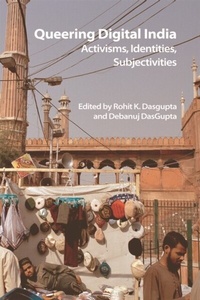
Queering Digital India
Description

The first book to look critically at digital technologies and the role they play within queer lives in contemporary India
This pioneering interdisciplinary collection works across mainstream and alternative spaces such as Twitter, Youtube, Facebook, Grindr and gay men's health websites. These digital platforms are then situated within the contemporary socio-political conjuncture in India, offering a way of understanding queerness and Indian-ness in contemporary India.
Queering in this book does not simply refer to a sexual category rather queerness is a mode of dispossession through which certain bodies are rendered as bodies marked for discipline and regulation. This book takes on diverse strands of queer theory in order to name the ways neoliberalism, nationalism, digital technologies, and movements for queer rights converge with each other within present day India. This analytical approach to queerness in India is the first of its kind and the result is a pioneering interdisciplinary collection.
Key Features
- Takes on diverse strands of queer theory to show where neoliberalism, nationalism, digital technologies and movements for queer rights converge in present-day India
- Integrates academic pieces with activist and practitioner narratives
- Looks at sexualised online communities: their aims, compositions and potentialities
- Discusses hook-up apps and social media, and how institutions use them to control, discipline and repress
- Engages with new forms of queer politics, feminist politics and online activism
Contributors
Niharika Banerjea, Ambedkar University, New Delhi, India
Aniruddha Dutta, University of Iowa, USA
Amit S. Rai, Queen Mary, University of London, UK
Jack Harrison-Quintana, independent researcher and Director of Grindr for Equality, USA
Radhika Gajjala, Bowling Green State University, Ohio, USA
Rahul Gairola, Indian Institute of Technology Roorkee, India
Kareem Khubchandani, Tufts University, USA
Ila Nagar, Ohio State University, USA
Rohit K Dasgupta, Loughborough University, UK
Pawan Singh, University of California San Diego, USA
Sneha Krishnan, St John's College, University of Oxford, UK
Debanuj DasGupta, University of Connecticut, USA
Inshah Malik, recently Yale University, USA
More details
Other editions
Additional editions
Content
- Intro
- List of Figures
- Series Editors' Preface
- Acknowledgements
- Chapter 1 Introduction: Queering Digital India
- 1 Digital Performance and Politics
- Chapter 2 Queering Digital Cultures: A Roundtable Conversation
- Chapter 3 Digital Closets: Post-millennial Representations of Queerness in Kapoor & Sons and Aligarh
- Chapter 4 Cruising the Ephemeral Archives of Bangalore's Gay Nightlife
- II Digital Activism(s) and Advocacy
- Chapter 5 Digitally Untouched: Janana (In) Visibility and the Digital Divide
- Chapter 6 Digital Outreach and Sexual Health Advocacy: SAATHII as a Response
- Chapter 7 The TV9 Sting Operation on PlanetRomeo: Absent Subjects, Digital Privacy and LGBTQ Activism
- III Digital Intimacies
- Chapter 8 'Bitch, don't be a lesbian': Selfi es and Same-Sex Desire
- Chapter 9 Disciplining the 'Delinquent': Situating Virtual Intimacies, Bodies and Pleasures Among Friendship Networks of Young Men in Kolkata, India
- Chapter 10 Kashmiri Desire and Digital Space: Queering National Identity and the Indian Citizen
- Contributors
- Index
